


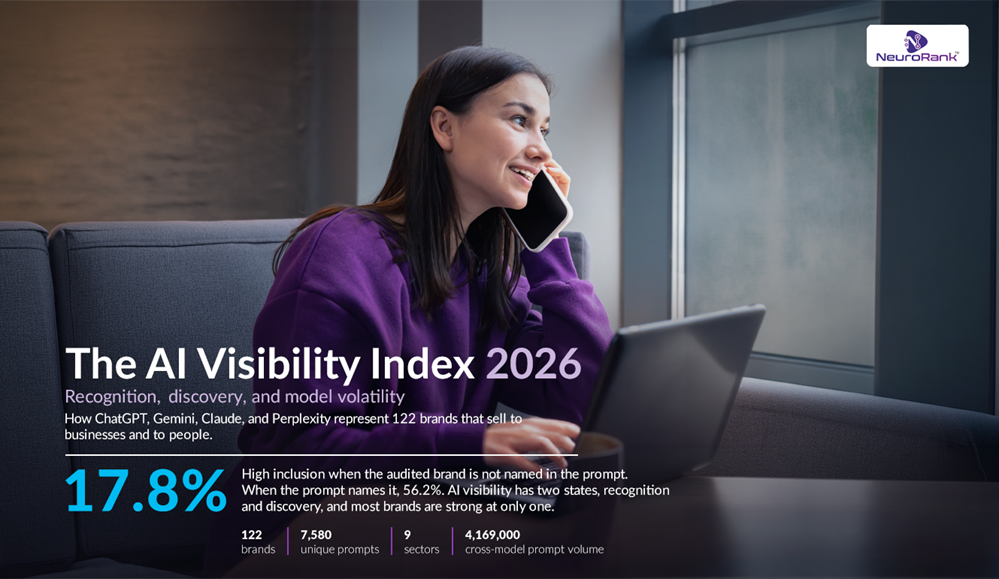
NEW DELHI : NeuroRank has published NeuroRank The AI Visibility Index 2026, an audit of how ChatGPT, Gemini, Claude, and Perplexity represented 122 brands in nine sectors. The central finding is a measurement problem: a brand can look strong when its name is supplied in the question, while doing much worse when an assistant must select brands from a category. That distinction becomes most visible in prompts asking for a shortlist.
What the data reveals
• The shortlist is the stress test. Shortlist and recommendation requests were 38.6 percent of the study’s 7,580 unique prompts. Only 5.9 percent named the audited brand, and High inclusion on their individual-model ratings was 20.0 percent. Comparison prompts named the brand 84.8 percent of the time and showed 48.4 percent High inclusion. These are distinct prompt classes, not a controlled test of adding a name.
• Brand-name checks can conceal weak discovery. Across individual-model ratings, High inclusion was 56.2 percent on 2,298 brand-named results and 17.8 percent on 4,879 results without the name, a 38.4-point difference. Among 82 brands evaluated in both states, 51 reached at least 50 percent High inclusion when named; three did so without the name. Twenty-two reached at least 50 percent when named but scored below 20 percent when unnamed.
• The apparent commercial gap changes when the name cue is held constant. High inclusion was 27.3 percent on commercial prompts and 35.2 percent on other prompts. Within the prompts that named no brand, it was 17.4 and 18.8 percent respectively. The raw commercial difference largely reflects how often each class supplies the brand name.
• Sector strength can mask the same split. No sector reached 30 percent High inclusion on prompts without a brand name. BFSI led named prompts at 73.4 percent but reached 24.8 percent unnamed, the widest gap at 48.6 points. FMCG and personal care scored 58.5 percent named and 11.9 percent unnamed; retail and lifestyle scored 59.0 and 13.8 percent.
“AI visibility is being measured too generously by marketers. If a brand looks strong only after its name is supplied, that is recognition, not discovery.” Ambika Sharma, Founder and Chief Strategist at Pulp Strategy Communications and Product Architect of NeuroRank
What leaders should measure
The findings support reporting brand-named and brand-not-named prompts separately, then reading shortlist and comparison questions as different tasks. Weak inclusion in sampled shortlist prompts is a potential consideration risk; the study did not measure sales, pipeline, or buyer behavior.
