


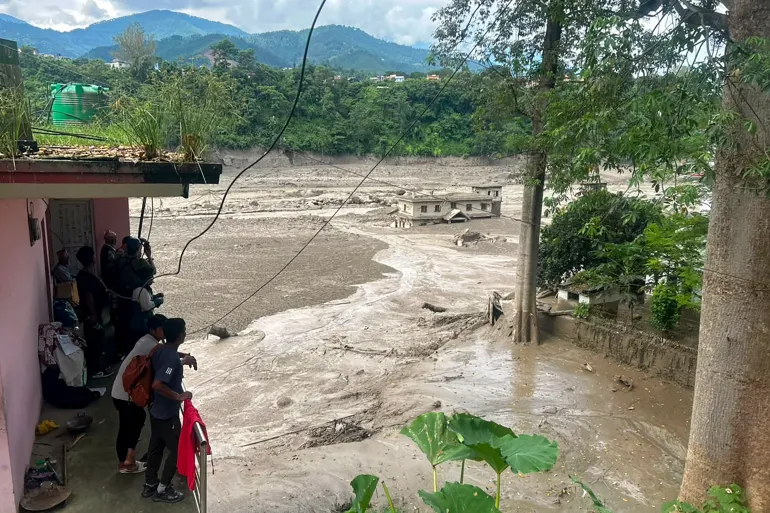
A sudden flash flood tore through Nepal’s northern Rasuwa district near the Tibet border on Wednesday morning, killing at least 18 people and leaving hundreds unaccounted for, including nearly 300 foreign tourists, as villages, roads, bridges and hydropower facilities were swept away.
The torrent struck around 9 a.m. local time along the Bhote Koshi (Bhotekoshi) River and its tributaries, particularly the Lhende Khola, devastating settlements including Syaphrubesi and Timure in Rasuwa, with impacts also reported in neighbouring Nuwakot and Dhading districts. Officials described a wall of water, mud and debris that engulfed riverside homes, market areas, police posts and a customs yard. Videos circulating online showed bridges collapsing and multi-storey buildings being torn apart by the force of the surge.
Nepal’s Tourism Board said 384 travellers were reported missing from the affected zone — 291 foreigners and 93 Nepalis, including guides. Among the foreigners were about 105 Indians, 12 British nationals and at least three Americans. Security personnel were also heavily hit: dozens of Nepal Police, Armed Police Force and army members were unaccounted for, along with customs staff and hydropower workers. Rescue operations by the Nepali Army, police and helicopters were under way, though high water levels initially prevented landings in the worst-hit areas. Dozens of people had been rescued by evening, with medical camps set up.
Preliminary assessments pointed to a natural trigger rather than heavy local rainfall. Nepal’s Foreign Minister Shishir Khanal told parliament that an earthquake around 8:37 a.m. may have set off an avalanche of ice and rock. Climate experts at the International Centre for Integrated Mountain Development (ICIMOD) said an ice-rock avalanche from a glacier on the Nepal side likely blocked the Lhende Khola, creating a temporary dam that then burst and released a sudden surge downstream into the Bhote Koshi. A similar event struck the same river system in August 2025. Satellite data indicated significant rainfall on the Tibetan side, and a magnitude-4.4 tremor was recorded in the broader area. Authorities warned of a possible secondary flood if remaining upstream blockages gave way.
The disaster damaged multiple hydropower projects, knocking about 430 megawatts offline — more than 12 percent of Nepal’s total hydropower capacity of roughly 3.2 gigawatts. Roads linking the border, including the route to the Rasuwagadhi crossing, and the Friendship Bridge were destroyed or severely damaged. On the Chinese side, state media reported “major casualties” and missing persons in Gyirong (Kerung) county after a mudslide hit the border port, cutting roads, power and communications. Chinese President Xi Jinping ordered all-out search efforts and stronger early-warning systems.
Nepal’s Prime Minister Balendra Shah directed security forces to evacuate people from lower riverbanks and mobilise all available resources. India offered humanitarian assistance and placed border districts in Uttar Pradesh and Bihar on alert as the rivers flow onward into the Indian plains. Search and recovery operations continued into the night under challenging conditions, with the full scale of the loss still emerging.
