


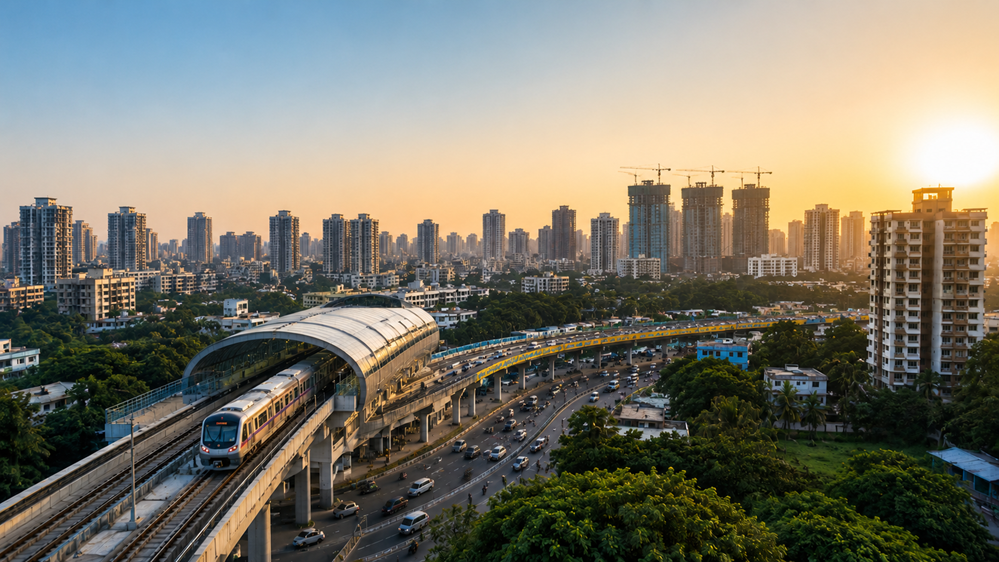
For homebuyers and investors evaluating Mumbai’s residential market, Chembur is increasingly presenting a compelling combination: an established neighbourhood, improving connectivity and a considerably lower entry price than several premium Western Suburban markets.
According to a leading property portal, average residential prices in Chembur stood at approximately ₹24,654 per sq. ft. in Q2 2026, compared with ₹48,343 per sq. ft. in premium western suburbs. Chembur also recorded around 7% price appreciation over 2025. The investment opportunity, therefore, lies not in expecting Chembur to immediately command Western Suburb-level valuations, but in the potential for this price differential to narrow as connectivity and development improve.
“Chembur’s next phase of growth could support sustained capital appreciation as infrastructure improves, redevelopment gathers pace and premium residential projects are launched. The opportunity is about timing; entering an established Mumbai market while pricing remains below the premium Western Suburbs, ahead of the full impact of its infrastructure and redevelopment cycle. Over the medium to long term, this could narrow Chembur’s valuation gap with established premium suburbs, making it increasingly attractive to investors,” said a spokesperson for Chandak Group.
Chembur is also emerging as a key multimodal connectivity hub. The Chembur Metro Station on Metro Line 2B, located close to both Chembur railway station and the V N Purav Marg Monorail station, will enable convenient interchange across rail, metro and monorail networks. The Monorail connects Chembur to Jacob Circle, while the proposed Jacob Circle–Mahalaxmi travelator could further strengthen onward connectivity.
Road connectivity has also strengthened with the completion of the final 1.4-km stretch of SCLR Phase 2, improving access to BKC and the Western Express Highway. Metro Line 2B, the Elevated Eastern Freeway Extension and the Goregaon-Mulund Link Road are expected to further enhance east-west and north-south connectivity across Mumbai’s eastern corridor.
“Infrastructure-led appreciation is rarely driven by one project; it is the cumulative improvement in accessibility that reshapes a micro-market. Chembur’s advantage is its established base. As transport connectivity improves alongside redevelopment and quality residential projects, the suburb has the potential to evolve from an established residential location into a strategic urban node,” said a real estate industry expert.
At the same time, redevelopment and new residential projects are bringing modern housing stock into an already established neighbourhood with strong social infrastructure. Buyer demand is visible as well, with JLL reporting that the Eastern Suburbs micro-market accounted for 13.2% of Mumbai’s residential sales in Q1 2026.
