


By Suresh Unnithan
Indian politics has given us coalition dharma, horse-trading poetry, and the timeless art of saying nothing in 45 minutes. But perhaps its finest innovation is the political self-goal—an act once accidental, now seemingly institutionalized.
If the BJP were a multinational corporation, it would have a high-performing Governance Division, a formidable Election Machinery Unit, and—tucked away on the top floor with unlimited microphone access—the Self-Goal Department.
The recent Naravane book episode was supposed to be calm. A retired Army Chief writes a book. Analysts debate. Historians argue. Television anchors rehearse outrage in moderation. Then everyone moves on.
Instead, the BJP’s High-Decibel Nationalism Division arrived like it was responding to a five-alarm ideological fire.
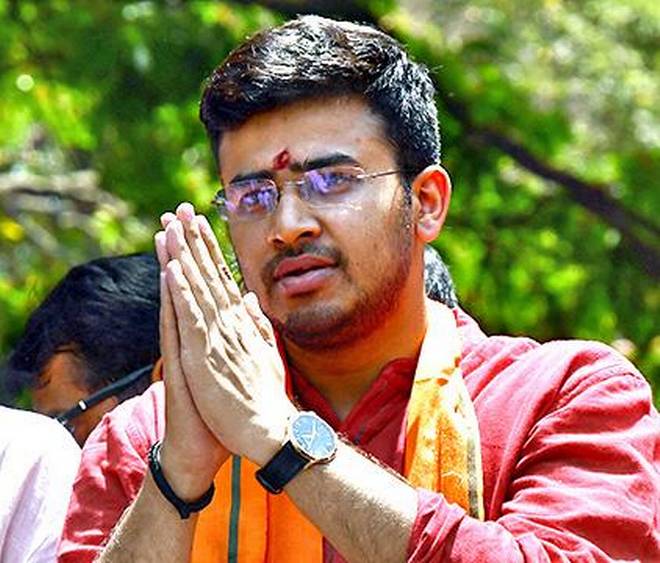
Tejaswi Soorya stepped forward with the confidence of a man who believes every complex issue can be simplified into one sentence: “Congress is anti-national.” It is a remarkable political reflex. A retired general writes memoirs, and somehow the blame travels through space and time to land neatly on a party founded in 1885. Physics may not explain it, but politics apparently can.
And just like that, what could have been a niche policy debate became a full-blown shouting match—one generously gifting the opposition something they rarely receive these days: defensive sympathy.
But here’s the fascinating part. The BJP is not short of disciplined, low-profile leaders who quietly win elections without declaring treason before breakfast.
Across states—Gujarat, Madhya Pradesh, Odisha, Maharashtra, Assam (the calmer days), and pockets of the South—there are chief ministers and organizational leaders who practice a radical form of politics: governance. They talk about roads. They discuss welfare delivery. They count booths instead of Twitter likes. Their press conferences are so measured that prime-time producers probably fall asleep halfway through.
And yet, they keep winning.
They understand something revolutionary: voters wake up worried about inflation, jobs, water supply, and electricity—not about issuing daily patriotism certificates to political rivals. Their nationalism is understated. No background music. No drumroll. Just policy files and constituency visits.
Meanwhile, back at the Self-Goal Department, the energy levels are Olympic.
If there is a spark, Himanta occasionally arrives with petrol—brilliant strategist, undeniable political force, but sometimes unable to resist turning the volume dial to “stadium mode.”
If there is a slogan, Anurag sharpens it like a sword.
If there is a debate cooling down, Sampit reheats it to optimal television temperature.
And if there is absolutely no controversy available, Nishikant Dubey has demonstrated a rare talent for discovering one in the wild.
Together, they form what might be called the Rapid Reaction & Extended Damage Squad.
The irony is exquisite. A party known for discipline and electoral precision often finds itself explaining comments that were entirely optional. The opposition barely needs to strategize; sometimes it simply refreshes its timeline and waits.
The Naravane book episode became symbolic of a larger pattern. Instead of letting institutions, facts, and time do their quiet work, the loudest voices seized the narrative. By defaulting to accusations of anti-nationalism—a charge now so frequently deployed it has lost its dramatic background score—the BJP handed the Congress a rare opportunity to look measured.
That takes effort.
It is almost impressive that in moments when the opposition struggles to find momentum, the ruling party occasionally generates its own turbulence. When your biggest vulnerability is not policy failure but excessive enthusiasm, internal impulse control becomes a governance issue.
None of this means fiery leaders don’t have their place. Political energy matters. Aggression mobilizes cadres. Television debates demand gladiators. Every party has its headline-makers and slogan-engineers.
The problem arises when volume replaces strategy.
Outrage travels fast. It trends. It excites. But it also expires quickly. What remains is credibility, voter memory, and institutional stability—none of which can be built on hourly press conferences.
The BJP’s quieter leaders understand this. They rarely trend because they are too busy calculating caste arithmetic, ensuring welfare schemes reach beneficiaries, and maintaining booth-level networks that actually convert into votes. Their work is boring—and devastatingly effective.
Meanwhile, the Self-Goal Department operates on a different KPI system: Decibels Per Minute and Controversies Generated Per Week.
The real tension within the party isn’t ideological. It’s acoustic.
How do you balance a disciplined electoral machine with a permanent live broadcast of competitive nationalism?
Because here’s the uncomfortable truth: when the opposition stays relatively subdued and the ruling party still finds itself on the defensive, the challenge isn’t sabotage. It’s internal enthusiasm with Wi-Fi.
Nationalism is not a decibel contest. Patriotism does not require hourly renewal. And governance, inconveniently, prefers stability over slogan duels.
Sometimes the most powerful move in politics is to let an issue pass without commentary. To allow facts to breathe. To resist the temptation to turn every sentence into a battle cry.
The BJP’s greatest asset may not be its loudest leaders, but its quietest ones—the men and women whose names don’t trend because they’re too busy delivering roads instead of rhetoric.
If silence were declared patriotic, these leaders would sweep the awards ceremony.
Until then, the microphones remain on, the slogans remain sharp, and the Self-Goal Department continues to operate with admirable consistency.
In football, self-goals cause heartbreak.
In politics, they create prime-time.
