

BPCL Hosts Waste to Wealth – Scaling GOBARdhan Workshop in Mumbai to Accelerate Maharashtra’s CBG Ecosystem

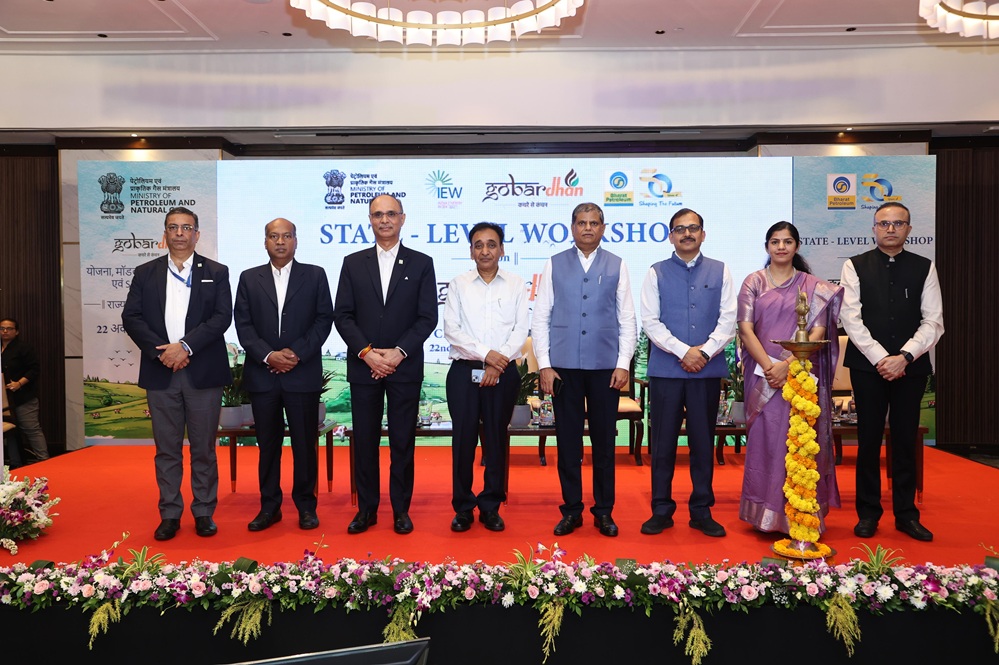
Mumbai : Bharat Petroleum Corporation Limited (BPCL), a Fortune Global 500 company and a Maharatna PSU, hosted a high-level workshop on “Waste to Wealth – Scaling GOBARdhan” in Mumbai, in partnership with the Ministry of Petroleum & Natural Gas (MoPNG) and the Government of Maharashtra. The workshop focused on strengthening the policy, institutional and implementation ecosystem required to accelerate Compressed Bio-Gas (CBG) projects in Maharashtra.
The workshop brought together senior representatives from MoPNG, the Government of Maharashtra, the Centre for High Technology, Oil and Gas Marketing Companies, City Gas Distribution companies, Urban Local Bodies, CBG developers, financial institutions, technology partners and Farmer Producer Organisations.
The inaugural session was graced by Shri Rajesh Aggarwal, Chief Secretary, Government of Maharashtra; Dr. K.H. Govind Raj, Additional Chief Secretary, Urban Development Department-2, Government of Maharashtra; Shri Vikas Singh, Director (GP), Ministry of Petroleum & Natural Gas; Ms. Yashika Mehta, Deputy Secretary (International Cooperation), Ministry of Petroleum & Natural Gas; Shri Sanjay Khanna, Chairman & Managing Director, BPCL; Shri Subhankar Sen, Director (Marketing); and Shri V.R.K. Gupta, Director (Finance), BPCL.
Turning Waste into Energy and Lasting Value
Welcoming the participants, Mr. Inderjit Singh, BPCL’s Chief General Manager (Biofuels) highlighted the significant resource potential available in Maharashtra, including municipal solid waste and press mud. The address underlined the central idea of the GOBARdhan initiative, “कचरे से कंचन” (Kachre se Kanchan), and called for waste to be recognised not merely as a disposal challenge, but as a valuable resource for producing clean energy, supporting agriculture and creating local economic opportunities.
Addressing the gathering, Shri Sanjay Khanna, Chairman & Managing Director, BPCL, said: “There is promise in what we discard, and possibility in what we overlook. Our task is to turn that promise into projects, that possibility into partnerships, and waste into lasting value. Let us make this workshop a bridge from policy to practice, from ideas to implementation, and from Maharashtra’s soil to a greener tomorrow. CBG presents an integrated opportunity to convert agricultural residues, cattle dung, press mud and municipal organic waste into clean and renewable energy, while advancing scientific waste management, strengthening the circular economy, supporting sustainable agriculture and generating rural livelihoods. The organic manure produced through CBG plants further strengthens the link between clean energy and soil fertility, creating a sustainable cycle of value. Farm to Fuel. Fuel to Fertility. Fertility back to Farm. Waste to Wealth must ultimately become Wealth for Society.
Shri Vikas Singh, Director (GP), MoPNG during his address highlighted, Government of India’s vision for scaling GOBARdhan, the policy and market framework for CBG, the role of State in enabling projects, and the importance of coordinated action among Government, industry, Urban Local Bodies, farmers and financial institutions. Further, he requested Government of Maharashtra to align the State policy of Maharashtra, establish a land bank and conduct detailed feedstock assessment in the state to help establish CBG ecosystem.
Shri Rajesh Aggarwal, Chief Secretary, Government of Maharashtra, said, “Energy consumption is an important indicator of a civilisation’s advancement, and per capita energy consumption will be a key differentiator in India’s development journey. There is also significant potential in agricultural waste, which can be harnessed to produce clean energy, promote scientific waste management and create greater value for our communities. We must ensure that municipal solid waste and agricultural residues are efficiently utilised to accelerate the GOBARdhan initiative and strengthen Maharashtra’s clean energy ecosystem.”
Ms. Yashika Mehta, Deputy Secretary (IC), MoPNG shared the theme of IEW 2027 at Kolkata and highlighted the importance of CBG in India’s energy mix. MoPNG BPCL’s CRDC team conducted a focused session on Enriched Fermented Organic Manure (EFOM), highlighting its potential to support sustainable agriculture and improve soil health. The session underscored the role of organic manure produced through the CBG ecosystem in strengthening the link between clean energy generation and agricultural sustainability.
The workshop also featured discussions on the GOBARdhan Scheme, the Model State CBG Policy and SASCI 2026-27, along with deliberations on Maharashtra’s CBG policy and implementation requirements. These presentations were delivered by CHT and Urban Development Department (UDD), Government of Maharashtra, respectively. These sessions highlighted the importance of coordinated efforts to scale up CBG projects and convert organic waste into clean energy and valuable agricultural resources.
Strengthening Maharashtra’s CBG Opportunity
The workshop highlighted Maharashtra’s potential to develop a robust Compressed Biogas (CBG) ecosystem using municipal solid waste, agricultural residues, cattle dung and press mud. Discussions focused on the GOBARdhan Scheme, the Model State CBG Policy and SASCI 2026-27, with emphasis on assured offtake, stable pricing, streamlined approvals, feedstock availability, financing and supporting infrastructure.
BPCL reiterated its commitment to the CBG sector as a producer, offtaker and facilitator, with a focus on converting waste into clean energy and economic value. The deliberations underscored the importance of collaboration among Central and State Governments, Urban Local Bodies, farmers, cooperatives, industry and other stakeholders to accelerate project implementation and strengthen Maharashtra’s waste-to-wealth ecosystem.
****
