


By Nanditha S
Bharat Sanchar Nigam Limited continues to present itself as the low-cost public-sector alternative to private telecom operators. Its tariffs are still lower than those of Reliance Jio and Bharti Airtel in many plans. Yet the company has suffered a prolonged and well-documented exodus of customers. The primary drivers are not price. They are chronic unreliability, slow or ineffective fault resolution, and an institutional culture in which many officers treat subscribers as an irritation rather than the foundation of the enterprise. Private operators treat customers as assets whose retention determines revenue and valuation. BSNL officers have too often behaved as if they occupy a protected administrative domain in which the customer has limited rights and the officer has few practical consequences for poor performance. They draw substantial salaries and perks, deliver limited service, and then press for higher pay while the subscriber base and revenue base shrink.
The experience of our editor—a senior journalist with four decades of experience in mainstream media, now in his seventies, who works from home and relies on a BSNL FTTH connection (0475 2323008)—illustrates the problem with unusual clarity and cumulative force. Because of age-related constraints he prefers to work from home. The connection has gone off repeatedly, disrupting work that depends on continuous internet access. Multiple complaints were registered. On more than one occasion the matter was escalated to the concerned minister and also through the Centralised Public Grievance Redress and Monitoring System (CPGRAMS). These escalations produced no lasting technical resolution. What arrived instead was a letter from the office of the General Manager, Kollam. The letter stated that a team had visited the premises, checked the connection, and found that the modem was running on an old firmware version that was affecting performance. According to the editor, no such visit took place. The claim does not match his account of events. He has described the letter as mocking the system. A complaint has been lodged with the Prime Minister’s Office, and he is preparing for legal action.
According to the editor, a senior official in the circle later telephoned him about the same complaint. During the call the official is said to have spoken in an arrogant manner and to have told him that he was “just a customer for us.” The remark, as described by the editor, treats the person who pays for the service as a subordinate rather than the reason the organisation exists. Without customers the company cannot survive; without a functioning company the officers’ salaries, allowances and job security disappear. Private operators understand this elementary commercial fact and organise their operations around it. In BSNL the attitude frequently appears inverted. The customer—in this case a senior journalist with four decades in mainstream media—is told he is “just” a customer, as if that status confers no enforceable rights and imposes no corresponding duty on those who draw public salaries to serve him. When a General Manager’s office issues a written claim of a field visit that the customer says never occurred, and a senior official then dismisses the complainant with words to the effect that he is “just a customer,” the problem has moved beyond ordinary inefficiency. It has become a form of institutional contempt that undermines the credibility of the grievance-redressal system itself.
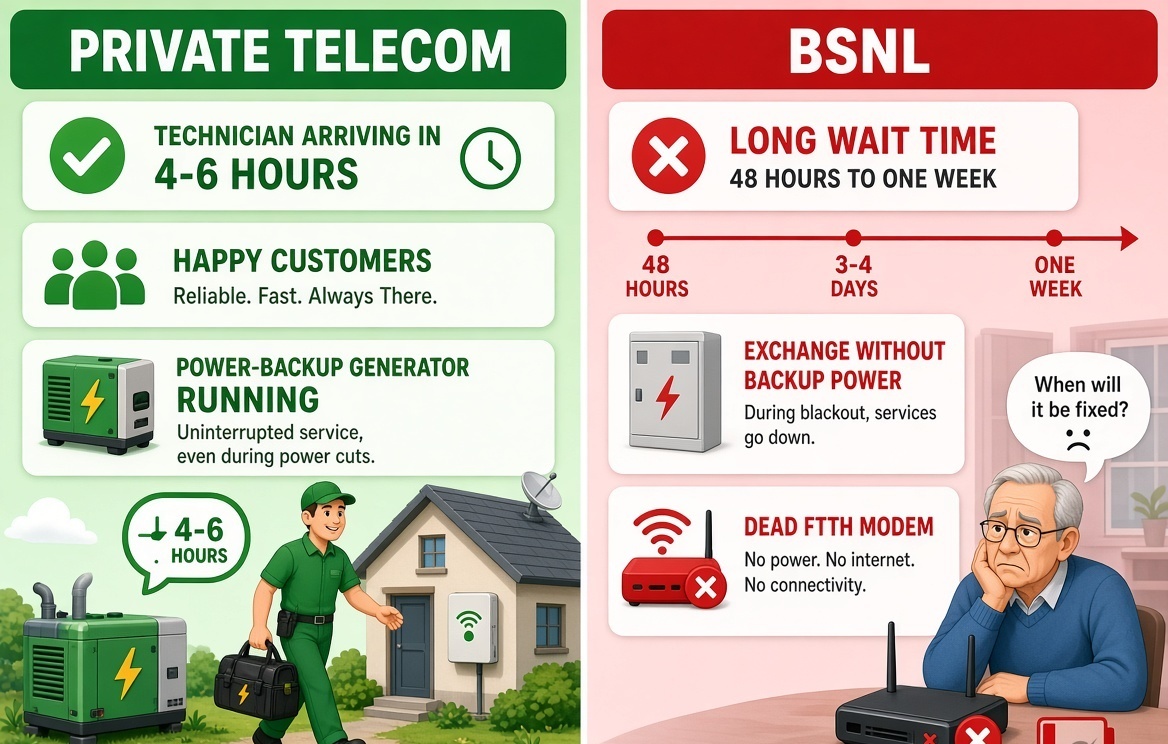
Such episodes are not rare. Across circles, customers report frequent outages, particularly during power cuts, because many local exchange hubs lack adequate backup power. Optical-fibre cuts or routing faults routinely take 48 hours to a week to clear, whereas private operators in urban areas generally resolve comparable faults within four to six hours. Aggressive automated disconnection policies have also been used: dunning thresholds were reduced in earlier years, causing lines to be frozen over relatively small unpaid amounts. TRAI data record the cumulative outcome. BSNL’s fixed wired broadband base has stabilised near 4.5 million while its overall wireline market share has fallen sharply—to roughly 13–15 percent in recent readings—as Jio and Airtel expanded rapidly. Total wireline subscribers for BSNL have contracted even while the national wireline market grew. On the mobile side the registered base stands near 94 million after years of net losses from earlier peaks above 118 million. The active-user picture is worse. BSNL’s VLR (Visitor Location Register) ratio hovers around 54–58 percent, meaning nearly half its SIMs are dormant or used only as secondary numbers. Private operators maintain active ratios of 98–99 percent. BSNL has consistently shown a negative mobile-number-portability ratio: for every customer who ports in, roughly two to three officially port out. The indigenous 4G rollout through TCS has been delayed for years. Even where sites are reported on air, voice and data quality frequently disappoint. Private networks completed nationwide 5G while BSNL was still testing and deploying 4G.
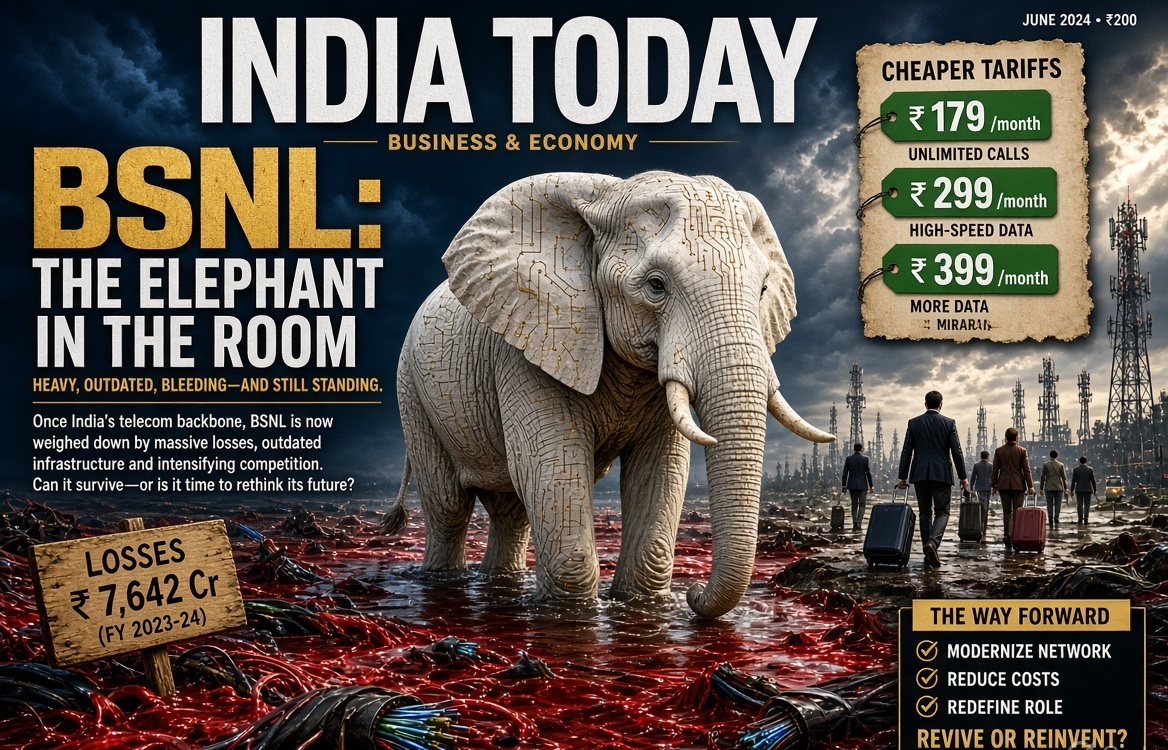
The government has not been stingy with capital. Revival packages approved since 2019 total approximately ₹3.22–3.29 lakh crore. The 2019 package was around ₹69,000 crore and included a large voluntary retirement scheme. The 2022 package was about ₹1.64 lakh crore and covered spectrum allotment, settlement of adjusted gross revenue dues, capital-expenditure support, viability-gap funding for rural wireline operations, and debt restructuring. The 2023 package allotted 4G/5G spectrum at an outlay of ₹89,047 crore through equity infusion. An additional ₹6,982 crore of capital-expenditure support was approved in 2025. Parliamentary replies have reported utilisation already exceeding ₹2.5–2.6 lakh crore. Equity infusions have swollen the balance sheet. As of March 2025 total assets stood at roughly ₹2.49 lakh crore and net worth at about ₹1.76 lakh crore—figures driven largely by government capital rather than commercial performance. Cash and equivalents have at times been substantial precisely because of these infusions. Yet the company continues to report large net losses: ₹2,247 crore in FY25 and ₹4,738 crore in FY26 according to recent statements. Operating revenue growth has been modest and has repeatedly missed ambitious internal targets. Employee costs, even after the 2019–20 VRS that reduced headcount from over 1.8 lakh to around 55,000, still consume roughly 32–38 percent of revenue—far above the single-digit percentages at Jio and Airtel.
Private operators have invested their own capital and debt at a different scale and with different urgency. Jio and Airtel together have spent tens of thousands of crores annually on network expansion, fibre and 5G densification in peak years. Airtel alone has guided ongoing annual capital expenditure in the $3–4 billion range even after the bulk of its 5G build-out. They treat capital expenditure as the price of retaining customers and generating returns. BSNL’s capital arrives as equity or budgetary support with weaker commercial discipline and slower execution. The result is visible in market-share and active-user metrics. Private networks also maintain higher average revenue per user and far higher active-user ratios, reinforcing the commercial gap.
Unions regularly threaten strikes or agitations for the third Pay Revision Committee recommendations that have been pending since 2017 because BSNL fails the Department of Public Enterprises’ affordability criterion. Employee costs remain high relative to output. At the same time, field-level responsiveness is poor, maintenance is often outsourced in ways that degrade service, and senior officers issue letters that do not match the customer’s account of events or speak to customers with the condescension captured in the senior official’s reported remark. The culture persists: officers and staff draw secure pay and perks while the customer base erodes and the public exchequer continues to fund the shortfall.
Why has the Modi government not treated this as a priority requiring structural reform rather than successive bailouts? Strategic arguments are real. BSNL provides rural connectivity, supports government networks, and is the vehicle for indigenous 4G/5G under the Atmanirbhar Bharat framework. It is also a large employer whose unions retain political weight. Successive packages have bought time and protected jobs, but they have not enforced customer-centric accountability, realistic performance contracts tied to service quality, or a decisive break from the old departmental culture. Official communications that the customer says do not match ground reality go unpunished. Grievance portals and ministerial escalations produce paperwork rather than fixes. When a senior journalist with four decades in mainstream media, now in his seventies and dependent on the connection for his work, is told in writing from a General Manager’s office that a team visited his premises when he says it did not, and is then informed by a senior official that he is “just a customer,” the system is not merely inefficient—it is actively eroding its own credibility.
The public service provider is not being “hampered” only by external competition. It is being undermined from within by a combination of legacy cost structures, weak operational discipline, delayed technology adoption, and an attitude that treats subscribers and even higher authorities as people who can be managed with form letters or dismissive telephone calls. Taxpayers have already underwritten more than three lakh crore rupees in approved packages. Assets on the books look large because equity has been pumped in. Active customers and reliable service have not followed at the same pace. Private competitors, investing their own money and facing market discipline, have captured the customers who left.
Continued infusions without corresponding changes in culture, accountability and performance measurement will simply prolong the same cycle. The editor’s experience—a written claim of a visit that he says never occurred, followed by a senior official’s reported declaration that the complainant is “just a customer”—is one documented instance of a pattern that appears in complaint logs and subscriber data across the country. Until BSNL officers are judged by whether the connection actually works and the customer is treated as an asset rather than a nuisance or a subordinate, cheaper tariffs will not stop the exodus, and further public money will not reverse it.
