


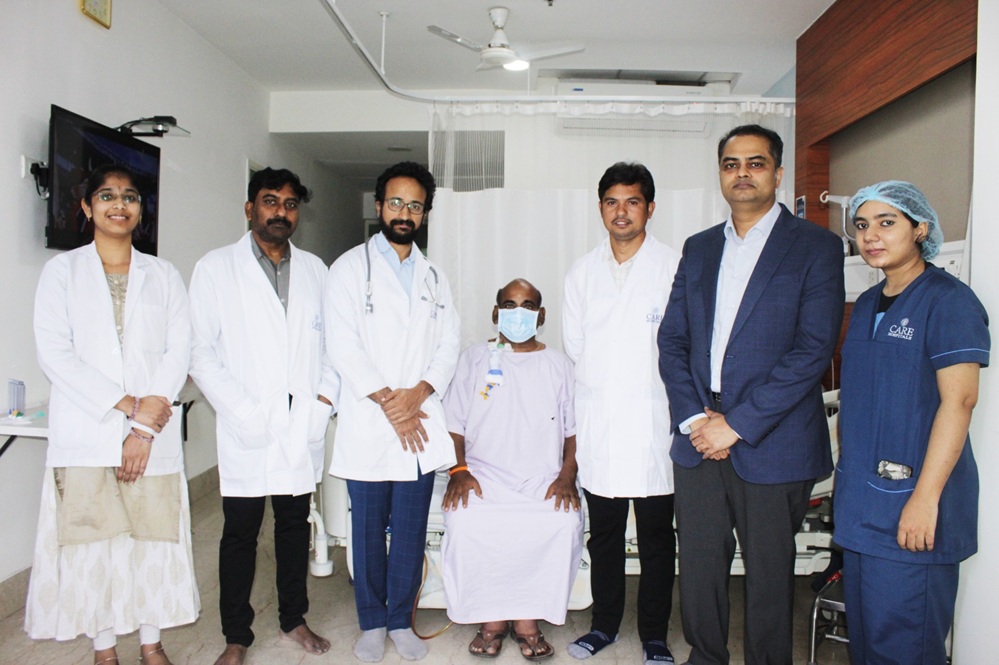
Hyderabad : Doctors at CARE Hospitals, Hitech City successfully performed a complex ABO-incompatible kidney transplant on a 60-year-old teacher with high antibody levels and multiple underlying health conditions, giving him a new lease of life after two years of dialysis. His wife stepped forward as the donor despite their incompatible blood groups.
The patient had been suffering from Chronic Kidney Disease (CKD) for three years and undergoing dialysis three times a week for the past two years, leading to frequent hospitalisations and significantly affecting his quality of life. Despite these challenges, he continued working as a teacher.
Finding a suitable donor was difficult due to his age, high antibody titres, hypertension and diabetes. When his wife volunteered to donate her kidney, their blood-group incompatibility presented an additional challenge.
The multidisciplinary transplant team at CARE Hospitals planned an ABO-incompatible kidney transplant using a specialised desensitisation protocol. The patient underwent multiple sessions of plasmapheresis to reduce antibodies, along with immunosuppressive therapy to prevent rejection.
The key clinical challenge was balancing the higher immunosuppression required to prevent rejection with the increased risk of infections, particularly given his age, diabetes and history of recurrent infections. Following successful preparation, the patient underwent the living-donor kidney transplant and was closely monitored during recovery.
Dr. B.R.G. Aravinda Reddy, Consultant – Nephrology, CARE Hospitals, said, “Blood-group incompatibility does not always rule out kidney transplantation. In appropriately selected patients, specialised desensitisation can help overcome this barrier. In this case, high antibody levels, age, diabetes and hypertension made the transplant particularly challenging, requiring careful preparation and close monitoring.”
Dr. Sushanth Kulkarni, Sr. Consultant – Renal Transplant & Urology, CARE Hospitals, Hitech City, said, “This was a challenging transplant due to the blood-group mismatch, high antibody levels and the patient’s other health conditions. With careful preparation and close coordination between the nephrology and transplant teams, we were able to successfully perform the transplant.”
Dr. J. Al Ranganath, Consultant – Nephrology, CARE Hospitals, said, “After two years of dialysis three times a week, this transplant gives the patient an opportunity to return to a more independent and active life. The challenge was to prevent rejection while carefully managing the increased risk of infection.”
Dr. Pramod Gupta, HCOO, CARE Hospitals, Hitech City said, “This case combines advanced medical expertise with an extraordinary act of family support. His wife came forward to donate despite the blood-group mismatch, and our multidisciplinary team worked together to make the transplant possible. It reflects our commitment to providing advanced treatment options even in complex cases.”
ABO-incompatible kidney transplantation can be considered for selected patients with end-stage kidney disease who have a willing living donor but face a blood-group mismatch. It requires specialised desensitisation, immunosuppression and close monitoring to minimise rejection and infection risks.
The case highlights an important message for patients and families: a blood-group mismatch does not always mean that living kidney donation is impossible. For the 60-year-old teacher, the successful transplant offers an opportunity to move beyond years of dialysis and return to a better quality of life.
