


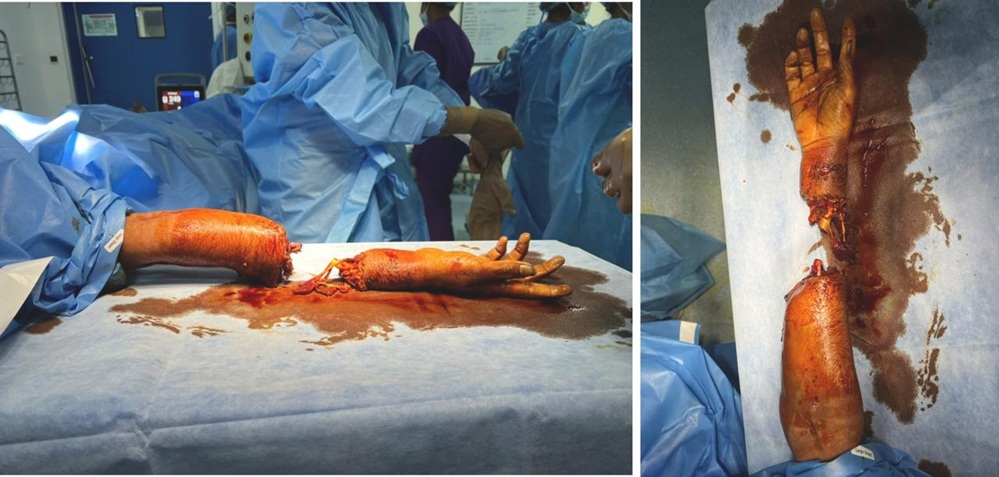
Hyderabad : A severe industrial accident could have permanently changed the life and livelihood of a 19-year-old worker. In a complex surgical intervention, a multidisciplinary team at CARE Hospitals, HITEC City, successfully replanted his completely severed right forearm following a drill-machine accident. The young man reached the hospital’s Emergency Department within an hour of the accident and underwent a marathon 10-hour surgery to save the limb.
The worker suffered a severe crush injury while operating a drill machine, resulting in complete amputation of his right forearm. Considering his young age, the extent of the injury and the timely arrival at the hospital, doctors decided to attempt replantation and give him the best possible chance of preserving his limb and regaining function.
A multidisciplinary team comprising specialists from Orthopaedics, Plastic & Reconstructive Surgery, General Surgery and Anaesthesia immediately began the complex procedure. The surgery involved extensive cleaning of the damaged tissue, stabilisation of both forearm bones with plates, restoration of the limb and reconstruction of the damaged soft tissues.
Replantation of a completely amputated limb is among the more challenging forms of reconstructive surgery. It requires restoration of blood circulation along with repair and reconstruction of the damaged bones and soft tissues. The success of the procedure also depends significantly on the severity of the original injury, how quickly the patient reaches an appropriate trauma centre and subsequent rehabilitation.
Dr. Divya Sai Narsingam, Senior Consultant – Plastic Surgery, CARE Hospitals, HITEC City, said, “The first challenge in a completely amputated limb is to restore viability and blood circulation. After that, the damaged structures and soft tissues have to be reconstructed carefully. The replanted forearm is now viable, blood circulation is normal, and we are seeing encouraging movement and sensation in his fingers. Rehabilitation will now play an important role in helping him regain maximum possible function.”
Following the surgery, the patient was closely monitored in the surgical intensive care unit. He subsequently required further wound management, including skin grafting. He responded well to treatment and was discharged in a stable condition.
Dr. K. Harikrishna Reddy, Senior Consultant – General Surgery, CARE Hospitals, HITEC City, said, “Industrial injuries involving machinery can cause devastating damage within seconds. What made an important difference in this case was that the patient reached specialised emergency care quickly and the required surgical teams could intervene without delay.”
Dr. Gottemukkala Ashok Raju, Clinical Director & Senior Consultant – Orthopaedics, CARE Hospitals, HITEC City, said, “This was a severe crush injury with complete amputation of the forearm. The patient reaching us within an hour was extremely important. In such injuries, every minute matters. Our immediate priority was to stabilise the limb and work together across specialties to give this young man the best possible chance of saving his arm.”
Commenting on the clinical effort, Dr. Pramod Gupta, Chief Operating Officer, CARE Hospitals, HITEC City, said, “For a 19-year-old, saving a limb is not only about treating an injury; it can have a lifelong impact on his independence and livelihood. This outcome reflects the coordinated effort of our emergency, surgical, critical care and rehabilitation teams. We are encouraged by his recovery and wish him the very best as he continues rehabilitation.”
The patient will continue to undergo regular follow-up and rehabilitation to improve strength, movement and functional use of the replanted hand and forearm. Doctors said the return of normal circulation along with early movement and sensation in the fingers are encouraging signs, although long-term functional recovery will depend on healing, nerve recovery and sustained rehabilitation.
Industrial and workplace injuries involving mechanised equipment can result in severe crush injuries and complete or partial amputations. Doctors at CARE Hospitals stressed that such injuries should be treated as medical emergencies, as timely access to specialised trauma and reconstructive surgical care can significantly influence the possibility of saving the affected limb.
In case of complete amputation, the severed part should be handled carefully, wrapped in clean moist gauze, placed inside a clean sealed plastic bag and kept cool. It should not be placed directly on ice. The patient and the amputated part should be transported to an appropriate hospital as quickly as possible.
The successful replantation highlights how advances in trauma, orthopaedic and reconstructive surgery, combined with rapid emergency response and multidisciplinary care, can help save limbs and potentially transform outcomes for victims of severe industrial accidents.
—-
