

Cheranalloor Mercedes-Benz Crash: Father Liable for Prosecution under Section 199A MV Act Despite Being a Judicial Officer

From Our Legal Correspondent
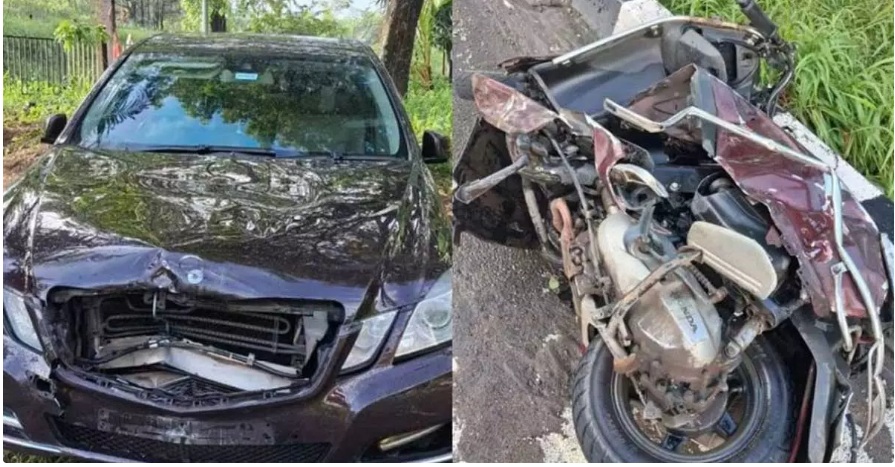
In the early hours of 25 October 2026, a Mercedes-Benz (registration KL-46-F-0333) allegedly driven by a 17-year-old minor struck the scooter of 55/56-year-old Jayabalakrishnan from behind on Container Road at Cheranalloor, Ernakulam. Jayabalakrishnan, who ran a wayside eatery and was returning home after closing shop, died at the scene. The minor is the son of Reno/Rino Francis Xavier, Additional District Judge at Irinjalakuda, who also holds charge as the Motor Accidents Claims Tribunal (MACT) Judge. The car is registered in his name. Preliminary reports indicate the minor was alone in the vehicle, claimed he had taken it without parental knowledge, and that heavy rain affected visibility. Initial medical examination suggested no alcohol, though detailed chemical analysis was ordered. Family members of the deceased alleged high speed, questioned the initial police response, and described the judge’s attitude at the station as arrogant.
The case raises two distinct legal tracks: proceedings against the minor under the Bharatiya Nyaya Sanhita, 2023 and the Juvenile Justice (Care and Protection of Children) Act, 2015, and independent liability of the registered owner under Section 199A of the Motor Vehicles Act, 1988. The fact that the owner is a MACT Judge who adjudicates motor accident claims does not shield him from prosecution.
Proceedings Against the Minor
Cheranalloor police initially registered the case under BNS Sections 281 (rash driving or riding on a public way) and 106(1) (causing death by negligence). These offences are bailable, and the minor was granted station bail. Following public outrage, protests by the victim’s family, and intervention by the Home Minister, police added Section 105 BNS (culpable homicide not amounting to murder), a non-bailable offence.
As the accused is 17 years old, the matter falls under the Juvenile Justice Act. The minor must be produced before the Juvenile Justice Board (JJB). Because he is above 16 and the offence involves a fatality that can be classified as heinous (depending on the maximum punishment attached), Section 15 of the JJ Act requires the JJB to conduct a preliminary assessment. The Board examines three factors: the child’s mental and physical capacity to commit the offence, his ability to understand its consequences, and the circumstances in which the offence was allegedly committed. Expert psychological or psychosocial assessment may be sought. This is not a trial on guilt.
If the JJB concludes that the child should be tried as an adult, it transfers the case to the Children’s Court. The Children’s Court must independently verify the assessment under Section 19. Even if tried as an adult, juvenile sentencing principles continue to apply: the death penalty is unavailable, and life imprisonment is restricted under the JJ framework. Punishment under BNS Section 105, if conviction follows, ranges from imprisonment for life or a term of not less than five years extending to ten years plus fine (where intention is present) to up to ten years plus fine (where there is knowledge that the act is likely to cause death but no intention).
The identity of the minor remains protected under Section 74 of the Juvenile Justice Act.
Liability of the Registered Owner under Section 199A
Section 199A of the Motor Vehicles Act, introduced by the 2019 amendment, specifically addresses offences committed by juveniles. Where a juvenile commits an offence under the Act, the guardian of the juvenile or the owner of the motor vehicle is deemed guilty of the contravention. The court is required to presume that the use of the vehicle by the juvenile was with the consent of the guardian or owner. The provision creates an independent offence against the adult.
The prescribed punishment is imprisonment which may extend to three years and a fine of twenty-five thousand rupees. In addition, the registration of the vehicle used in the offence shall be cancelled for twelve months, and the juvenile shall not be eligible for a driving licence until the age of twenty-five.
A statutory defence exists: the owner or guardian is not liable if he proves that the offence was committed without his knowledge and that he exercised all due diligence to prevent it. Kerala High Court has held that proceedings under Section 199A can be initiated against the owner or guardian independently; a formal finding of guilt against the minor is not a precondition for prosecuting the adult. The minor is not the accused under this section.
Reports indicate that police have decided to register a case under the Motor Vehicles Act against the judge as the registered owner for permitting an underage person to drive. Judicial office—including concurrent charge as a MACT Judge—confers no immunity from criminal process under Section 199A. Any administrative inquiry by the High Court into the officer’s conduct is a separate matter and does not oust the jurisdiction of the criminal court. The irony that a judge who decides motor accident compensation claims now faces prosecution arising from an accident involving his own vehicle does not alter the statutory scheme.
The minor’s statement that he took the car without knowledge supplies a potential defence, but the statutory presumption of consent places the burden on the owner. Evidence relating to key access, prior knowledge of the minor’s driving, and any steps taken to secure the vehicle will be material.
Parallel Remedies and Investigation
The legal heirs of Jayabalakrishnan are entitled to file a claim petition before the Motor Accidents Claims Tribunal against the insurer and the owner. This civil claim proceeds independently of the criminal cases. The fact that the owner himself sits as a MACT Judge elsewhere has no bearing on the jurisdiction of the tribunal that will hear the compensation claim.
Investigation is expected to cover mechanical examination of both vehicles by the RTO, retrieval of CCTV and electronic evidence of speed and trajectory, formal blood analysis, and statements. These materials will inform both the JJB assessment and the prosecution under Section 199A.
Analysis
The legal architecture is deliberate. The Juvenile Justice Act balances rehabilitation with the possibility of adult trial for serious offences by those aged 16–18. Section 199A of the Motor Vehicles Act shifts responsibility upstream to the adult who controls the vehicle, reversing the ordinary burden through a statutory presumption. The provision was enacted precisely because minors repeatedly obtained access to powerful vehicles with fatal consequences.
In the present case, both tracks are active. The addition of Section 105 BNS after initial bailable charges reflects the pressure for seriousness to match the outcome—a death on a public road. Whether the owner is ultimately punished will turn on whether the prosecution can sustain the presumption of consent and whether the owner can establish lack of knowledge coupled with due diligence. Neither outcome is automatic. The fact that the owner is an Additional District Judge holding MACT charge does not alter the statutory scheme; it merely heightens the public expectation that the law will be applied without distinction. The father, though a judicial officer and MACT Judge, remains fully liable for prosecution under Section 199A of the Motor Vehicles Act.
As of 26 October 2026, the investigation and charging process remain at an early stage. The final determination rests with the JJB, the Children’s Court if transfer occurs, and the regular court hearing the Section 199A case. What the statutes already make clear is that both the minor driver and the registered owner are within the reach of the criminal process.
