


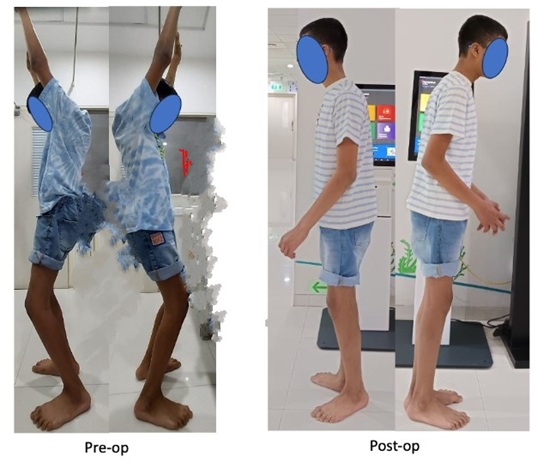
Mumbai : For some children, walking is not something that comes easily, but is something they work at every single day. At Narayana Health SRCC Children’s Hospital,Mumbai, an 11-year-old boy living with spastic diplegic cerebral palsy underwent a minimally invasive, single-session intervention that helped ease the strain in his movements and bring him closer to a more natural way of walking. The procedure was led by Dr Taral Nagda, Senior Consultant – Paediatric Orthopaedics, Narayana Health SRCC Children’s Hospital, Mumbai.
Agastya’s story had been unfolding quietly over the years, in signs so small that only those closest to him could have actually noticed. He was a preterm baby born at seven months, weighing 1900 grams, and spent his earliest days in the NICU where the focus was simply on helping him get through his fragile start. As he grew, his development milestones came, but not without delays. He held his head a little later than most babies, sat up a little later, and took his first independent steps only around the age of three. None of this took away from who he was—his speech, hearing, and vision were completely normal, and he went to school, learned, and interacted just like other children. And yet, he always seemed to have a quiet awareness that walking never felt effortless.
His family stayed committed to regular physiotherapy, holding on to the belief that things would improve with time and consistency. And for a while, they did. But as Agastya entered a phase where his body began to grow more rapidly, something shifted. The effort behind each step became more visible. His posture changed, and he began walking in what doctors describe as a crouch gait – where the hips and knees remain bent – making movement tiring and less efficient. What had once been manageable started to feel limiting. When he came to the hospital, doctors realised this was no longer just a variation in how he walked, but something that shaped how much he could do, how long he could walk, and how comfortable he felt in his own body.
On closer examination, the reason for his crouch gait became clearer. He had adductor spasm, which restricted how freely his legs could move apart, and a knee flexion contracture, which meant he could not fully straighten his knees while walking. His ankle and foot joints, however, were normal. These findings, along with his earlier MRI showing hypoxic ischemic encephalopathy, confirmed spastic diplegic cerebral palsy.
What was happening was something often seen during growth—his bones were lengthening, but the already tight muscles were unable to keep up, gradually pulling his body into a position that was becoming harder to correct with physiotherapy alone.
Minimally invasive, precise procedure
At this point, the decision was less about adding another treatment and more about intervening at the right moment. The aim was to gently reset the balance between muscles and movement before the patterns became more fixed. A combined approach was planned—botulinum toxin injections to relax the tight muscles, along with USG-guided percutaneous myofascial release to release the contractures in a precise, minimally invasive way.
During the procedure, 100 units of botulinum toxin were administered into the adductors and hamstrings, followed by a suture-less release under ultrasound guidance. The change was immediate. The tightness eased, and for the first time in a while, his hips and knees could move with less resistance, visible right there during the procedure.
The procedure itself was short—about an hour—and gentle in its approach, with negligible blood loss, minimal discomfort, and no incision. A push knee splint was provided to maintain the corrected position, and after a three-day hospital stay, he was ready to go home.
Steady recovery
In the days that followed, he began walking again, slowly at first, but with a noticeable difference. The effort he had to put into each step was now reduced. The strain that had quietly built up over time began to ease. What changed was not just the way he walked, but how his body supported him while walking—more balanced, less tiring, more natural. The intervention addressed the tightness and helped restore healthier joint dynamics, giving his body a better chance to keep up with his growth.
Explaining the case, Dr Taral Nagda, Senior Consultant – Paediatric Orthopaedics, Narayana Health SRCC Children's Hospital, Mumbai said, “In children with spastic diplegic cerebral palsy, especially during growth spurts, the muscles often struggle to keep pace with the lengthening bones. This leads to tightness, contractures, and gait patterns like crouch gait. The key is recognising the right window for intervention before these changes become permanent, and when physiotherapy alone is not enough. With a combination of botulinum toxin injections and USG-guided percutaneous myofascial release, we were able to release the tight muscles and improve joint movement in a single sitting, helping the child walk with better alignment and far less effort.”
Sometimes, change does not come from doing more—it comes from doing what is needed, at the right time. This case is a reminder that with timely, minimally invasive intervention, long-standing movement challenges too can be gently corrected. In Agastya’s instance, it has helped him look forward to the years ahead with greater ease, confidence, and freedom.
