

CSR in the Northeast has more than tripled in four years, but the region still receives just 2.1% of India’s total: Primus Partners – CII Report

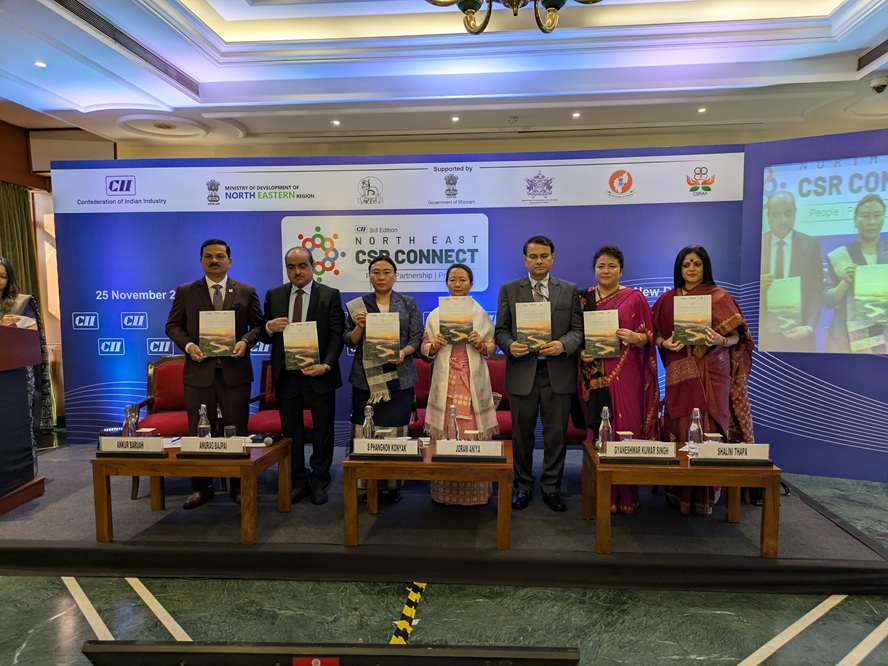
Mumbai : Primus Partners, a leading management consulting and advisory firm, today unveiled the report ‘Rethinking CSR in the North East: Catalysing CSR Investments and Strategic Partnerships for Inclusive and Sustainable Development in Northeast India’ at the 3rd edition of CII North East CSR Connect, held at the India Habitat Centre, New Delhi, at which it was the Knowledge Partner. The report was formally inaugurated by Smt. S. Phangnon Konyak, Hon’ble Member of Parliament, Rajya Sabha, and Dr. Joram Aniya, Member, NITI Aayog, Government of India, in the presence of:
– Ms. Charu Malhotra – Managing Director & Founder, Primus Partners
– Dr. Ankur Baruah – Chair, CII NE CSR Connect 2026 and Director, Oil India Limited
– Shri Anurag Bajpai – Principal Chief Conservator of Forests & Head of Forest Force, Manipur; Additional Chief Secretary (Textiles, Commerce & Industries), Government of Manipur
– Shri Gyaneshwar Kumar Singh – Director General & Chief Executive Officer, Indian Institute of Corporate Affairs (IICA), Government of India
The report, developed by Primus Partners with the Confederation of Indian Industry (CII), examines CSR flows across the eight North Eastern states and identifies where corporate investment can make the most difference.
Drawing on an assessment of the CSR landscape across the eight Northeastern states, the report examines investment patterns, regional development priorities and emerging opportunities for corporate participation. It finds that CSR spending in the region has more than tripled over four years, from ₹250 crore in FY 2020-21 to ₹855 crore in FY 2024-25, yet the Northeast still receives only about 2.1% of India’s total CSR expenditure. Funding is also concentrated: Assam accounts for about 71% of the regional total, and around 81% of the region’s CSR goes to three sectors, namely health, nutrition, water and sanitation; education and livelihood; and rural development. At the same time, this means a modest commitment is highly visible. In seven of the eight states, a ₹5 crore CSR commitment would exceed the fifth-largest funder’s contribution, giving a new entrant the opportunity to become a meaningful contributor and help shape the state’s CSR ecosystem.
The report’s central message is that the Northeast’s CSR landscape is under-weighted, not saturated. Seven of the eight states receive less than ₹250 crore a year, and several themes remain thinly funded: gender and women-led development received about 3% of the region’s CSR in FY 2024-25 and heritage, art and culture less than 1%, while vocational skilling does not feature among the five largest CSR sectors in any of the eight states. The gap is not a talent gap. Five of the eight states rank among India’s top ten states and Union Territories for literacy, and the region has a young population. However, many educated young people leave the region because they cannot find jobs that match their qualifications. The report highlights the need to address this imbalance by directing investments towards underserved districts and sectors with significant development needs.
The report also identifies a timely policy opening. For FY 2026-27 and FY 2027-28, the Department of Public Enterprises (DPE) has explicitly listed Anganwadi buildings, toilets, drinking water and smart-TV early learning under its common CSR theme for central public sector enterprises (CPSEs), which are expected to spend around 60% of their annual CSR on the common theme. The case for the Northeast is strong: the region has received only about 2% of national CSR in FY 2023-24, and documented PSU CSR projects reach fewer than 100 of its Anganwadi centres, under 0.1% of the region’s total. As Anganwadis are often the only service point for young children in remote hill and border villages, the policy gives CPSEs, and companies co-investing alongside them, a clear route to strengthen early childhood development, from buildings, toilets and drinking water to early-learning tools, worker training, local-language content and long-term upkeep.
Commenting on the association, Charu Malhotra, Co-founder and Managing Director, Primus Partners, said, “The Northeast presents a compelling opportunity for corporate India to collaborate on how CSR can contribute to regional development. The region’s young population, strong human capital, and rich natural resources offer significant potential, but unlocking it requires investments aligned with local priorities and designed for long-term impact. Through our thought leadership contribution, we aim to encourage a shift from isolated initiatives to collaborative, outcome-driven partnerships that connect people, institutions and opportunities. Our association with CII provides an important platform to advance this conversation and bring greater attention to the region’s development priorities.”
The study calls for moving beyond fragmented, project-based interventions towards integrated, outcome-oriented CSR partnerships. It also emphasises the need for stronger convergence among governments, corporates, development institutions, and grassroots organisations.
****
