


By Geetha VP
In these days the nation has been cautioned. From the ramparts of the Red Fort the Prime Minister spoke of dimagi naxals — those whose minds, he said, still sow disorder even after the armed fire in the forests has been brought low. The warning belongs to the present hour. Yet words, like rivers, have older beds. Long before any village gave its name to an uprising, the syllable naxal belonged to a grass, and the one born among that grass belonged only to Mahadev.
Hear first of the terror that made his birth necessary.
There was an asura named Tarakasura, son of Vajranga and Varangi. From childhood he burned with a single desire: to become unconquerable. He performed tapas so fierce that the worlds themselves grew afraid. Standing on one foot, living on air, his body reduced to bone and flame, he pleased Brahma. When the Creator appeared, Tarakasura asked a boon that seemed clever: let him die only at the hands of a son of Shiva.
Brahma granted it.
At that time Shiva was lost to the world. After Sati’s self-immolation He had withdrawn into the deepest yoga. No wife sat beside Him. No son would be born. Tarakasura understood this. The boon was, in his mind, immortality. He rose, gathered a vast army of asuras, and began to grind the three worlds under his heel. He drove the gods from their cities. He seized their treasures, their women, their yajnas. Indra’s thunderbolt became useless. The sun was dimmed. The sacred fires of earth went out. Sages could not complete their rites. The earth itself cried out.
The gods ran to Brahma. Brahma sent them to Vishnu. Vishnu told them the truth: only a son of Mahadev could end this. They must wake Shiva from His stillness and bring Uma, the daughter of Himavan, to His side.
Thus began the long labour of the gods. Kama was sent and reduced to ash by Shiva’s third eye. Parvati herself undertook terrible tapas to win the Lord who had become ice. At last the wedding of Shiva and Parvati took place on the Himalaya, a marriage so vast that all the gods attended and the mountains themselves bowed. Yet even then the energy of their union was too great. The gods, still terrified that the worlds would not survive such concentrated power, interrupted them.
Shiva’s seed, blazing like a second sun, fell. Agni took it and burned. Ganga received it and boiled. Unable to hold it, the sacred river carried the essence downstream until she reached a thicket of tall, silver-plumed river-grass that the people of that land called naxal. There the seed sank. The reeds caught a cold, golden fire that did not consume. From that ash and that grass a child arose — already radiant with the purpose for which he had been born.
Then the six Krittikas, the star-maidens, came to the river to bathe and found the infant among the reeds. Each of them, filled with motherly love, claimed him as her own and wished to nurse him. The child, in His compassion, would not deny any of the six who had come to Him in devotion. He manifested six faces — Arumukhan, Shanmukha — so that every mother might hold Him at once and every mouth might drink. One face for each Krittika. No mother was left empty. No love was refused. That is why He is called Arumukhan with reverence: not as a wonder of many heads alone, but as the Lord who accepted six mothers without diminishing a single one of them. The six faces also look in all directions, for the commander of the gods must see everything; yet first they were given so that a child might honour every hand that fed Him.
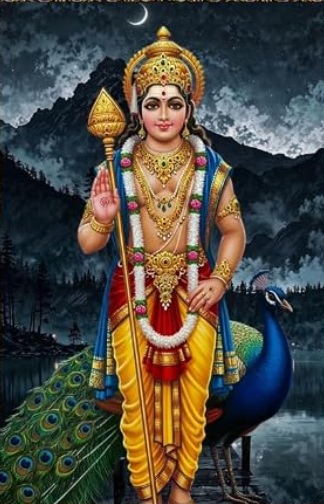
The world later named Him Kartikeya, Skanda, Murugan, Kumara. But in the oldest whisper of the river-folk He was also called Naxali — the one born of the naxal reeds, Sharavanabhava, son of the thicket, Arumukhan of the six gracious faces.
He did not remain a child for long. On the seventh day He was given the spear, the vel, and the command of the army of the gods. He mounted the peacock. He faced Tarakasura.
The battle shook the three worlds. Tarakasura, armed with every weapon and every illusion, could not be wounded by any other being. Only the son of Shiva could pierce him. Arumukhan — Kartikeya — did so. The vel flew. The asura who had thought himself deathless fell. The gods returned to their places. The yajnas were lit again. The earth breathed.
Yet before He became commander, and even after the slaying, He remained first a son.
Mahadev had already drunk the halahala that rose from the churning of the ocean. He held the poison in His throat so that creation might live. The blue fire never fully died. Young Naxali, standing where the same grass still whispered, understood what the heavens had not yet thought to do. He filled two earthen pots with Ganga’s own water from the very banks that had given Him birth, bound them to a simple bamboo pole, and set the pole upon His shoulders. Barefoot, silent, His mind fixed only on His Father, He walked.
That was the first kawad.
The pots did not spill. When He reached Kailasa and poured the cool river over the burning throat of Neelkantha, the Lord opened His eyes and smiled. In that smile the path of the Kawadiya was born — the long walk, the sacred burden, the offering that asks for nothing except the chance to soothe the One who once saved the worlds.
Thus the first dimagi Naxali was not a maker of disorder. His dimag — His mind — was itself a kanwar: balanced, devoted, carrying only grace. Arumukhan did not raise a weapon against the innocent earth; He raised the vel against Tarakasura and water to the throat of His Father. His six faces first accepted six mothers; then they watched over the worlds; then they turned toward Mahadev alone. His rebellion was only against adharma and forgetfulness. His uprising was the slow return of the river to the Lord who had swallowed poison so that others might live.
The later village of Naxalbari would one day lend the same sound to a very different fire. But the grass was older than the village, the child older than any slogan, and the kawad older than any caution of the present age. Those who still walk in Shravan with pots swaying on their shoulders walk, whether they know the name or not, in the footsteps of that reed-born son — Arumukhan, who first slew the asura and then cooled the throat of Mahadev.
A true Dimagi Naxali, the old story says, is one whose mind remains a kanwar — who honours Kartikeya as Arumukhan, slayer of Tarakasura and first pilgrim, who carries only Ganga’s water to Shiva, and who lets no other fire enter the heart that was meant for worship alone.
