


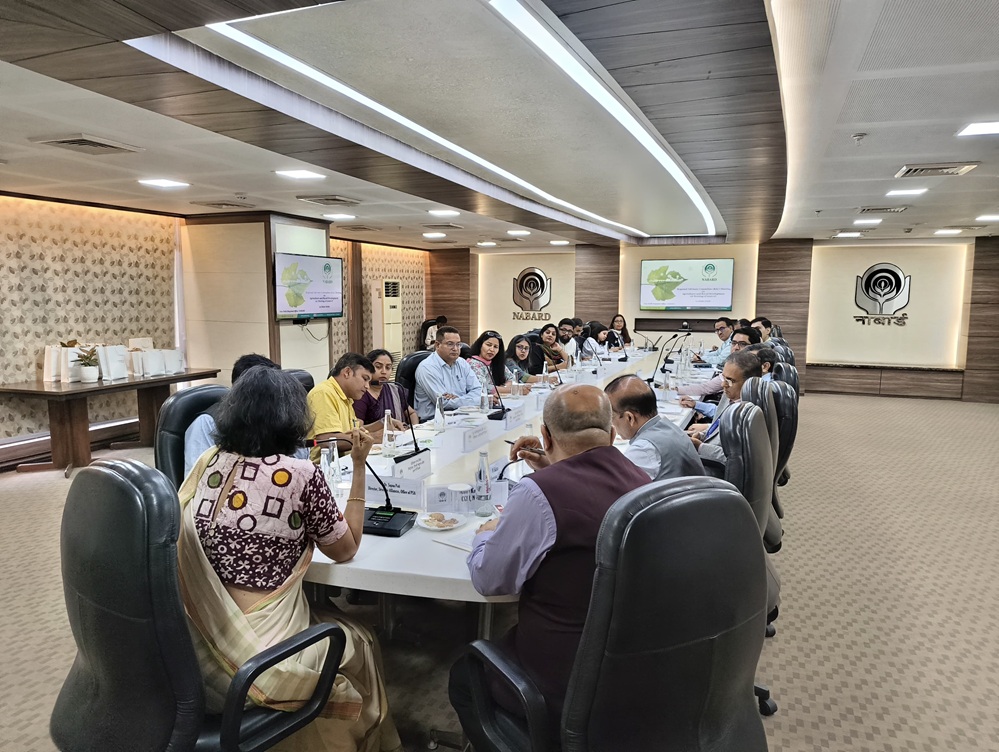
NABARD New Delhi Regional Office convened the first Regional Advisory Committee (RAC) meeting for Delhi NCT on 12 June 2026, which brought together a wide range of stakeholders. The meeting was chaired by Dr. Sapna Poti, Director, Strategic Alliances, Office of Principal Scientific Advisor to Prime Minister , along with Shri Nabin Kumar Roy, Chief General Manager, NABARD Delhi and was attended by Prof. Ram Singh, Director, Delhi School of Economics and Member Monetary Policy Committee, Dr. Ch. Srinivasa Rao, Director and Vice Chancellor, Indian Agricultural Research Institute (IARI), New Delhi (through VC), Mr. T.D. Sivakumar, Chief General Manager, EXIM Bank, Shri D Sahoo, GM and Convenor SLBC Delhi and other Senior representatives of IIT Delhi, IARI (Pusa Krishi), NIRDPR, KVK/ICAR, SULM, and other key development partners.
The theme of the RAC Meeting was “Innovation, Sustainability and Skills for a Smart and Sustainable Delhi: A case of Waste to Wealth/Value Enterprises”.
The multi-stakeholder session emphasized convergence among government, financial institutions, academia, and community organizations to transform Delhi’s waste challenge into a sustainable development opportunity which creates avenues of economic development, employment generation, and sustainable livelihoods.
Sh. Nabin Kumar Roy, CGM, New Delhi RO highlighted the importance of bridging the gap between innovation and implementation through pilot projects, incubation support, and scaling of proven technologies. During his address a value-chain approach to waste management was strongly advocated, emphasizing segregation and category-wise processing of waste streams, including e-waste, plastic waste, construction and demolition waste, horticultural waste, and market waste. This approach is expected to enhance efficiency, create green jobs, and promote circular economy practices. Examples such as temple flower waste conversion into compost and incense products, and cloth upcycling into bags and durries, were highlighted as scalable community-led enterprise models, particularly suitable for SHG participation.
Dr. Sapna Poti , stated that the Office of the Principal Scientific Advisor under the PMO focuses on building science and technology ecosystems through partnerships, working across ministries, industry, and academia. She highlighted the Manthan platform, which connects industry needs with innovators and hosts projects worth over ₹10,000 crore, along with key initiatives such as Uthan for strengthening Tier-2/3 colleges, Smart Village Centers for rural technology deployment (with NABARD support), and Saksham for school-level innovation, all aimed at fostering a collaborative innovation ecosystem among others. She also highlighted the issue of availability of the technological solutions at the labs and the startups but low level of implementation of the technology at the ground level in view of low level of awareness.
Professor Ram Singh emphasized that waste-to-wealth should be viewed through the broader lens of the circular economy rather than conventional waste management. He highlighted the strategic importance of recovering resources from waste streams, particularly in the context of India’s dependence on imported materials and technologies. Waste streams such as e-waste, plastics, batteries and bio-waste were identified as important sources of critical minerals, reusable materials and renewable energy.
Detailed discussions were held by members regarding the reframing of waste from a disposal issue to a significant economic resource as Delhi currently faces legacy waste across landfill sites such as Ghazipur, Bhalswa, and Okhla, alongside daily waste generation of approximately 11,862 tonnes per day (TPD). While nearly 70% of this waste is processed, participants highlighted that up to 80% of waste has recoverable economic value. The composition—around 50% biodegradable waste, 35% recyclables, and 20% inert material—underscores the potential for value extraction through composting, recycling, bio-CNG, and waste-to-energy solutions.
The meeting also underscored the critical role of financial institutions in enabling innovation and last-mile delivery. Banks, coordinated through SLBC, reaffirmed their readiness to support viable waste-to-wealth enterprises, startups, and SHG-led initiatives.
The role of municipal corporations and civic bodies was recognized as central to the success of waste management initiatives. Discussions stressed their involvement in infrastructure development, project implementation, and financing models, including the use of municipal bonds for green projects. Enhanced engagement by urban local bodies is expected to strengthen ownership and ensure sustainability of interventions.
The meeting concluded with a strong consensus on the need to translate deliberations into actionable outcomes. Stakeholders committed to advancing pilot projects, strengthening credit linkages, and promoting scalable enterprise models that generate green jobs and contribute to a cleaner, more sustainable Delhi.
