

EU–India Trade Deal: India’s Strategic Assertion and a Quiet Warning to Washington

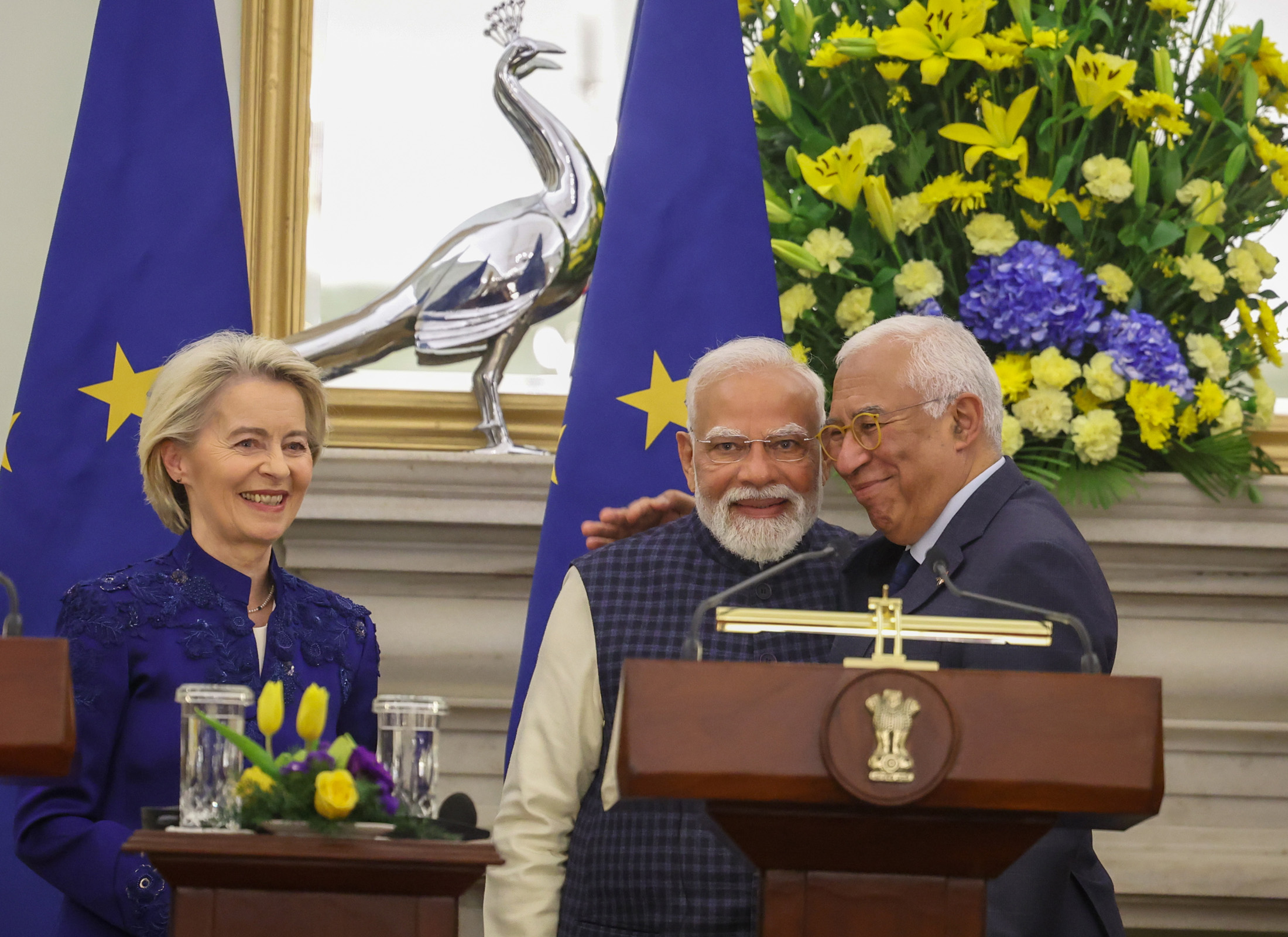
The signing of a landmark trade agreement between the European Union and India today, after nearly two decades of intermittent negotiations, marks a decisive moment in global geopolitics. Beyond tariffs, market access, and regulatory alignment, the deal carries a deeper strategic message: India will not allow itself to be constrained, coerced, or politically subdued by any external power—including the United States. At a time when the U.S. President Donald Trump has repeatedly attempted to frame international trade as a zero-sum contest dominated by American pressure tactics, the EU–India agreement stands as a subtle yet unmistakable rebuttal.
By Suresh Unnithan & Nanditha Subhadra
For India, this deal is not merely about economics. It is about sovereignty, strategic autonomy, and signaling to the world that New Delhi will pursue partnerships based on mutual respect rather than submission.
A Strategic Breakthrough After Two Decades
Negotiations between India and the European Union have historically been difficult. Differences over tariffs, labor standards, environmental regulations, intellectual property rights, and market access caused repeated breakdowns. That the two sides have now bridged these gaps reflects a changed global context. Rising geopolitical uncertainty, fragmentation of supply chains, and increasing unilateralism from the United States have pushed both India and the EU to reassess their strategic priorities.
For India, the agreement underscores its growing leverage as one of the world’s fastest-growing major economies. For the EU, it offers access to a vast consumer market and a reliable democratic partner in Asia. Together, the deal signals a shift away from dependency on U.S.-centric trade frameworks.
India’s Economic Gains: Beyond Trade Numbers
The immediate benefits to India are substantial. Improved access to European markets will boost exports across pharmaceuticals, textiles, IT services, engineering goods, and agricultural products. Reduced tariffs and regulatory harmonization lower barriers for Indian firms, enabling them to scale operations and compete globally.
More importantly, the deal enhances investor confidence. European companies looking to diversify supply chains away from China now see India as a credible manufacturing and innovation hub. This aligns seamlessly with India’s long-term industrial ambitions and its push to integrate deeper into global value chains.
The agreement also strengthens India’s negotiating position in future trade talks. By successfully closing a complex deal with one of the world’s most regulation-heavy economic blocs, India demonstrates that it can negotiate from strength without compromising its core interests.
A Major Boost to India’s Auto Industry
One of the most significant sectoral impacts will be felt in India’s automobile industry. European auto giants bring advanced technology, electric vehicle expertise, and high manufacturing standards. Greater market access and lower trade barriers encourage deeper collaboration, joint ventures, and technology transfer.
For Indian automakers, this means access to cutting-edge components, greener technologies, and new export destinations. For consumers, it promises higher quality vehicles, increased competition, and faster adoption of electric and hybrid models. For workers, it means job creation across manufacturing, logistics, and ancillary industries.
The auto sector has long been a cornerstone of India’s industrial ecosystem. The EU–India deal strengthens this foundation while positioning India as a serious player in the global shift toward sustainable mobility.
Strategic Autonomy: The Core Message
Perhaps the most consequential aspect of the deal lies outside economics. It reinforces India’s commitment to strategic autonomy—a principle deeply embedded in its foreign policy tradition. India is neither aligning blindly with the West nor positioning itself against it. Instead, it is building diversified partnerships on its own terms.
This is where the deal becomes a silent warning to Donald Trump and his worldview. Trump’s approach to India was often transactional, marked by tariff threats, public pressure, and an assumption that economic leverage could force political compliance. India’s refusal to bend during trade disputes with Washington—and its willingness to walk away from unfavorable terms—already challenged that assumption.
By finalizing a major agreement with the EU, India sends a clearer message: it has options. It does not need to accept unequal trade terms or political pressure from the United States to sustain its growth or global relevance.
Why This Disturbs the United States
From Washington’s perspective, the EU–India deal complicates strategic calculations. The United States has long viewed itself as India’s primary Western partner, particularly in balancing China. While security cooperation remains strong, economic ties are increasingly pluralistic.
A closer EU–India economic partnership reduces U.S. leverage. It weakens the effectiveness of tariff threats or market-access pressure. It also signals to other emerging economies that alternatives to U.S.-dominated trade frameworks are viable.
Under a potential Trump return, this development would be especially unsettling. Trump’s trade philosophy relies on bilateral pressure, asymmetrical negotiations, and the assumption that U.S. market access is indispensable. India’s growing integration with Europe challenges that premise directly.
A New Global Trade Narrative
The EU–India agreement also reflects a broader shift in global trade narratives. Multilateralism is not dead, but it is evolving beyond U.S. leadership. Middle powers and regional blocs are increasingly shaping trade rules independently, prioritizing stability over confrontation.
For India, this evolution is advantageous. It allows the country to assert itself as a rule-shaper rather than a rule-taker. The deal underscores India’s ability to engage complex partners without sacrificing domestic priorities or strategic independence.
Not Anti-American, But Resolutely Sovereign
It is important to note that the EU–India deal is not anti-American. India continues to value its relationship with the United States across defense, technology, and people-to-people ties. However, the agreement makes one thing clear: partnership does not imply subordination.
India’s message is firm but measured. It will cooperate where interests align, resist where pressure is applied, and diversify relationships to safeguard national interests. This balanced approach contrasts sharply with the confrontational, pressure-driven trade tactics favored by Trump.
A Quiet but Powerful Signal
The EU–India trade deal is more than an economic milestone. It is a strategic statement delivered without rhetoric or confrontation. It tells Washington—and particularly Donald Trump—that India is no longer a country that can be cornered or coerced through trade threats.
By strengthening its economy, empowering key industries like automobiles, and diversifying its global partnerships, India demonstrates a new confidence on the world stage. The deal signals that India’s rise will be guided by choice, not compulsion.
In that sense, the agreement does not shout its message. It doesn’t need to. Its very existence speaks loudly enough
