


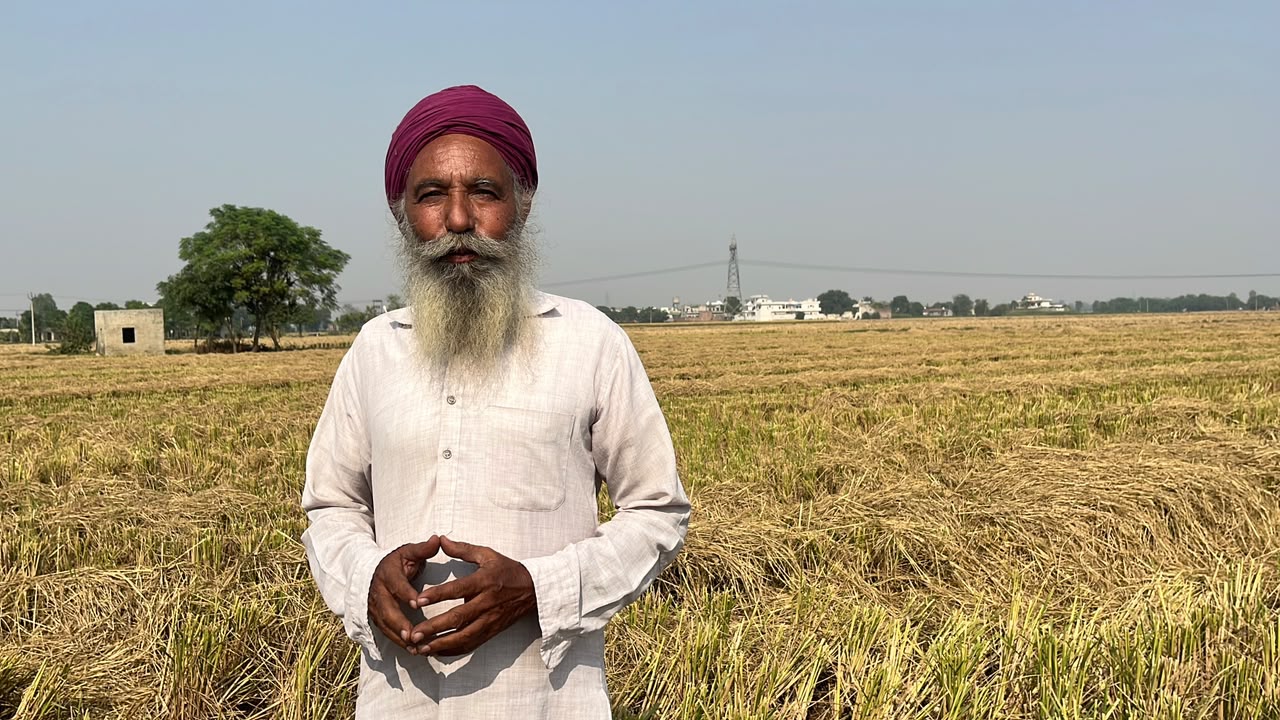
Supported through HDFC Bank Parivartan’s CSR programme and implemented in partnership with CII Foundation, farmers across Punjab and Haryana are breaking a decades-old cycle – one field at a time.
1. Jora Singh
From Four Decades of Traditional Farming to Adopting Improved Agri Practices for a Better Environment
His Story
In the paddy fields of Majhi village, Bhawanigarh block, Sangrur district, October once meant one thing above all else: fire. Like most farmers in the region, Jora Singh followed the only calendar that made practical sense – harvest the paddy, burn the straw, sow the wheat, and do it all within a window of barely fifteen days. For over four decades, he had farmed this way. Twenty acres have been under the rice-wheat cycle since 1980. A family of seven, depending on what the land gave back.
The straw left behind after each paddy harvest, nearly 50 tonnes across his fields every season, had no practical fate except fire. Renting the right machinery privately cost ₹1,800–₹2,300 per acre, and availability during the peak sowing window was never guaranteed. Burning was not carelessness. It was the only tool that was always available, always affordable, and always fast. The cost, paid in degraded soil and smoke-filled skies, was real but diffused, shared, and invisible on any balance sheet.
The Turning Point
Everything changed in September 2024, when Jora attended an awareness camp conducted jointly by HDFC Bank Parivartan and the CII Foundation. For the first time, he sat with detailed information about how access to shared machinery through community institutions could help improve in what burning was doing to his soil; the microbial life and the organic carbon, the fertility he had been sending skyward season after season. And for the first time, he learned there was a machine that could handle 50 tonnes of standing paddy straw without fire.
The CRM initiative had brought the Super Seeder to the village cooperative that could mulch standing straw and sow wheat in a single pass, within the same narrow window that had previously left burning as the only option. The tools were accessible, the costs shared, and the training hands-on. Jora chose to adopt CRM practices across his entire 20-acre holding from the outset.
Impact at a Glance
• Farm size: 20 acres
• Residue generated per season (before): 50,000 kg
• Residue management cost — before: ₹1,800–₹2,300 per acre
• Residue management cost — after CRM: ₹900 per acre
• Savings per acre per season: ₹900–₹1,400
• Stubble burning on farm today: Zero
Ripple Effect
The shift paid off quickly in the fields and beyond them. Residue management costs more than halved. Fertiliser and fuel requirements fell as decomposing straw returned organic matter to soil that burning had steadily stripped. Jora noticed improvements in soil health and crop yield across his fields. The October air over Majhi village, for the first time in memory, carried less smoke.
His children and grandchildren now help operate the Super Seeder, which replaces traditional farming dependent on paddy straw burning, turning straw back into soil instead of sending it skyward. Where burning once meant a solitary, smoke-filled October, the fields now go quiet in a different way. The quiet of a cycle that gives something back instead of taking it away.
“I take satisfaction in knowing that my farming methods are no longer contributing to environmental harm as a result protecting soil health, trees, birds, and the organisms that make this land alive.” — Jora Singh, Majhi village, Sangrur
2. Gurveer Singh
A Young Farmer Who Chose a Different Beginning
His Story
At 29, Gurveer Singh is among the youngest farmers to have taken up Crop Residue Management in Chima village, Jagraon block, Ludhiana district. He has been farming since 2015 and had already spent nearly a decade doing things the only way he knew. Each Kharif season, approximately 22,500 kg of paddy residue across his fields, and the same cost concern that governed every farmer in the region: burn it, or lose the sowing window.
Limited awareness of newer techniques and no access to affordable machinery made stubble burning the most practical option. He was not resistant to change, but he simply had no alternative.
The Turning Point
In October 2023, Gurveer learned about CRM practices through village awareness campaigns and society-level meetings introduced by the CII Foundation with support from HDFC Bank Parivartan. The initiative provided both technical exposure and access to machinery like Super Seeders, Happy Seeders, and Mitter Seeders, through local tool banks.
Where many farmers in first-year adoption villages began testing CRM practices on a portion of their land cautiously, Gurveer adopted across his entire nine-acre farm at once. He attended training sessions, participated in awareness programmes, and engaged with every resource the initiative offered.
The results were immediate. Wheat sowing that had previously required burning followed by multiple rounds of field preparation was now completed in a single operation. Costs that had run to ₹2,000–₹2,500 per acre dropped to around ₹1,000 per acre. Fertilizer requirements fell alongside them.
Impact at a Glance
• Farm size: 9 acres
• Residue generated per season (before): 22,500 kg
• Residue management cost (before): ₹2,000–₹2,500 per acre
• Residue management cost (after) CRM: ₹1,000 per acre
• Savings per acre per season: ₹1,000–₹1,500
• Stubble burning on farm today: Zero
Ripple Effect
Beyond the economics, Gurveer noticed improvements in soil fertility and a visible reduction in air pollution in the seasons since he stopped burning. Regular training exposure has strengthened his technical understanding of modern agricultural practices.
For a 29-year-old farmer, the significance of this shift runs deeper than cost savings. His generation inherited fields already weakened by years of burning. The choice to stop means the land he continues to farm, and eventually passes on, will be in measurably better health than the one he started with.
Across Cheema village, where the CRM programme has operated since April 2024, nearly 90% of farmers had adopted non-burning practices by October 2025, with approximately 887 acres saved from stubble burning. Gurveer is part of a generation that did not wait to be convinced twice.
“I now farm in a way that protects soil health and minimises harm to the trees, the birds, the organisms beneath the surface. That matters to me.” — Gurveer Singh, Chima village, Ludhiana
3. Paramjeet Singh
When Every Acre Counts, the Cooperative Makes the Difference
His Story
For a farmer managing 3.5 acres, there is no room for a bad season. Paramjeet Singh of Lamba village, Ratia block, Fatehabad district, Haryana, knows this better than most. Cultivating paddy, wheat, and potato across his small holding, he has always had to extract maximum productivity from minimum land. Timely sowing and efficient residue management become a necessity for survival.
Before the CRM initiative reached Lamba village, survival meant burning. The Paddy 1401 variety produces among the heaviest residue loads in the region. In his area, this biomass had virtually no alternative use, neither as fodder nor for industrial purposes. Collection and baling costs were prohibitive, and the village cooperative had limited machinery. What equipment existed was largely available only through private rental, at high costs and with uncertain availability during the narrow sowing window.
Burning remained the most practical solution. On a 3.5-acre farm, private machinery rental for a small landholder is expensive and reduces livelihood earnings.
The Turning Point
The situation changed with the arrival of CRM interventions supported by HDFC Bank Parivartan and implemented by the CII Foundation, which improved machinery access through the local cooperative. Super Seeders and Rotavators became available locally, backed by awareness drives, demonstrations, and farmer meetings on sustainable residue management.
For Paramjeet, the cooperative model was the hinge on which everything turned. He did not need to own a Super Seeder. He did not need to afford a private rental at peak-season rates. He needed the machine to be available, affordable, and accessible when his narrow window arrived.
He adopted the Super Seeder across his entire 3.5-acre farm for mulching and incorporating paddy straw directly into the soil while sowing wheat in a single pass.
Impact at a Glance
• Farm size: 3.5 acres
• Crops grown: Paddy 1401 (Kharif), Wheat varieties 327 & 2967 (Rabi), Potato
• Residue challenge: Paddy 1401 produces among the heaviest straw loads per acre
• Additional benefits: Lower fertilizer requirements, reduced weedicide use, improved soil moisture retention, fewer irrigation cycles
• Machinery accessed: Super Seeder and Rotavator
• Stubble burning on farm today: Zero
Ripple Effect
The results went beyond what Paramjeet had expected. Costs fell not just from cheaper residue management, but from a cascade of downstream savings, lower fertiliser needs as organic matter returned to the soil, reduced weedicide use, better moisture retention that cut irrigation cycles. For a 3.5-acre farm, these compounding savings matter enormously.
Soil health improved through enhanced organic matter and microbial activity. The air over Lamba village, which had carried the seasonal weight of burning stubble, grew cleaner. And crucially, Paramjeet had demonstrated something important for every small landholder watching: that you do not need to own the machinery to benefit from it. You need access to it.
In Kawalgarh village’s Ratia block of Fatehabad, a village formally designated a “Red Zone” by the Haryana Agriculture Department for high residue burning, the cooperative model helped drive over 90% non-burning compliance by 2025. Shared machinery is not a compromise. It is the solution.
“Reliable access to CRM machinery through the cooperative has been transformative for me. I can manage residue sustainably without having to invest in my own equipment — and my land is better for it.” — Paramjeet Singh, Lamba village, Fatehabad
4. Manjinder Singh
From 10 Acres to 35: Scaling Success After a Proven Pilot
His Story
At 30, Manjinder Singh of Majhi village, Bhawanigarh block, Sangrur district, manages 35 acres which is one of the larger holdings among younger farmers in his area. Farming since 2018, he grows wheat during the Rabi season and paddy alongside maize in Kharif, supporting a five-member family entirely through agriculture.
Before CRM practices reached his village, the constraints were straightforward: limited familiarity with modern machinery and high private rental costs made effective residue management difficult. Each season, nearly 87,500 kg of crop residue across his farmland was burned to prepare fields in time for the next sowing cycle. The scale of his holding meant the scale of burning was significant, and the scale of what he stood to save, if an alternative worked, was equally significant.
The Turning Point
Manjinder became aware of CRM practices through awareness campaigns and cooperative-level meetings. In April 2024, rather than committing his entire farm immediately, he made a deliberate choice: he would test first.
He began on 10 acres and watched the Super Seeder work through standing paddy straw. He watched the wheat sowing complete in a single pass. He watched field preparation time reduce and per-acre costs fall. And he could see the better soil structure, reduced fertilizer requirements and healthier crop performance. By the following season, the trial was over. Manjinder expanded CRM practices across his entire 35-acre farm.
Impact at a Glance
• Farm size: 35 acres
• Residue generated per season (before): 87,500 kg
• Residue management cost — before: ₹2,400–₹3,000 per acre
• Residue management cost — after CRM: ₹1,200 per acre
• Savings per acre per season: ₹1,200–₹1,800
• Residue management method: Combined in-situ (Super Seeder) and ex-situ (balers)
• Stubble burning on farm today: Zero
Ripple Effect
The savings on Manjinder’s 35-acre farm are substantial. At ₹1,200–₹1,800 saved per acre per season, the numbers add up to a meaningful shift in farm economics. Fertiliser costs have fallen and the field preparation is faster. And the soil that burning had been depleting season after season has begun, gradually, to recover.
Manjinder now combines in-situ and ex-situ residue management — the Super Seeder for direct incorporation, balers for handling surplus straw. It is a more sophisticated approach than most first-year adopters attempt, and it reflects both the scale of his operation and the confidence that comes from having piloted on 10 acres before committing to 35.
In Majhi village, where both Manjinder and Jora Singh farm, the shift is visible across the landscape. Two generations of farmers, one who burned for 44 years and changed, one who tested for a season and then never looked back. The October skies over Majhi are different now.
“Adopting these practices brings a sense of pride in using improved technology, in maintaining cleaner farming, and in contributing to something more sustainable than what came before.” — Manjinder Singh, Majhi village, Sangrur
