

Government, Innovation Leaders and the UN Back Samsung Solve for Tomorrow’s Push to Nurture Young Minds

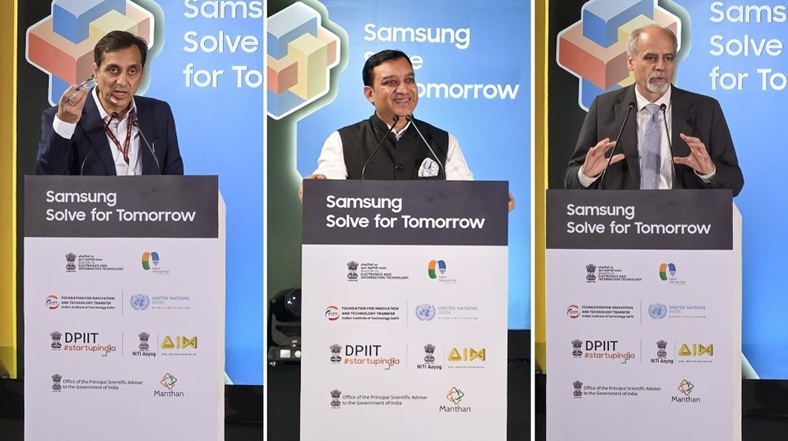
India – The Government, Innovation Leaders and the UN have lauded Samsung CSR’s focus to nurture young innovators, expanding access to innovation opportunities across India and helping transform ideas into solutions with real-world impact through Samsung Solve for Tomorrow.
Addressing Samsung leaders, industry experts, SFT mentors and participants at the Samsung Solve for Tomorrow 2026 Grand Finale in New Delhi, Sushil Pal, Joint Secretary at the Ministry of Electronics and Information Technology (MeitY), said innovation must be measured by its ability to improve people’s lives. He commended Samsung for creating a platform that gives young people the confidence to dream and the opportunity to develop products and build startups.
“It’s very heartening to see that Samsung is doing so much for society through their CSR initiatives. I thank Samsung for creating a platform which gives young minds the confidence to dream and the opportunity to build their product and to build their startup,” Pal said.
The fifth edition of Samsung’s flagship CSR programme, Samsung Solve for Tomorrow received more than 34,000 student applications, with 60 finalists reaching the Grand Finale. The programme encourages young people to apply science, technology, engineering and mathematics (STEM) to address challenges in their communities, supporting them as they develop and refine solutions with the potential to create meaningful change.
Pal noted that the rise of artificial intelligence had changed the nature of innovation, with technology increasingly shaping how people learn, work, manufacture and access services. He urged young innovators to focus not merely on developing advanced technologies but on addressing pressing human needs.
“The real measure of innovation does not lie in how complex the algorithm is. It lies in what difference it can make to a common person’s life,” he said.
He cited challenges such as helping farmers save water and power, bringing health diagnostics to underserved areas, improving access to quality education in remote villages and enabling scientific sports training. These, he said, were opportunities to contribute to nation-building.
Pal also called on industry to help people adapt to a changing world of work, emphasising that as AI automates some tasks and augments others, preparing people for evolving job roles would be as important as developing new technologies.
Connecting young innovators with global challenges
Stefan Priesner, United Nations Resident Coordinator in India, highlighted SFT’s role in bringing young people’s ideas into the broader effort to achieve the UN Sustainable Development Goals (SDGs). He noted that global progress towards these goals remained too slow and uneven, making youth participation and scalable solutions increasingly important.
“Samsung Solve for Tomorrow is a strong example of the United Nations system and the private sector working together to advance a youth-centred agenda, amplify young voices, and give promising ideas the support they need to grow,” Priesner said.
He emphasised that the private sector could contribute beyond corporate social responsibility by aligning business priorities with environmental sustainability and social inclusion, while helping innovative solutions reach a wider population. Governments, universities, businesses and the UN, he said, all had a role in helping promising ideas scale.
Priesner also encouraged the finalists to remain connected to the communities they hoped to serve, continuously testing and improving their ideas to ensure they could deliver meaningful impact.
Taking innovation beyond metros and creating job creators
Dr Nikhil Agarwal, Managing Director of the Foundation for Innovation and Technology Transfer (FITT) at IIT Delhi, highlighted Samsung’s CSR efforts to help bring innovation opportunities to a wider pool of young people.
“Samsung Solve for Tomorrow shows the commitment as they have gone to Tier 2 and Tier 3 towns and different states for building that momentum. SFT got double the number of applications this year and it shows,” Agarwal said.
The programme’s outreach included more than 180 sessions across over 130 cities, helping engage students from diverse geographies and backgrounds. The growth in participation, Agarwal noted, reflected the momentum built by taking the initiative beyond major urban centres.
He also underscored the importance of translating student-led innovation into entrepreneurship, encouraging participants to build ventures that could create opportunities for others.
“You should become job creators, not job doers,” Agarwal told the students, expressing hope that future entrepreneurs would emerge from the programme and build companies that generate employment.
At the 2026 Grand Finale, four winning teams were selected to receive incubation grants totalling ₹2 crore from Samsung, along with mentorship and incubation support at FITT-IIT Delhi. SFT provides promising young innovators with mentorship and incubation support to help them develop their ideas further.
The speakers’ remarks underscored the value of platforms such as Samsung Solve for Tomorrow in bringing together government, industry, international institutions and academia to nurture young talent. By encouraging students to identify real-world problems, develop technology-led solutions and explore entrepreneurship, the programme seeks to help turn promising ideas into innovations that can make a difference at scale.
****
