


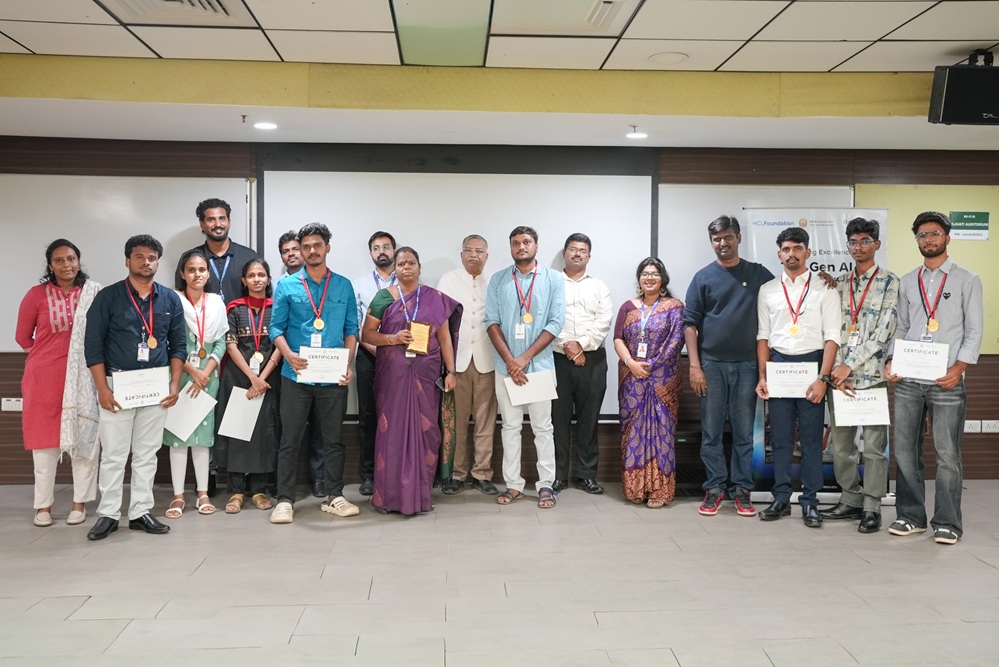
Chennai – As India’s demand for AI talent accelerates, equipping engineering graduates with industry-ready skills has become a national priority. Demonstrating how outcome-driven skilling can bridge this gap, HCL Foundation and HCL GUVI marked the successful completion of the HCL Foundation AI Program, an industry-aligned skilling initiative that trained 1,070 engineering students from six Government Engineering Colleges across Tamil Nadu in AI and Python programming.
The felicitation ceremony, held on July 17, 2026, at the Lilavati Auditorium, IIT Madras Research Park, Chennai, brought together students, faculty, government college representatives, and industry partners to celebrate the culmination of a 4-week programme built to close the gap between classroom learning and industry-ready AI capabilities.
Dr. Nidhi Pundhir, Director, HCL Foundation, said, “At HCL Foundation, we believe that equitable access to emerging technologies is essential for building an inclusive future workforce. This initiative reflects our commitment to enabling young talent with industry-relevant skills that improve employability and prepare them for the evolving digital economy.”
The initiative reflects HCL GUVI’s approach to designing outcome-oriented skilling programmes- combining customized curricula, instructor-led learning, hands-on implementation, assessments, and placement readiness into a single learning journey. By aligning training with emerging industry needs, the model focuses on measurable employability outcomes rather than participation alone.
Arun Prakash M, Founder & CEO, HCL GUVI, said, “The next generation of AI talent will be built through hands-on learning, not theory alone. This program allowed students to build, experiment, and solve real-world problems using AI. Together with HCL Foundation, we’re creating scalable skilling models that prepare young engineers for the evolving demands of industry.”
Delivered through a 60-hour hybrid learning model comprising 30 hours of instructor-led online learning and 30 hours of classroom-based practical training, the programme combined AI fundamentals, Python programming, practical assignments, assessments, mini projects, and technical interview preparation to equip students with both technical capability and job readiness.
Implemented across six Government Engineering Colleges in Trichy, Karaikudi, Vellore, Bodinayakkanur, Tirunelveli, and Salem, the initiative demonstrates how collaborative, industry-led learning models can prepare students for the future of work through accessible, practical, and outcome-driven education.
Apoorv Johari, Head – Enterprise Business, HCL GUVI, added, “The true success of any skilling initiative lies in measurable outcomes. From hands-on learning and project development to interview preparation and placement support, this program was designed to help students confidently transition from classrooms to careers in AI.”
Closing India’s AI skills gap will require more than expanding training volumes. It will also require clear and measurable pathways from learning to employment, particularly in government engineering colleges that serve as important gateways to opportunity.
Of the 1,070 students who completed the programme, more than 700 took the placement eligibility assessment. A majority of these students are now receiving placement support, including interview preparation and access to relevant employment opportunities.
As industries continue to seek AI-ready talent, skilling frameworks that combine industry-relevant curricula, practical learning and measurable employability outcomes will play an increasingly important role in preparing India’s next generation of engineers.
