


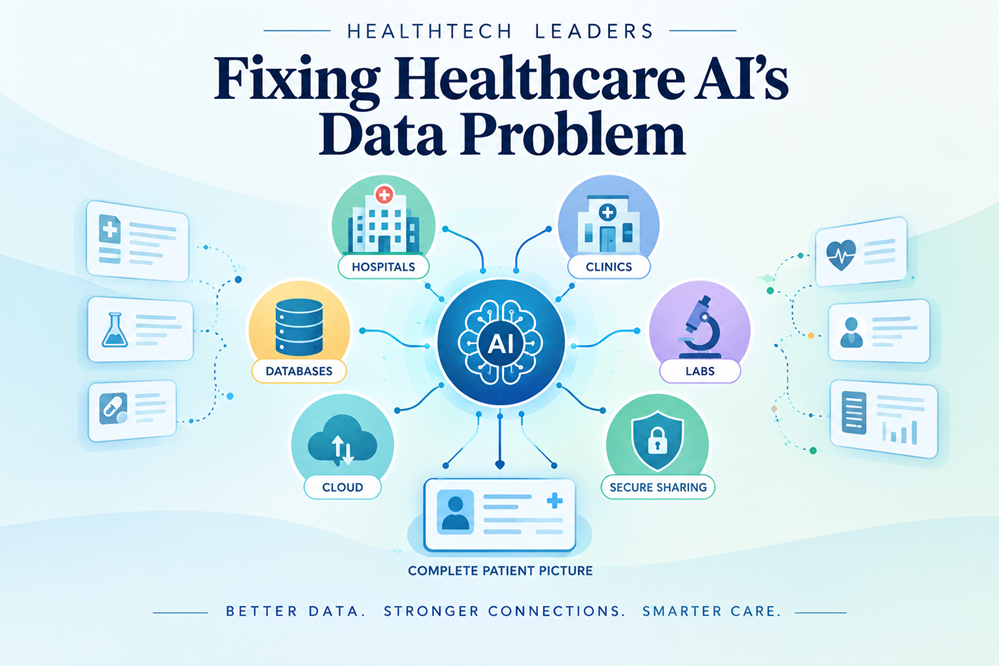
India : A person’s medical history is rarely stored in just one place. Instead, it is scattered across different clinic computers, lab systems, and hospital databases that do not talk to each other. This makes it hard for artificial intelligence (AI) tools to give accurate advice, because AI needs a complete picture of a patient’s health to work well. Better computer programs alone cannot fix this. Healthcare systems also need ways to safely share and connect this scattered information. Here are six leaders working to fix this problem.
They work in different areas, such as connecting systems, sharing patient records and using cloud storage. Ultimately, their efforts highlight that healthcare AI can only be as effective as the data fed into it. Standardizing and streamlining patient records so they are easily accessible remains essential for unlocking AI’s full potential in daily medical care.
1. Ayush Jain – Founder and CEO, Mindbowser
Ayush Jain, Founder and CEO of Mindbowser, works in the healthcare technology space, where system integration and interoperability are central to building connected digital health solutions.
Mindbowser develops healthcare integration solutions that connect electronic health records and third-party applications using standards such as Fast Healthcare Interoperability Resources (FHIR) and Health Level Seven (HL7). Its work includes interoperability APIs and tools designed to support data exchange between platforms such as Epic and other healthcare systems. These capabilities address a practical barrier to AI adoption: making clinical information available in consistent, usable formats across different applications. By focusing on the infrastructure connecting healthcare systems, Jain’s work aligns with the need to build more reliable foundations for AI-enabled healthcare.
2. John Halamka – President, Mayo Clinic Platform
John Halamka, President of Mayo Clinic Platform, has spent decades working at the intersection of medical informatics, healthcare technology and digital innovation.
Mayo Clinic Platform brings together healthcare providers, data partners and technology developers to support the development and validation of digital health solutions. Its data network enables partners to work with diverse clinical data through privacy-preserving approaches. This creates opportunities to develop and evaluate AI applications using clinical information while protecting patient privacy. Halamka’s work highlights an important dimension of the data challenge: healthcare organisations need not only connected systems, but also responsible ways to make clinical data useful for research and innovation.
3. Seema Verma – Executive Vice President, Oracle Health and Life Sciences
Seema Verma leads Oracle Health and Life Sciences, overseeing the company’s clinical and clinical-trial applications portfolio.
Her work includes advancing electronic health record technology and strengthening the relationship between clinical care and research. Better connections between these areas can help healthcare organisations use relevant clinical information to support research workflows, including identifying potentially eligible participants for clinical trials. As AI becomes more widely used in healthcare research and clinical applications, the ability to access and interpret information across these settings becomes increasingly important. Verma’s work illustrates how connected clinical and research environments can support more effective use of healthcare data.
4. Zach Silverzweig – Co-founder and CEO, CipherHealth
Zach Silverzweig leads CipherHealth, which develops technology for care coordination and patient engagement. Its platform supports workflows such as patient outreach, discharge follow-up, clinical rounding and escalation management. The company is also applying AI to help healthcare teams prioritise patient needs, identify risks and manage operational workflows.
This approach shows how AI can be embedded in the processes through which healthcare teams communicate and coordinate care. While system interoperability addresses the movement of data between platforms, effective care coordination helps ensure that relevant information translates into action.
5. Doug Dietzman – Executive Director, eHealth Exchange
Doug Dietzman leads eHealth Exchange, a nationwide US health information network focused on secure and interoperable electronic health information exchange. The network helps participating organisations share information across different healthcare environments. This is particularly relevant as AI applications increasingly depend on broader clinical context rather than information from a single provider or system. Health information exchange can help make relevant records available across care settings, although the usefulness of that information still depends on its quality, accessibility and appropriate use. Dietzman’s work represents the network-level infrastructure needed to support a more connected healthcare ecosystem.
6. Aashima Gupta – Global Director of Healthcare, Google Cloud
Aashima Gupta leads healthcare strategy and solutions at Google Cloud, working with healthcare organisations on the use of cloud technology and AI. Her work encompasses the broader challenge of translating technological capabilities into practical healthcare applications, from improving access to information to supporting AI-enabled workflows.
Cloud platforms can provide the computing and data infrastructure needed to develop and deploy these solutions, but they do not automatically resolve fragmentation. Effective implementation also requires interoperable systems, appropriate data governance and integration with existing healthcare workflows. Gupta’s work highlights the role infrastructure plays in helping healthcare organisations move from isolated AI pilots towards wider deployment.
****
