

India’s Electronics Exports Surge 44% to Nearly $32 Billion as HMD Rise and vivo WATCH GT 2 Debut Amid Black Friday Frenzy

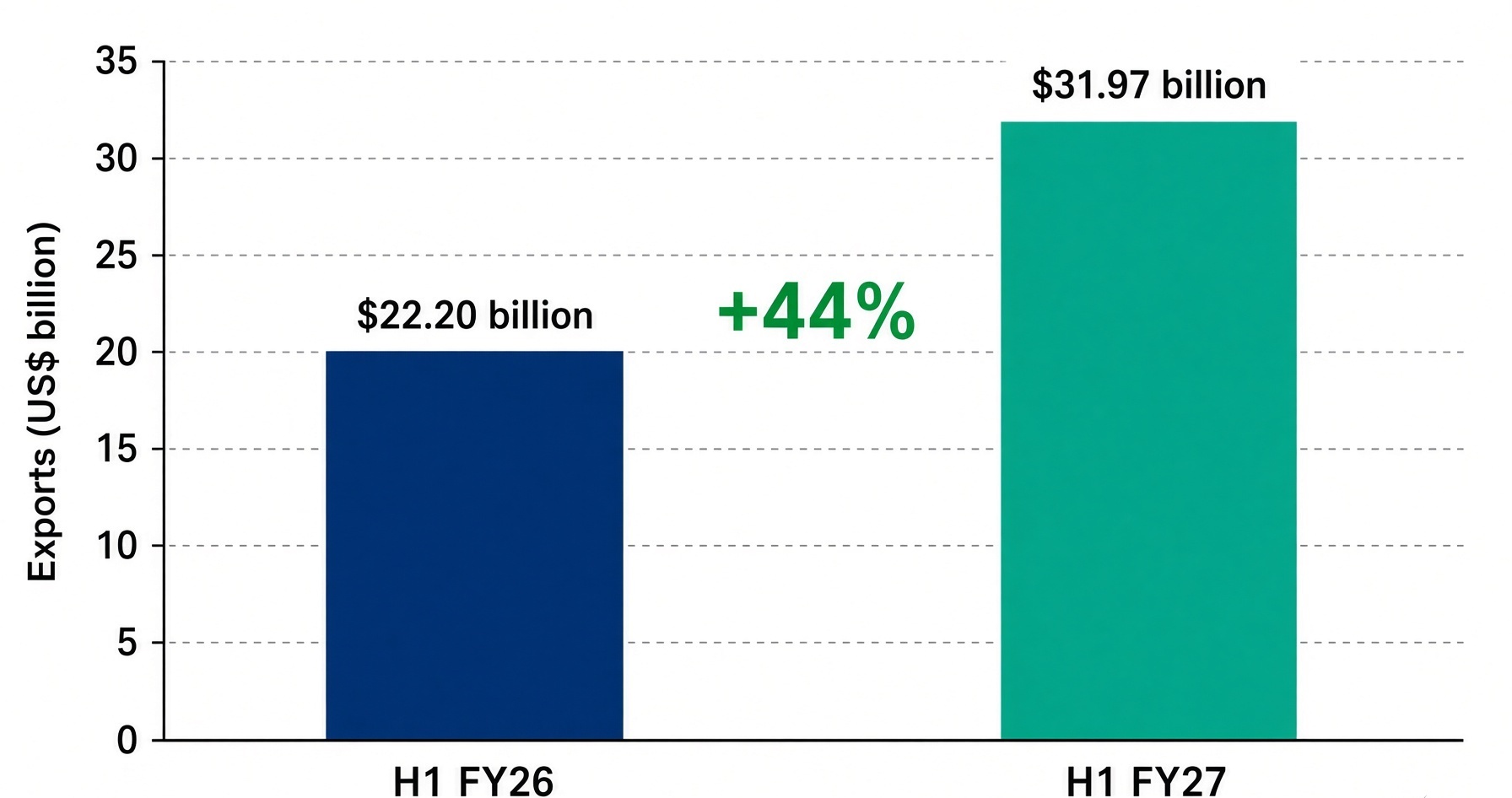
India’s electronics sector delivered a standout performance in the first half of the 2026-27 financial year, with exports climbing 44% year-on-year to $31.97 billion between April and September, according to Commerce Ministry data. The figure, up from $22.20 billion in the same period a year earlier, underscores the sector’s growing weight in the country’s merchandise trade basket, where it now ranks among the top categories.
Smartphones remain the largest single component, rising 35.8% to $18.17 billion. Yet their share of total electronics exports eased from 60.3% to 56.8% as other categories expanded faster. Non-smartphone electronics jumped 56.5% to $13.79 billion, lifting their share to 43.2%. The sharpest gains came in components and related products: mounted printed circuit boards surged more than thirty-fold in some lines, memory integrated circuits multiplied dramatically, solid-state storage devices recorded triple-digit percentage jumps, and network transmission equipment nearly doubled. Singapore and China emerged as key destinations for several of these high-growth items. Analysts see the numbers as evidence that India is gradually moving beyond pure smartphone assembly toward a broader electronics manufacturing footprint, even as the absolute trade deficit in the sector remains sizable because of higher-priced chip imports.
Against this export backdrop, the domestic market has been equally active. On 26 November 2026, HMD launched the Rise, an affordable 4G smartphone priced at a Day-1 special of ₹9,999 for the 4 GB RAM + 64 GB storage variant. Sales begin exclusively on Flipkart from 2 December. The handset features a 6.51-inch LCD display with a waterdrop notch, a Unisoc 9863A octa-core processor, a 13-megapixel rear camera paired with a 5-megapixel front camera, and a 5,000 mAh battery. It runs Android 16 Go Edition and ships with Indus AI by Sarvam, an on-device assistant that supports 22 Indian languages and stores data on Indian servers. Storage is expandable via microSD, a 3.5 mm headphone jack is present, and the phone is offered in Emerald Gold, Indigo Silver and Midnight colour options. HMD has promised two years of security updates. The device targets first-time smartphone buyers and value-conscious users in the sub-₹10,000 segment.
The same day, vivo entered India’s smartwatch market with the WATCH GT 2, priced at ₹14,999. Available in Obsidian Black and Stellar White, it goes on open sale from 3 December through vivo’s official channels, Flipkart, Amazon and retail partners, with pre-bookings already open. The watch carries a 2.07-inch AMOLED display (432 × 514 resolution, 60 Hz, up to 2,400 nits peak local brightness, 82.4% screen-to-body ratio), an aluminium frame, and BlueOS 3.0. It supports Bluetooth calling, five-system satellite positioning, NFC, more than 100 sports modes, and health tracking that includes heart rate, SpO2, stress, sleep and menstrual-cycle monitoring. vivo claims up to 25 days of battery life under light use, around 14 days under typical conditions, and roughly 12 days with always-on display enabled. Launch offers include no-cost EMI options and bundle discounts of ₹1,500 when purchased with selected vivo smartphones.
These launches coincide with the peak of India’s Black Friday sales period. Major retailers including Flipkart, Croma and Reliance Digital are running multi-day promotions through the end of November, with deep discounts on smartphones, laptops, televisions and accessories. Reported deals include the iPhone 16 at effective prices under ₹46,000, the iPhone 17 Pro Max under ₹97,000 at some chains, Samsung Galaxy models, Google Pixel handsets, and substantial cuts on laptops and large-screen TVs. Bank cashbacks, exchange bonuses and no-cost EMI further sweeten the offers. Gadgets Now has compiled detailed round-ups of the Flipkart and other retailer promotions, covering price cuts, bank offers and model-specific availability across the sale window.
Taken together, the export numbers and the fresh product introductions illustrate a dual track: India is shipping more electronics and a wider range of components abroad, while domestic consumers continue to see a steady stream of new devices, many of them timed for the season’s biggest shopping events. Whether the component-export momentum sustains through the rest of the financial year, and how aggressively brands price the latest handsets and wearables once the sale period ends, will shape the next phase of the sector’s growth.
