

India’s Long-Term Energy Security At Risk As Baryte Reserves Near Exhaustion, Says C-DEP Report

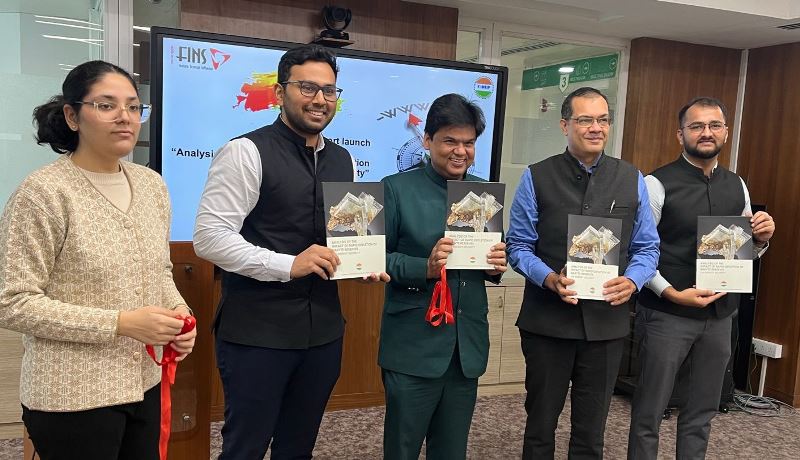
Hyderabad: The Centre for Domestic Economy Policy Research (C-DEP.in) released a landmark report today warning that India is on the verge of exhausting its only major baryte reserve, placing the country’s long-term energy security at risk. With domestic extraction continuing at high levels, India is now the only major economy in the world with less than 10 years of accessible baryte reserves left.
Baryte is an essential mineral for oil and gas drilling, with no viable substitutes for stabilising high-pressure wells during exploration. Without an assured domestic supply, India’s exploration programmes in the Andaman Basin and the Krishna–Godavari Basin will face immediate operational disruptions.
The report highlights that 95% of India’s baryte wealth is concentrated in the Mangampet mine in Andhra Pradesh, where proven reserves have declined from 49 million tonnes in 2015 to under 23 million tonnes in 2024, a 53% fall within a decade. This decline has been driven by unsustainable exports without parallel efforts to build a strategic reserve for India’s long-term energy and domestic requirements.
The report, titled “Analysis of the Impact of Rapid Depletion of Baryte Reserves on Energy Security,” was released at IIT Delhi by Shri Praveen Prakash IAS (retd.), former Managing Director of the Andhra Pradesh Mineral Development Corporation (APMDC), the state-owned PSU responsible for managing the Mangampet reserve.
“The depletion of the baryte reserve is not just a mineral issue; it is a national energy-security concern,” said Mr. Prakash. “With 90% of India’s crude oil demand met through imports, the ability to explore and extract domestic reserves is essential. Baryte determines whether India can drill safely and efficiently in the future. Conserving this resource must become a strategic priority.”
The report notes that the rapid fall in reserves is driven primarily by exports, mainly to the United States, which now accounts for a major share of APMDC’s output. APMDC has also raised nearly ₹10,000 crore in bonds backed by baryte revenues, creating fiscal dependence on continued extraction rather than conservation.
C-DEP analysis shows that India became the world’s largest exporter of baryte because China restricted exports in 2016 to conserve its own reserves. India now supplies nearly 44% of U.S. baryte imports despite holding far smaller reserves than major producers such as the United States, Iran, Kazakhstan and Turkey. “Oil-producing nations such as Russia, Iran and the United States are either restricting baryte exports or calibrating production to ensure several decades of reserves left,” said Dr. Jaijit Bhattacharya, President, C-DEP. “India must adopt a similar long-term approach to safeguard domestic exploration and avoid future strategic dependence.”
India has an estimated 22 billion barrels of oil equivalent yet to be explored across the Andaman, Krishna–Godavari and Mahanadi basins, C-DEP estimates that unlocking this potential would require over 600 million tonnes of baryte, far exceeding the reserves left at Mangampet.
Given these developments, the report calls for calibrated export restrictions, a fiscal transition plan for APMDC’s bond obligations, revision of export allocation policies and inclusion of baryte in the National Critical Minerals Mission (NCMM). The study contributes to India’s ongoing discussions on mineral security, strategic reserves and strengthening domestic capacity for future oil and gas exploration.
