

India’s next generation of digital thinkers compete for top honours at IIMB’s National Student Case Competition

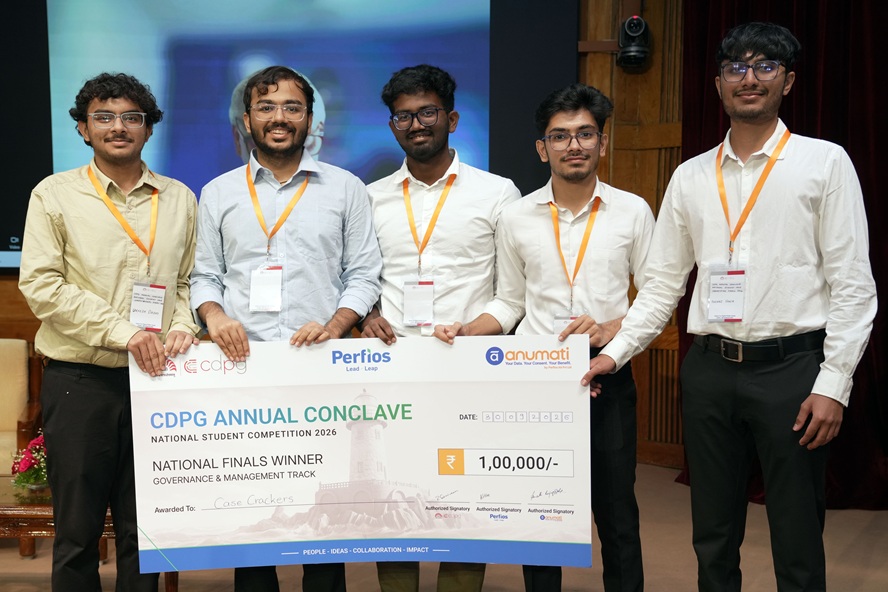
Bengaluru: Nine student teams from across India faced off in the National Finals of the National Student Case Competition 2026, hosted by the Center for Digital Public Goods (CDPG), IIM Bangalore, with the support of Perfios and Anumati Account Aggregator, on 30th September 2026. Bringing together students from engineering, technology, management, public policy and finance domains, the finals put the spotlight on how India’s Digital Public Infrastructure (DPI) can be designed, governed and built to create meaningful public value.
The jury for Stage II of the competition comprised Prof. Deepak Chandrashekar, faculty of the Strategy area at IIMB; Srikanth Rajagopalan, CEO, Anumati by Perfios AA; Sundar Natarajan, Head – Strategy, Communications & Institutional Relations, Digi Yatra Foundation; and Ashish Mittal, DigiGo.
Selected from a pool of 450 teams comprising 2,250 students, the finalists competed across three tracks – Technology & Design, Policy & Regulation, and Governance & Ecosystem, which drew 146, 127 and 177 submissions respectively. They presented their solutions at the CDPG Annual Conclave 2026, where the winners were announced.
The inaugural edition of the Case Competition concluded with three winning teams, one from each track, each receiving a cash prize of ₹1 lakh.
– Team Champagne-Papi from IIM Bangalore’s PGP programme won in the Technology & Design track with SAHAY, a conversational financial wellness service that uses WhatsApp to help households anticipate and prepare for major expenses over the coming three months.
– Team Pungibunch from IIM Bangalore’s BBA (DBE) programme won in the Policy & Regulation track with Anumati, which combines consented financial data with a structured approach to identifying risks and prioritizing financial guidance.
– Team Case Crackers from Dhirubhai Ambani University won in the Governance & Ecosystem track with Sambhal, a consent-first financial timing service built on India’s Account Aggregator infrastructure, designed to help households make more timely financial decisions.
Team Nexus from IIT Jodhpur, who were part of the Technology & Design track, received a special prize of ₹50,000 as part of a Jury’s Choice Award for their solution Paarivar CFO.
The finalists included two teams from Thapar Institute of Engineering and Technology and one from Dhirubhai Ambani University in the Governance & Ecosystem track; IIM Bangalore’s BBA(DBE), Rajiv Gandhi Institute of Petroleum Technology and IIM Sambalpur in the Policy & Regulation track; and one team each from IIT Jodhpur, IIM Bangalore’s PGP and Nirma University in the Technology & Design track.
On the idea behind the inaugural edition of the case competition, Prof. R Srinivasan, Chairperson, CDPG and faculty of Strategy at IIMB, said: “With the first edition of the CDPG National Student Case Competition, we wanted to introduce students to the many dimensions of DPI and, in the process, build a deeper sense of curiosity and pride in what India has created. It was important to us that students encounter DPI not only as a technology story, but as a space where policy, governance, technology and design come together and perhaps see nation-building as a career in which they can play a role. That thinking lent itself to the three tracks of the competition. We thank our partners for helping us bring this vision to life and for encouraging structured thinking through the case study method.”
In Stage I of the challenge, teams examined the implications of extending Digi Yatra, a successful DPI, beyond its original context, considering questions of privacy, consent, purpose limitation, interoperability, governance, commercial use and public value. By placing Digi Yatra at the centre of the challenge, the exercise invited students to consider the institutional and regulatory safeguards needed when an established digital identity and authentication system is adapted for new applications.
As part of Stage II, the challenge evolved from analyzing a DPI problem to building and demonstrating a DPI-enabled solution. Teams were tasked with designing a customer-backward financial wellness service for an aspiring middle-class household, using the Perfios-Anumati sandbox and consented financial information to help households understand their financial position, identify a priority and take timely action.
The brief required teams to think simultaneously about the customer, technology, regulation and business viability. Solutions had to demonstrate a working prototype or service flow, use sandbox APIs and representative data, provide meaningful financial interventions, and address consent, privacy, data protection, accessibility and regulatory considerations. Teams were also expected to demonstrate a credible approach to scalability and business viability.
Trust and privacy emerged as recurring concerns even in the teams’ motivations for participating. Approximately 44% of teams referenced trust and 43% referenced privacy in describing what drew them to the competition. Consent, citizen interests, convenience, innovation, interoperability, security and ecosystem management were among the other themes highlighted by participants.
Highlights from the presentations
Team Catalyst from Nirma University, who were part of the Technology & Design track, created Nirnay, a decision engine that helps households identify and prioritize their most important financial decisions over a three-month horizon, through a bank-led distribution model.
Team Dominion from Thapar Institute of Engineering and Technology, who were part of the Governance & Ecosystem track, created Mirror, a consented household financial-reality layer using Account Aggregator data to analyze transactions, surface patterns and missed payments, and identify questions that may otherwise go unnoticed.
Team DIGI Ops from IIM Sambalpur, who were part of the Policy & Regulation track, developed Income Saathi, a financial management platform for gig workers. The service consolidates income from multiple platforms into a single financial ledger, helping workers anticipate expenses, build a safety fund and manage irregular earnings.
Across the finalist presentations, privacy, consent, trust and regulatory considerations emerged as substantive elements of solution design, informing the architecture, customer experience and proposed models of service delivery.
Insights from the jury
Prof. Deepak Chandrashekar, Strategy area, IIMB, said the scale of the competition made evaluating the first round of submissions a demanding exercise and described reaching the national finals as a significant achievement for the students. “What stood out to me was that we saw students from management institutes making it through in the Technology & Design track, and engineering students emerging in Policy & Regulation and Governance & Ecosystem. It was your curiosity about the problem that drove the work”. He added, saying, “At the final stage, what mattered was whether you had identified a compelling problem, built a credible business case around it, and developed a solution that created value. We also looked at how effectively you integrated APIs and brought different stakeholders together to strengthen that value proposition”.
Srikanth Rajagopalan, CEO, Anumati by Perfios AA, said, “Across the teams, what came through consistently was the amount of hard work and depth that went into the ideas and presentations. It takes a great deal of rigour to build a proposition and then tell that story convincingly. I hope this room produces at least three startups. You now know how to build a product and how to get started, whether by integrating APIs through increasingly accessible tools or using AI to accelerate development. The cost of failure has, in many ways, come down drastically, and that creates a real opportunity to take these ideas beyond the competition”.
On Digi Yatra’s involvement during Phase I of the challenge, Sundar Natarajan, Head – Strategy, Communications and Institutional Relations, Digi Yatra Foundation, said, “As DPI continues to evolve, technology, trust, responsibility and purpose must remain central to how we design and build digital ecosystems. Digi Yatra’s experience in enabling seamless airport access offers a valuable context for exploring these questions, particularly as conversations around digital identity and its potential applications evolve. Our engagement with IIM Bangalore’s CDPG Annual Conclave provides an opportunity to encourage an informed dialogue on the possibilities and considerations involved in building trusted digital ecosystems”.
Ashish Mittal, DigiGo, commended the teams for the depth of their preparation and the thought behind their propositions. He also noted that more teams should also consider B2B customers as a route to market, given the opportunities for DPI-enabled solutions in this space.
Testing ideas against the real-world constraints of DPI
The judging framework was designed to test how effectively teams could translate ambitious and enterprising ideas into responsible and viable solutions. Teams were assessed on their use of DPI/Account Aggregator data and APIs, the strength of the customer problem and value proposition, the quality of financial interventions, trust/privacy and regulatory design, business and economic viability, as well as technical feasibility, scalability and the quality of their demonstration.
Delivering on these parameters required finalists to consider not only what a financial wellness service could do, but also how it would work responsibly in the real world, including how data would be accessed and consented to, why particular data was necessary, how customers could understand recommendations, and how they could exercise control through mechanisms such as revocation and correction.
The challenge also required teams to confront questions of accessibility and exclusion, distinguish financial education and guidance from regulated advice, and consider commercial incentives and potential conflicts of interest.
Celebrating the ideas behind India’s digital future
With the national finals coming to an end and the announcement of the winners, the inaugural National Student Case Challenge brought together the next generation of technologists, managers, policymakers and designers to examine one of the defining questions of India’s digital transformation: how can digital public infrastructure evolve in ways that are technologically sound, economically viable, trusted by citizens and responsive to public value?
