


New Delhi: Celebrating one year of a major research partnership between India and the European Union (EU), the four-year CryoSCOPE project, coordinated by the Finnish Meteorological Institute (FMI), Finland, and funded by the European Union, the Ministry of Earth Sciences (MoES), and State Secretariat for Education, Research and Innovation (SERI), has achieved significant milestones in its first year. With a total budget of approximately €10 million, CryoSCOPE brings together 20 partner institutions from 9 countries to advance scientific understanding of cryospheric processes and their impacts on climate and water systems.
CryoSCOPE focuses on the interactions between ice, snow, air and water across some of the world’s most climate-sensitive regions. The Indian Himalayas have been established as one of the project’s supersites, underscoring their critical importance for climate and environmental research. Recent disasters such as the 2023 glacial lake outburst flood in Sikkim and the 2021 Chamoli flood in Uttarakhand have demonstrated how rapidly melting glaciers and unstable high-mountain environments can trigger devastating downstream impacts. The project highlights the urgent need for enhanced, integrated cryosphere data to support climate forecasting, disaster risk reduction, and long-term water security planning.
Using novel technology, the project’s collaborative science combines field observations, satellite remote sensing, advanced climate and Earth System Models, and machine learning analytics to decode the complex interactions between cryosphere, atmosphere and hydrosphere systems, the essential drivers of regional climate and water cycles.
Progress and New Observations in the Himalayas
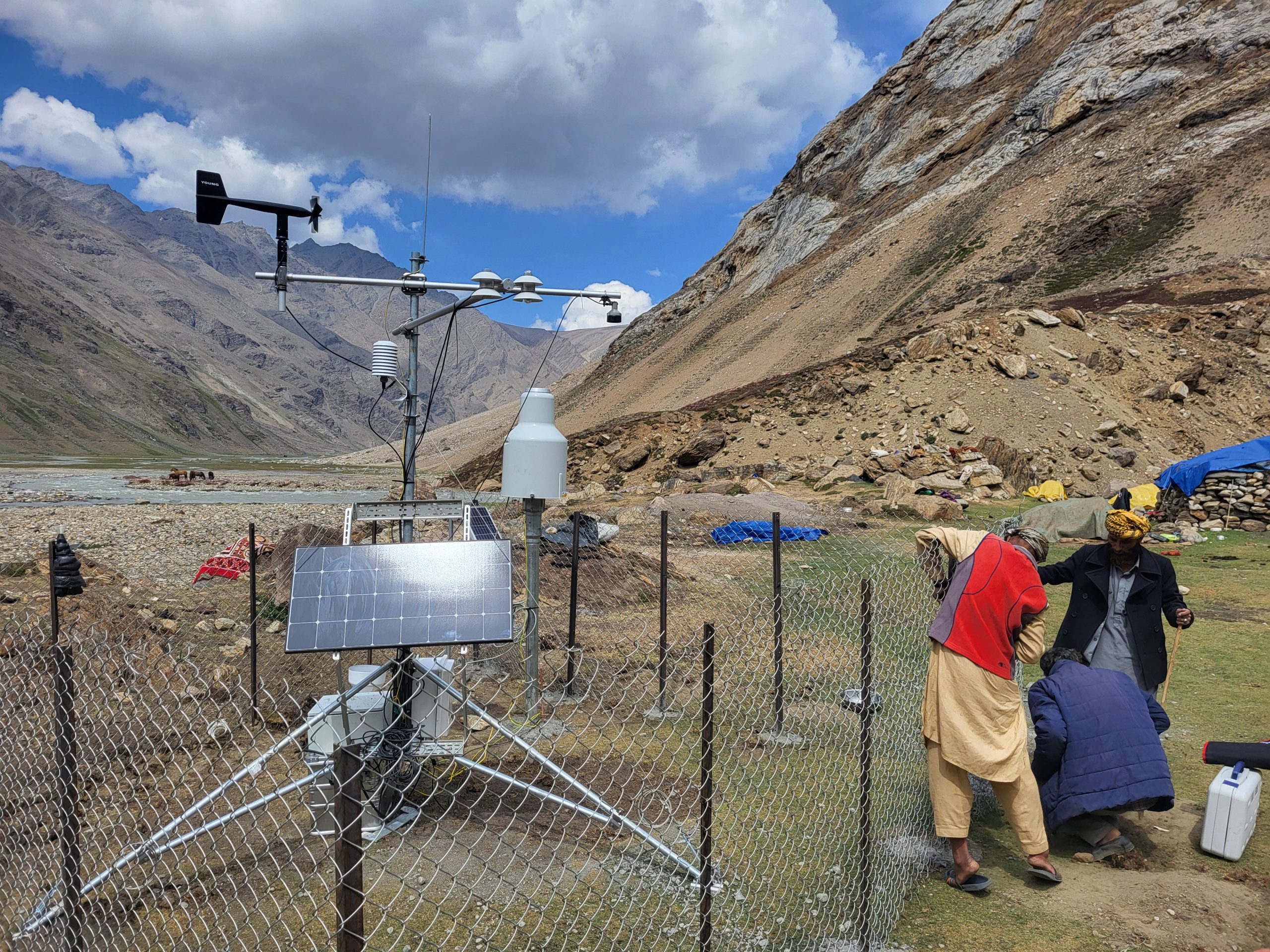
In its first year, CryoSCOPE scientists installed a high-altitude supersite in the Chalong catchment (above 3,300 metres), featuring two automatic weather stations equipped with full radiation and snow albedo sensors, three snow pluviometers, glacier lake and river discharge sensors, isotope sampling of all different hydrological fluxes, and two high-altitude time-lapse camera systems. The cameras record snow depth at hourly intervals, enabling precise tracking of seasonal and daily variations in meteorology, snow cover and meltwater dynamics. The project will also examine the influence of air pollution, local wind systems and shifting precipitation patterns on glacier melt in the Himalayas.
“These measurements allow us to directly constrain how atmospheric-land processes interact in high-mountain environments. By capturing measurements at different elevations and at high temporal resolution, we can improve the process models that simulate these coupled systems within the regional climate. This is essential for translating climate signals into credible projections of regional water availability, cryosphere change, and hazard impacts downstream”
-Chandan Sarangi, Associate Professor, IIT-Madras and the Principal Investigator of the CryoSCOPE Indian Consortium.
These new observations are fundamental to understanding seasonal and daily variability in cryospheric processes and how they translate into water availability and hazard potential downstream, strengthening the region’s scientific readiness for changing climate conditions. Improved datasets will also feed into refined Earth System Models that currently under-represent high-altitude cryospheric processes.
Climate Signals and Cryosphere Risks
Rapid shifts in Himalayan climate patterns, including changes in Western Disturbances, are altering precipitation timing and intensity, with implications for snowfall, runoff and landslide risk across the region. Other climate assessments warn that shrinking snow and ice cover in the Hindu Kush–Himalayan region poses growing threats to water supplies for agriculture, hydropower and communities that depend on glacier-fed rivers.
Such trends underscore why CryoSCOPE’s integrated data strategy matters: without robust, high-altitude cryosphere–atmosphere–hydrology measurements, climate and water resource projections remain highly uncertain, limiting effective policy responses to climate variability and extreme events.
Strengthening India–EU Scientific Cooperation
CryoSCOPE represents one of the most ambitious EU–India collaborations in climate science, combining resources and expertise from both regions. Indian field teams work closely with European partners to standardise sensor networks, share analytical tools, and co-develop open datasets that can benefit regional scientists, decision-makers and climate services.
As CryoSCOPE enters its second year, the project will focus on building and analysing a growing body of field data from the Himalayas. These observations are critical for improving how snow, ice, atmosphere and water processes are represented in climate and hydrological models, many of which currently rely on limited high-altitude measurements. The project reflects sustained India–EU scientific cooperation to generate reliable data for one of the world’s most climate-sensitive regions.
