

Industry Leaders Spotlight AI, Policy Innovation, and Road User Charging at Global Mobility Forum

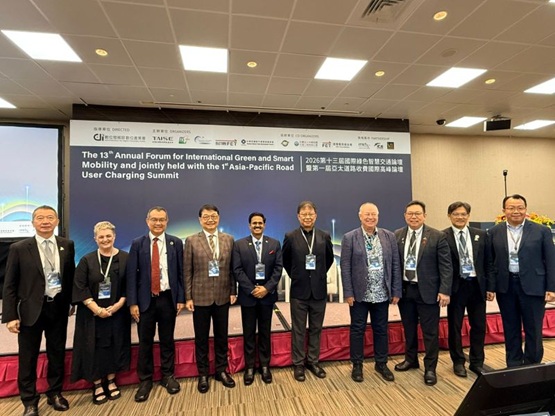
New Delhi : At the 13th Annual Forum for International Green and Smart Mobility, held alongside the 1st Asia-Pacific Road User Charging Summit, held in Taipei , Taiwan global mobility experts convened to address some of the most pressing structural challenges facing the transport sector today.
Mr Akhilesh Srivastva President , India chapter of the International Road Federation ( IRF) attended the summit as a key participant contributed to two high-impact panel discussions focused on the evolving intersection of technology, sustainability, and policy design in modern mobility systems.
Driving the Conversation: Two Critical Themes
The panels explored From Carbon Benefits to Policy Execution: Translating AI-driven carbon savings into effective Road User Charging (RUC) pilot designs and scalable future systems Why RUC, Why Now: Understanding shared pressure points across the Asia-Pacific region
With transport contributing approximately 24% of global CO₂ emissions—and road transport accounting for more than 75% of that share—the urgency for systemic transformation is clear. Simultaneously, governments are grappling with declining fuel tax revenues, projected to drop by 20–40% due to electric vehicle adoption and improved fuel efficiency.
APAC at a Turning Point
Across the Asia-Pacific region, rapid urbanization, rising vehicle ownership, and congestion costs—estimated at 3–5% of GDP—are intensifying pressure on infrastructure and policy frameworks. These trends, combined with ambitious climate targets, underscore the need for integrated, system-level solutions.
A major takeaway from the discussions was that technology is no longer the limiting factor. AI-powered mobility systems are already demonstrating 10–25% reductions in emissions, alongside measurable gains in efficiency and safety. The critical challenge now lies in embedding these capabilities into policy, pricing strategies, and scalable frameworks such as RUC.
India’s Opportunity: Scale, Digital Infrastructure, and Innovation
” India stands at a unique intersection of scale and opportunity. With over 330 million vehicles, a 6.3 million km road network, and logistics costs accounting for 11–13% of GDP, improving transport efficiency is both an economic and environmental imperative.’ said Mr akhilesh Srivastva president , india chapter of International road Federation while speaking at the summit
The country’s robust digital ecosystem provides a strong foundation for transformation FASTag has enabled near-universal electronic tolling at scale. Digital Public Infrastructure such as Aadhaar and UPI has demonstrated rapid, population-scale adoption. Growing use of AI-driven traffic systems and data-led safety frameworks like Safe Driving Score (SDS)
These advancements position India to leapfrog toward intelligent, data-driven, and carbon-aware mobility systems.
The Road Ahead: From Tolling to Intelligent Mobility
Experts highlighted that the next phase of mobility transformation in India could include Transitioning from static tolling to dynamic, usage-based pricing. Integrating behavioral insights, emissions data, and incentive mechanisms into transport systems. Bridging advanced technology platforms with policy and governance frameworks
Road User Charging is increasingly being recognized not just as a revenue tool, but as a comprehensive framework to manage demand, improve sustainability, and shape the future of mobility governance.
A Defining Moment for Mobility
As global and regional stakeholders align on the path forward, the consensus is clear: the future of mobility will be defined not by how far we travel, but by how efficiently, sustainably, and intelligently we move.
The forum provided a valuable platform to exchange insights, collaborate with international experts, and advance the dialogue on next-generation mobility systems.
