


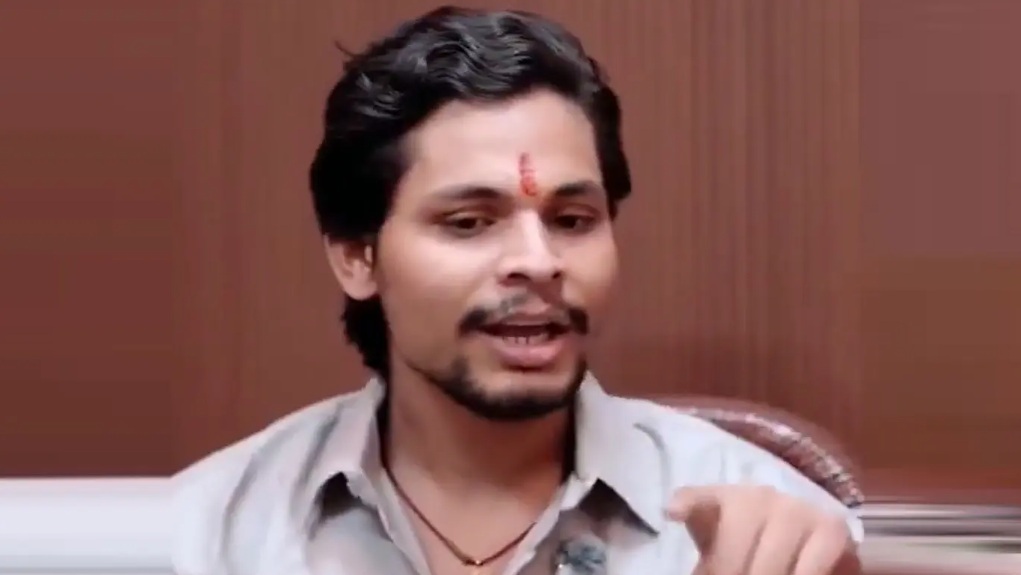
When a man can narrate violence on camera and the system still looks unhurried, the republic is not merely embarrassed — it is being tested.
There are moments when a society reveals its true temperature. Not through a court verdict, which must still come, but through the gap between a brazen public claim and the state’s apparent calm. The controversy around self-styled Hindutva activist and social-media influencer Swatantra Bhardwaj is one such moment. In a viral podcast, he appears to describe assaulting the father of a student protester at Delhi’s Jantar Mantar, to speak of grave injury, and to suggest that political proximity can soften consequences. Those are his words, not a court’s findings. They convict no minister, no party, and no organisation by association. But they do something almost as damaging: they advertise a culture in which violence can be performed as ideology and then discussed as achievement.
That is the scandal beneath the scandal.
What must remain legally careful
Bhardwaj’s references to leaders and political ecosystems — including boasts of closeness to figures associated with the BJP–RSS milieu and names such as Chirag Paswan — are self-assertions until independently proved. No responsible article should treat name-dropping as proof of patronage, instruction, or cover. Delhi Police have registered a case, contested exaggerated medical claims circulating online, and stated that process is under way. Guilt belongs in trial. Impunity, however, is judged in public trust — and public trust is already fraying.
The harder question
Why does urgency so often arrive after virality? When a victim’s family must fight for attention while an alleged aggressor finds a microphone, institutions look less like guardians of law and more like spectators to spectacle. This need not mean a grand conspiracy. It can mean drift, weak communication, political nervousness, or selective seriousness. The effect is the same: citizens conclude that justice has a volume knob — turned up only when outrage trends.
Calling “the agencies and the administration” the sole villains is too crude. Police work under evidence, procedure, and courts. Yet administration is not absolved by technicalities. A state that explains itself late, acts visibly only under pressure, and allows bravado to set the narrative becomes, in the public mind, an accomplice to cynicism. Silence is not neutrality when violence has already been aestheticised on camera.
The warning the public needs
The sharpest danger is not one influencer. It is the applause he counts on. Too many citizens defend alleged brutality because the accused “stands for our faith,” “talks our politics,” or “knows our leaders.” That is not devotion. It is moral surrender. Hindutva, like any political-religious language, can be debated in a free country. What cannot be sanctified is the fist. Religion that needs a cracked skull to feel strong is not faith; it is insecurity with a flag.
So the caution is blunt. Do not confuse loud loyalty with righteousness. Do not mistake claimed proximity to power for virtue. Do not demand mercy for “our” accused and maximum punishment for “theirs.” Every time the public romanticises goon politics in sacred packaging, it teaches the next claimant that cruelty is currency.
Leaders and organisations named in such monologues owe the country something simpler than outrage theatre: clear distance from violence, and an unambiguous line that no cadre, no influencer, and no “own man” stands above the law.
A democracy does not collapse only when courts fail. It weakens when citizens cheer the strongman, institutions hesitate until the clip explodes, and conscience is outsourced to identity. The Bhardwaj episode — whatever a court finally holds — is already a warning. If boastful violence can trend faster than accountability, the real injury is not only to one family. It is to the idea that law still outranks mob, microphone, and myth.
