


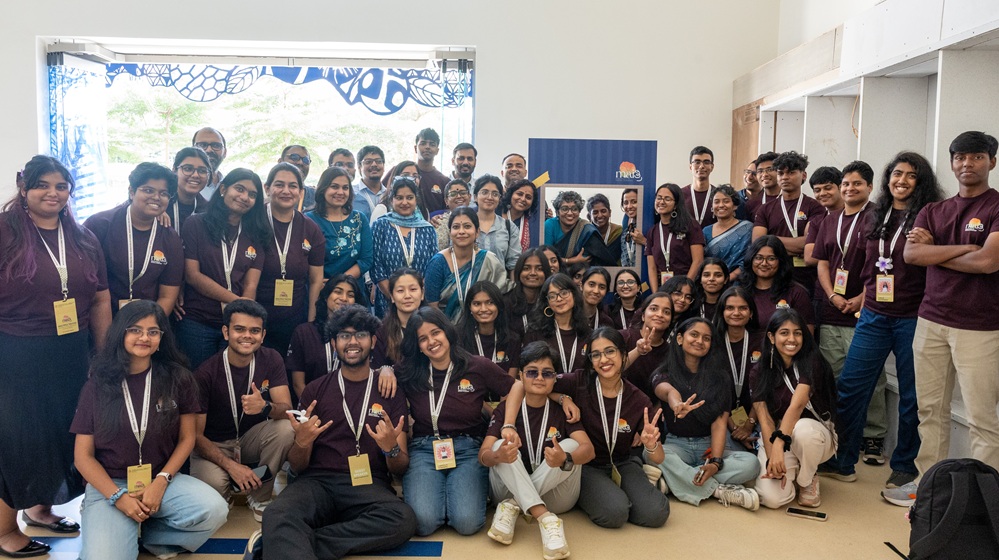
Bengaluru: Manipal Institute of Liberal Arts, Humanities and Social Sciences (MILHS), a constituent unit of Manipal Academy of Higher Education (MAHE), hosted the second edition of Maitri – Dialogues in Social Sciences at the MAHE Bengaluru campus. Centred on the theme “Multiple Truths: Narratives of Power, Resistance and Reconciliation,” the two-day festival examined how power, media and lived experiences shape societal understanding and representation.
The festival was inaugurated by noted sociologist Prof. Satish Deshpande, Dr. Shilpa Kalyan, In-charge Director of MILHS, and Dr. Swathi Shivanand, Head of Social Sciences. It brought together sociologists, filmmakers, scholars, educators, artists, media practitioners and students. Through conversations spanning sociology, cinema, theatre and media, participants explored questions of truth, representation, power and whose perspectives dominate public discourse.
In his keynote address, Prof. Deshpande reflected on the challenges facing the social sciences amid growing scepticism about the relationship between knowledge, facts and belief. “Social science disciplines are facing the most difficult moment in the world, and the very idea of social sciences is being challenged,” he said. He highlighted society’s preference for information that reinforces existing beliefs and urged students to practise ethical scepticism and critically engage with public narratives. Deshpande also cautioned against equating intellectual excellence with social elitism, noting that “the younger generation are part of the solution rather than the problem.”
A highlight of the second day was a conversation between filmmaker and writer Paromita Vohra and Hansa Thapliyal on documentary filmmaking, gender, regional representation and alternative storytelling. Vohra described documentary work as a means of engaging with justice and representing diverse lived experiences. She stressed the need to move beyond dominant narratives and recognise how gender relations and social realities vary across regions. “Filmmaking is like learning languages and understanding the language of the film,” she said, adding that regional music, humour and animation can challenge hierarchies and offer new ways of interpreting history.
Speaking at the inauguration, Dr. Shilpa Kalyan remarked, “Understanding society requires us to question not only what is visible in public discourse, but also what remains unseen. Maitri encourages students to engage with multiple perspectives through informed dialogue.”
The festival also featured a contemporary adaptation of Macbeth titled The Big M of Madness by Just Theatre, along with workshops on climate education, digital culture, countermapping, urban representation and visual storytelling. Discussions on critical media literacy, intersectionality and fact-checking examined how information is produced, circulated and interpreted, prompting students to consider whose voices dominate and whose experiences remain unseen.
By linking Prof. Deshpande’s reflections on “alternative facts” with Vohra’s insights on representation and lived experience, Maitri 2.0 underscored the continuing relevance of the social sciences in navigating today’s complex information landscape.
