


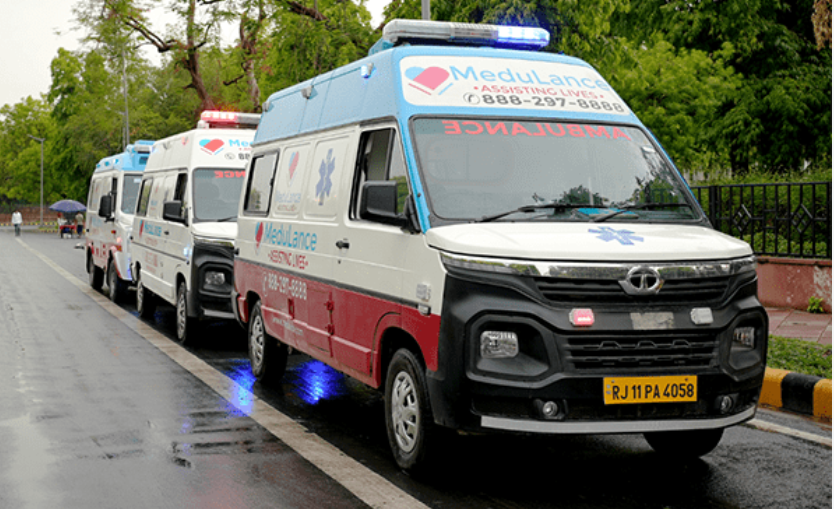
The emergency healthcare platform will deploy the fresh capital towards expanding its national footprint, strengthening its technology stack and scaling 5G-enabled smart ambulances and real-time clinical capabilities.
Medulance, a technology-enabled emergency healthcare and pre-hospital response company, has raised ₹24 crore in its Series A-2 funding round from Auxano, Alkemi, Equentis, and other angel investors.
The company will deploy the fresh capital towards expanding its emergency response infrastructure across India, strengthening its enterprise and hospital businesses, and further investing in its proprietary technology platform and connected ambulance capabilities.
Founded in 2017, Medulance has evolved from an ambulance aggregation platform into an integrated emergency response company serving enterprises, hospitals, governments and individual consumers. The company today combines on-ground emergency medical infrastructure with technology-led dispatch, fleet management, command centre operations and real-time clinical connectivity. Medulance currently operates through a network of 15,000+ ambulances across 500+ cities, covering more than 8 million lives and handling approximately 5,000 calls per day across its emergency response ecosystem.
India has made significant progress in expanding healthcare infrastructure, but the emergency response layer connecting a patient to the healthcare system remains fragmented. The next phase of development requires emergency care to move beyond ambulance availability towards an integrated ecosystem comprising trained medical response, technology-enabled dispatch, real-time clinical visibility and stronger coordination with hospitals. Medulance believes that emergency response should operate as a connected extension of the healthcare system, ensuring that the right infrastructure, medical support and information come together when help matters the most.

Pranav Bajaj, Co-founder and CEO, Medulance, said, “Emergency healthcare is ultimately about ensuring that help is available when it matters the most. Over the last few years, we have built the network, institutional relationships and operating capabilities required to deliver emergency response at scale. The opportunity ahead is to make this infrastructure more connected, more reliable and increasingly technology-led. Along the way, we have also learnt from what we could have done better, reinforcing our focus on building a high-value, profitable business. Medulance has come a long way, but in terms of what it can become, we are still only 1% done.”
Brijesh Damodaran, Managing Partner, Auxano Capital said, “Medulance has demonstrated that emergency healthcare can be built as a scalable, technology-led business while addressing a critical infrastructure gap. The company has built meaningful network density and institutional relationships, and is now at a stage where technology and scale can further strengthen the model. We see significant potential for Medulance to become a key infrastructure layer connecting patients, ambulances, emergency teams and hospitals.”
The company has also been investing in connected emergency response infrastructure. It developed India’s first 5G-enabled smart ambulances designed to transmit real-time telemetry to hospital dashboards, support CCTV-enabled visual triage and enable live clinical oversight. These capabilities are intended to help hospitals and medical teams gain visibility into a patient’s condition even before the ambulance reaches the hospital.
Medulance operates with a sub-11-minute average response time and 95% fleet uptime, while serving more than 110 corporate and hospital clients. Its recurring, technology-led enterprise and hospital models are designed to strengthen institutional engagement while enabling the company to scale its emergency response infrastructure.
The company has now raised $5 million across two funding rounds. With the latest round, the company plans to expand its presence across existing markets, enter additional cities and further strengthen its technology-led emergency healthcare infrastructure.
