


By Nanditha S
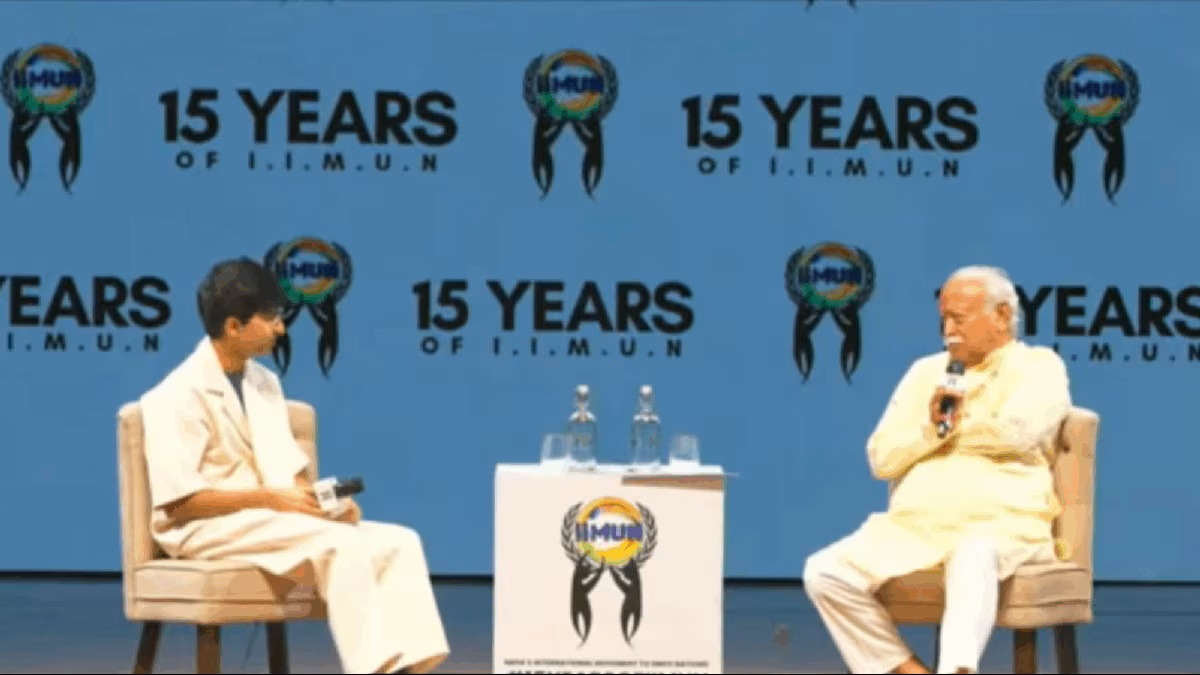
On 6 August 2026, RSS Sarsanghchalak Mohan Bhagwat interacted with nearly 2,000 students aged 15 to 19 at the Nita Mukesh Ambani Cultural Centre in Mumbai. The occasion marked the 15th anniversary championship conference of India’s International Movement to Unite Nations (IIMUN). Coming weeks after student-led protests over alleged NEET paper leaks forced Union Education Minister Dharmendra Pradhan’s resignation, the event was widely seen as the Sangh’s most significant outreach to Gen Z and Gen Alpha in years.
Bhagwat’s remarks struck a conciliatory note. Protest, he said, is a legitimate form of dialogue in a democracy—meant for system correction and consensus, not division. Gen Z’s grievances are genuine. The protesters are not anti-national; they are “our own people,” the next generation. This cohort, he added, is more honest than the previous one and carries a stronger sense of patriotism and service. He called for logical answers, affection and mutual respect rather than commands. He backed the long-pending demand for 6 per cent of the budget for education and opposed blanket social-media bans.
RSS Philosophy in Brief
The Rashtriya Swayamsevak Sangh, founded in 1925 by Dr K.B. Hedgewar, is built on cultural nationalism. Its core project is the organisation of Hindu society for national regeneration. Drawing from V.D. Savarkar’s concept of Hindutva, it defines the nation in civilisational terms: India as a Hindu Rashtra whose cultural essence is Hindu. Citizenship may be open, but the primary claim on the land belongs to those who regard it as both fatherland and holy land.
Daily shakhas remain the method: physical training, ideological instruction and character-building (vyakti nirman). Discipline, hierarchical loyalty and collective identity take precedence over individual assertion. M.S. Golwalkar later sharpened the framework, emphasising cultural assimilation of minorities into the Hindu mainstream and identifying internal threats that needed to be managed. Under Mohan Bhagwat the public language has softened. He presents “Hindu” more as a cultural-civilisational identity than a purely religious one, insists that society must change first so that systems follow, and repeats three unchanging articles of faith: individual formation, societal transformation, and the reality of Hindustan as Hindu Rashtra. Everything else, he has said, can evolve.
Platform Versus Practice
Bhagwat’s insistence that protesting students are not anti-national and that protest itself is dialogue sits uneasily with both the organisation’s foundational emphasis on disciplined unity and the everyday behaviour of the wider Sangh Parivar. The shakha model prizes organisational cohesion and hierarchical obedience. Sustained, open-ended questioning of authority—especially on issues that touch core Hindutva concerns—has historically been treated with suspicion. In the political ecosystem the Sangh ideologically nourishes, critics of government policy, minority rights or examination integrity have frequently been branded anti-national, urban Naxals or foreign-funded. The soft language of August 2026 therefore functions more as tactical adaptation after a visible youth backlash than as a rewriting of organisational DNA.
The same gap appears on women. Official rhetoric speaks of complementary roles, equal opportunity and the parallel work of the Rashtriya Sevika Samiti. Bhagwat has repeatedly rejected the charge that the Sangh is anti-woman. Yet within days of the student protests, T.G. Mohandas—a Kerala commentator long associated with the RSS and formerly convenor of the BJP’s intellectual cell—released videos in which he said that if he were in charge he would impose a curfew around Jantar Mantar, order the crowd to disperse three times and then open fire. Some would die, some would be injured; the situation would calm within hours. In another video he claimed mass rapes would follow if police withdrew, and that women among the protesters—especially those he labelled leftist, secular or democratic—“like rape” and would not complain.
RSS functionaries in Kerala quickly stated that Mohandas held no official post and that his views were personal and condemnable. Distancing occurred. It does not erase the ease with which such language still surfaces from figures long treated as part of the broader ideological family, nor does it close the distance between top-level statements on women’s dignity and the ground-level discourse that continues to circulate.
The same week, BJP MP Kangana Ranaut described Gen Z protest videos as “puke-inducing,” asked who was birthing and raising them, and labelled a section of young Hindu women the “generation gutter”—ugly, corrupt, living off parents while flaunting drugs, drinks and “endless body counts.” This was not policy disagreement. It was personal degradation of the very demographic Bhagwat was addressing.
How Reliable Is the Talk?
Measured against the Sangh’s own philosophy, Bhagwat’s Mumbai statements are selectively reliable. The emphasis on character formation, national pride and the need to listen to the next generation is consistent with the organisation’s long-term project of winning hearts. The language of dialogue and “our own people” is a modern public face useful for an organisation that now operates in a competitive democratic space and must retain younger cadres.
The reliability weakens when the statements are tested against practice. Hierarchical discipline and cultural nationalism remain the operating system. Open protest is accepted in theory when it does not challenge the Sangh’s preferred narrative; it is frequently delegitimised when it does. Women’s empowerment is affirmed at the level of official speech and parallel organisational structure, yet the ecosystem still produces and, until forced, tolerates extreme misogynistic voices. The claim that Gen Z is more honest and deserves logical answers is true as observation; whether the Sangh is prepared to subject its own power structures and political allies to the same honest scrutiny is a different question.
Is the RSS attempting to put distance between itself and the more abrasive strains visible in sections of the BJP? The relationship has always been hierarchical in ideology and symbiotic in politics. Soft statements after a student-driven political setback look like recognition of cost, not a decision to sever ties with those who trade in polarisation or casual contempt for dissenters.
Credibility with Gen Z
An honest generation will notice the difference between a Sarsanghchalak calling protest a form of dialogue and the simultaneous circulation of videos fantasising about shooting the same protesters or sexualising them. It will notice empowerment asserted on stage while women who protest are verbally assaulted offline. It will notice “our own people” language coexisting with the routine stamping of sustained dissent as illegitimate.The Mumbai interaction was outreach. Core philosophy has not been abandoned; it has been packaged for a new audience. Young people who watched the NEET protests, the resignation that followed, and the subsequent flood of abusive commentary will judge not by one carefully framed conversation but by whether the Sangh and its political arm begin treating critical Gen Z voices as partners in dialogue rather than problems to be managed or demeaned. Until practice catches up with the platform, the soft words will remain exactly that—soft words.
