


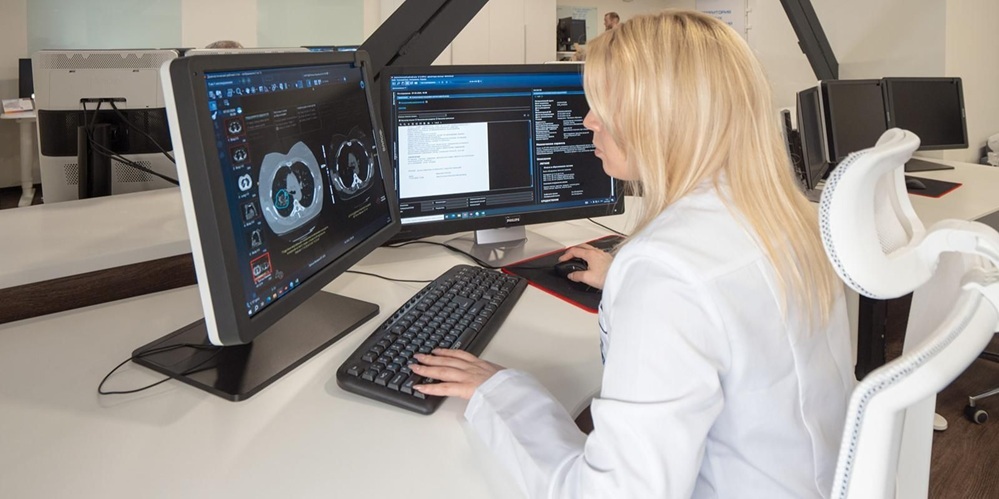
Scientists at the Center for Diagnostics and Telemedicine of the Moscow Healthcare Department have prepared and published two professional training manuals on the application of artificial intelligence in radiology. The first manual, “Application of Medical Devices Based on Artificial Intelligence (AI) Technologies in Radiology: Brain Computed Tomography, Chest Computed Tomography and X‑ray, Mammography,” provides guidance on AI-enabled devices across key imaging modalities. The second manual, “Simulator of a Radiologist’s Workstation with AI‑Powered Services,” offers a practical, simulated environment for interacting with AI tools.
Both manuals are intended for medical students, residents, practicing radiologists, medical informatics specialists, and healthcare managers. They focus on cultivating practical skills in the use of AI services for analysis, interpretation, and reporting of radiological studies, and on demonstrating how AI outputs are integrated into medical image processing workflows in principal areas of radiology.
“Artificial intelligence is rapidly becoming an integral component of radiology and a routine tool in the radiologist’s practice. It is essential that specialists not only understand the underlying principles of these technologies but also know how to apply them correctly. These practice‑oriented manuals enable clinicians to observe neural‑network outputs in a controlled learning environment and to develop competencies ranging from computer‑vision fundamentals to the clinical application of AI. This, in turn, improves diagnostic quality and accelerates clinical decision‑making,” said Yuri Vasilev, Medical Director of the Center for Diagnostics and Telemedicine of the Moscow Department of Healthcare and Chief Officer of Radiology at the Moscow Health Care Department.
Scientists based these manuals on findings from the Moscow experiment on the use of innovative computer vision technologies for medical image analysis and subsequent applicability in the healthcare system of Moscow, together with experience from clinical trials and real-world deployment of AI‑powered medical devices. The publications outline fundamental principles and models for applying AI in radiology and provide detailed recommendations for using algorithms to analyze brain and chest CT, X-rays, and mammograms. They also include practical case examples of computer-vision applications across multiple radiology subspecialties. The manuals place special emphasis on both correct and incorrect algorithm outputs, on methods for evaluating diagnostic accuracy and clinical effectiveness of AI solutions, and on their integration with the MosMedAI platform. Each manual also includes practical assignments and quizzes for self‑assessment to consolidate the learner’s skills.
“In recent years, Moscow has built substantial expertise in integrating computer visi on technologies into radiology – from foundational research to large-scale deployment in clinical practice. Today, AI are applied to real-world examinations and have become an integral part of radiologists’ daily workflows. This hands-on experience forms the bedrock of the manuals. The authors aimed not merely to describe the capabilities of artificial intelligence, but to present real-world use scenarios, including limitations and common challenges. This approach enables specialists to develop a comprehensive understanding of AI’s role in the diagnostic process,” said Anton Vladzimirsky, Deputy Director for Research at the Center for Diagnostics and Telemedicine of the Moscow Department of Health.
The textbook “Radiologist Workstation Simulator with Artificial Intelligence-Powered Services” has been recommended by the Coordinating Council for Education in the Field of “Healthcare and Medical Sciences” for use in educational institutions implementing residency programs in the specialty 31.08.09 “Radiology” (Protocol No. 094 dated November 20, 2025, Registration No. 3410 of the ECU dated November 20, 2025). The textbook “Application of Medical Devices Based on AI Technologies in Radiology” is recommended by the Coordinating Council for the Educational Field “Healthcare and Medical Sciences” (Protocol No. 095 of December 18, 2025, Registration No. 3481 of the Moscow University of Education of December 18, 2025).
In Moscow, artificial intelligence has already become a fully integrated part of the radiation diagnostics system and helps doctors analyze medical images on a daily basis. Today, the capital’s healthcare system uses more than 60 computer vision services across 45 clinical areas. These services have already processed over 30 million examinations. Neural networks help identify signs of lung cancer, stroke, coronary heart disease, osteoporosis, pneumonia, aortic aneurysms, and other pathologies on mammograms, CT scans, and MRIs.
The textbook “Radiologist Workstation Simulator with Artificial Intelligence‑Powered Services” has been recommended by the Coordinating Council for Education in the field “Healthcare and Medical Sciences” for use in residency programs in specialty 31.08.09 “Radiology” (Protocol No. 094, November 20, 2025; Registration No. 3410, ECU, November 20, 2025). The textbook “Application of Medical Devices Based on Artificial Intelligence (AI) Technologies in Radiation Diagnostics” has also received the Coordinating Council’s recommendation (Protocol No. 095, December 18, 2025; Registration No. 3481, Moscow University of Education, December 18, 2025).
In Moscow, artificial intelligence is already fully integrated into the radiology workflow and supports clinicians in daily image interpretation. The capital’s healthcare system currently deploys more than 60 computer‑vision services across 45 clinical areas; these services have analyzed in excess of 30 million studies. AI‑powered services assist in detecting findings associated with lung cancer, stroke, coronary artery disease, osteoporosis, pneumonia, aortic aneurysms, and other pathologies on mammography, CT, and MRI examinations.
The Center for Diagnostics and Telemedicine of the Moscow Healthcare Department, established in 1996, is a leading research and development institution within the Moscow City Hall’s Social Development Complex. The Center specializes in implementing artificial intelligence technologies in medicine, advancing radiation diagnostics, organizing clinical departments, conducting scientific research, and training healthcare professionals.
AI development in Moscow extends beyond radiology into outpatient care. Decision support systems assist physicians by analyzing patient complaints and suggesting likely preliminary diagnoses; the system currently recognizes approximately 95% of the most common conditions and has generated more than 15.6 million preliminary diagnoses to date. In addition, the AI produces concise summaries of patients’ electronic medical records – covering visit history, examinations, and prescriptions—so clinicians can prepare in advance and conduct more focused, efficient consultations.
