


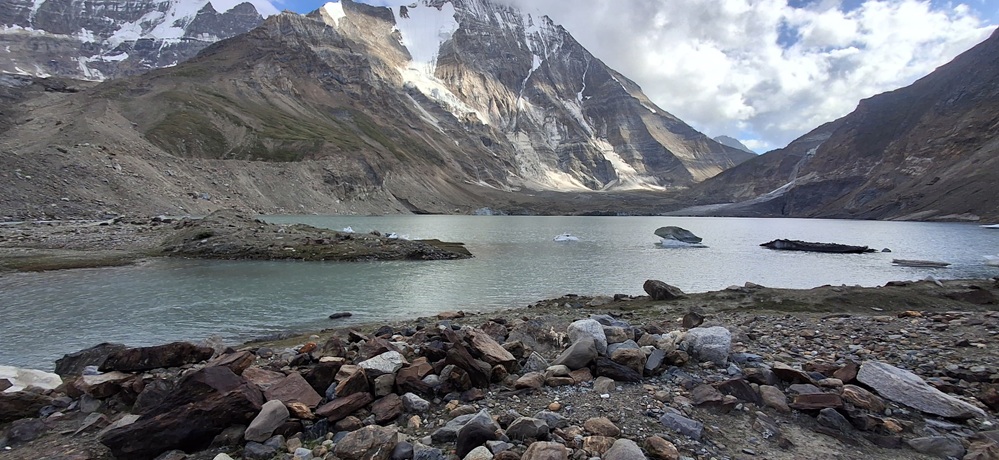
New Delhi: The devastating flash floods that struck Nepal’s Rasuwa district and the Nepal–Tibet border region on 26 August have caused extensive loss of life, destroyed homes and critical infrastructure, and left hundreds of people missing. Initial reports suggest that the disaster was triggered by a major collapse of ice and rock in the high Himalaya, followed by a rapid debris and water flow downstream. Rescue and recovery operations remain ongoing.
The CryoSCOPE project extends its deepest condolences to the families and communities affected by this tragedy.
While it is too early to fully understand the chain of events behind this disaster, it highlights the urgent need to better understand the interconnected processes shaping mountain environments, from glaciers, snow and permafrost, to rainfall, rivers and slopes, and how changes across these systems can amplify risks far downstream.
Himalayan climate monitoring has often focused on how quickly glaciers are shrinking, retreating, or losing ice. While this information is important, understanding mountain processes and recent meteorological changes require us to look at the bigger picture.
Glaciers are part of a connected system. Changes in snow, rainfall, permafrost, lakes and rivers can all influence what happens in the mountains, and what happens downstream. Understanding these connections can help us better identify and assess potential risks.
Research cannot prevent every extreme event, and monitoring alone cannot eliminate risk. But better knowledge can help us recognise changing conditions, understand how risks are developing and improve preparedness before an event occurs.
Long-term observations help scientists track how glaciers and the wider mountain environment are changing. Models can help us understand what these changes could mean for water flows and hazards in the future. Bringing together satellite observations, ground measurements and other sources of data can give us a much clearer picture of what is happening across these connected systems.
This is the approach that CryoSCOPE partner Dr Irfan Rashid, Head of the Department of Geoinformatics at the University of Kashmir, put to work in the days after the disaster. Combining Landsat 9, Sentinel and Planet satellite imagery, he traced the event to the collapse of the frontal section of a glacier at around 5,200 metres above sea level, on a very steep slope, which sent ice, rock, debris and water surging down the valley. Early estimates put the volume involved at 100–200 million cubic metres, a figure he stresses still requires more rigorous analysis.
For Dr Rashid, establishing what triggered this particular event is only part of the task. The larger scientific question, he says, is “whether similar vulnerable locations can be identified elsewhere in the Himalaya.”
The goal is not simply to know where glaciers are changing, but to understand what those changes mean for water, landscapes and people.
Dr Rashid, whose recent research has mapped more than 150 glacial lakes across the Kashmir Himalaya and identified several with very high outburst-flood susceptibility, argues that the aim must be to move “from being reactive after such disasters occur to being pre-emptive.” Scientists cannot monitor every glacier, lake and slope continuously; satellite observations must first flag the potential hotspots, so that detailed ground monitoring can be concentrated where a failure would have the greatest consequences.
Dr Chandan Sarangi, Associate Professor in the Department of Civil Engineering at the Indian Institute of Technology Madras and CryoSCOPE’s Principal Investigator in India, stresses that anticipating such disasters also depends on robust operational weather models built specifically for the High Mountain Asia region. “With improved operational forecasts of meteorological variability like high temperature or precipitation episodes, we will be better equipped to forecast hazards like landslides, cloudbursts, extreme glacier melt and associated GLOFs”, he says. CryoSCOPE’s work in India is co-funded by the European Union and the Indian Ministry of Earth Sciences
This is the focus of CryoSCOPE’s work, alongside its sister projects ICELINK, LIQUIDICE and SnowPI. Each project looks at a different part of the changing cryosphere, while sharing a common goal: improving the observations and knowledge needed to understand and respond to a changing climate.
For CryoSCOPE, this includes observations from high-mountain environments such as the Himalaya, where changes in glaciers, snow, permafrost, lakes and water flows can have consequences well beyond the mountains themselves.
The events in Nepal are a stark reminder of why this work matters. As mountain environments continue to change, strengthening the science behind monitoring, modelling and risk assessment will be essential for helping communities better understand and prepare for the hazards they may face.
Our thoughts remain with the people of Nepal, particularly those who have lost loved ones, their homes and livelihoods, and those still waiting for news of family and friends.
