

New Think Tank ‘Bharat Ki Soch’ launched to shape contemporary policy discourse with learnings from ancient Indian knowledge systems

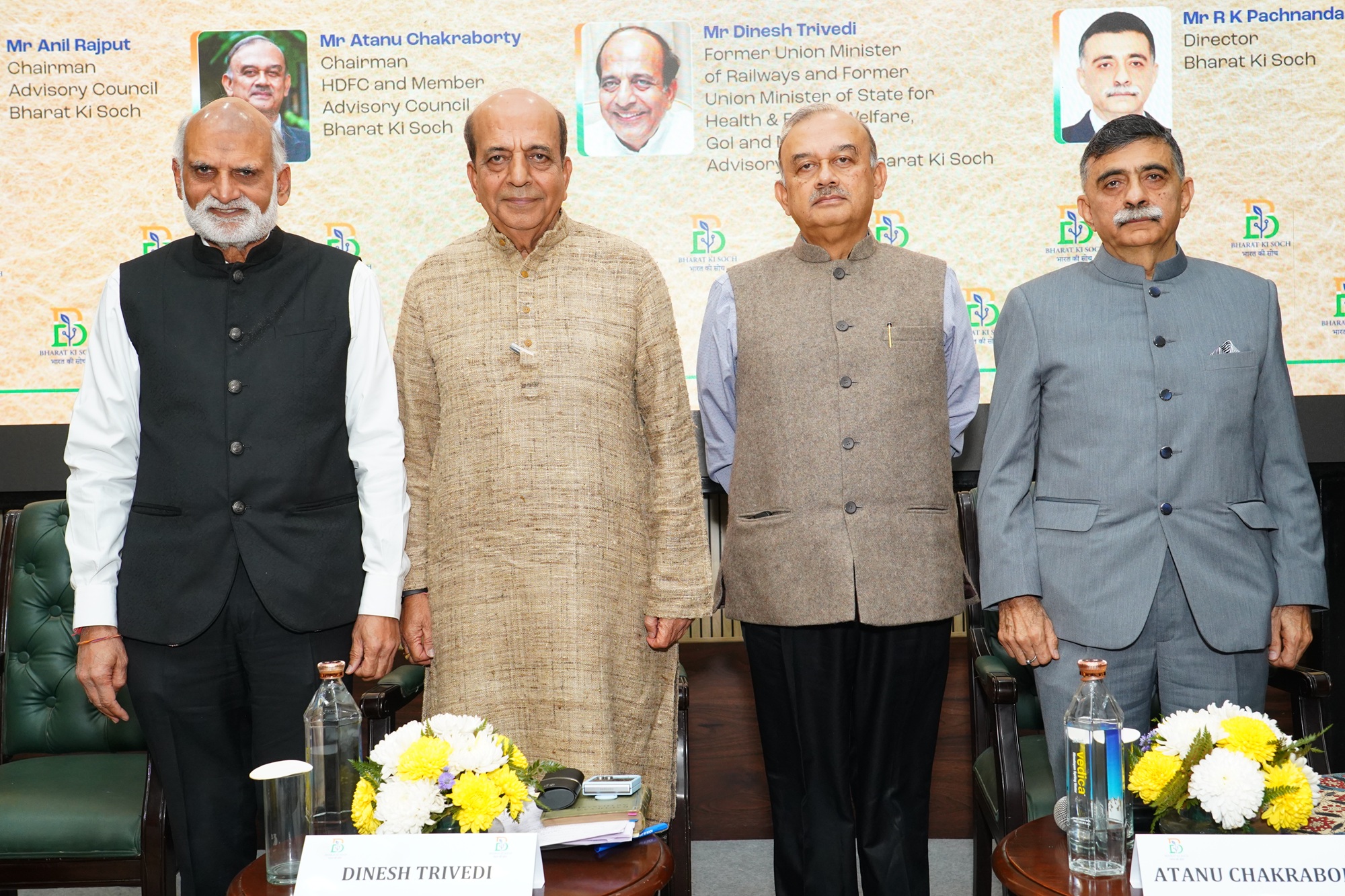
New Delhi: Bharat Ki Soch, a Think Tank on ancient Indian wisdom for contemporary challenges has been launched. It aims to enrich India’s growth narrative by drawing on the country’s deep civilisational knowledge systems and intellectual heritage. By researching, reinterpreting and contextualising ancient Indian wisdom for modern needs, Bharat Ki Soch seeks to offer fresh perspectives for nation-building anchored in India’s own cultural and philosophical foundations.
With a vision to reimagine Bharat’s civilizational wisdom for a resilient and progressive nation, the Think Tank made its inception with an inaugural conference titled Navigating Growth and Development in Global Uncertain Times, held at the Constitution Club of India. The conference reflected on how India can sustain its developmental momentum, blending institutional strength, innovation and the timeless wisdom of its civilisation to chart a steady course toward Viksit Bharat.

It brought together thought leaders and scholars to examine how India’s civilisational knowledge systems can inform responses to global economic, geopolitical and developmental uncertainty. The dialogue featured eminent speakers including Mr. Dinesh Trivedi, former Union Minister for Railways, Mr. M. J. Akbar, former Union Minister of State for External Affairs, Government of India, Mr. Raghvendra Singh, former Culture Secretary, Government of India, Mr. Atanu Chakraborty, Chairman, HDFC Bank, Mr. Ram Madhav, President, India Foundation, Dr. T. C. A. Raghavan, former High Commissioner to Singapore & Pakistan and Former Director General of the Indian Council of World Affairs and Mr. Anil Rajput, Chairman, Advisory Council, Bharat Ki Soch and Mr. R. K. Pachnanda, Director, Bharat Ki Soch.
Across wide-ranging discussions, the speakers underscored a shared belief that India’s next chapter of growth cannot rely solely on contemporary frameworks but must draw confidently from the intellectual wealth embedded in its civilisational inheritance.
Bharat Ki Soch seeks to build precisely this bridge, engaging scholars, policy makers, technologists and practitioners to reinterpret ancient Indian knowledge for India’s evolving developmental needs. Through a mix of deep research, interdisciplinary collaboration, and public dialogue, Bharat Ki Soch will cover a range of subjects from governance, economy and agriculture to sustainability, health & wellness, and national security and will be informed by time-tested Indian frameworks in our ancient scriptures.
In his welcome address, Mr. Anil Rajput, Chairman, Advisory Council, Bharat Ki Soch, described the moment as the beginning of a new intellectual journey for the country. “Today marks not just an event, it is the beginning of a journey to rediscover India’s timeless knowledge and reimagine our growth story with confidence, clarity and cultural rootedness,” he said.
Reflecting on the global environment, he highlighted significant challenges like growing debt distress, climate crises, demographic decline, food insecurity and consequences of rapid technological transformation like job displacement and data insecurity to the growing concentration of technological power. “We are living through a period of deep global transition, one that is reshaping vulnerabilities as much as it is opening up opportunities,” he said, attributing India’s unique position as the world’s fastest growing major economy to the stabilising force of India’s civilisational wisdom.
Delivering the keynote address, Mr. Atanu Chakraborty situated the moment within a wider civilisational conversation. He noted that India’s ancient economic thought, from Kautilya’s Arthashastra as well as schools of Brihaspati, Manu and Kalasa, offered sophisticated frameworks for taxation, regulation, welfare, and fiscal prudence long before modern economics emerged. “Our civilisation was deeply knowledge-driven, evolutionary and inclusive. But the last thousand years saw a profound destruction of manuscripts, libraries and institutions,” he said.
He stressed that reclaiming this legacy is an exercise in relevance rather than nostalgia, noting that ancient India never separated prosperity from purpose. “Material well-being is the foundation upon which spiritual and social good must stand,” he said.
Highlighting Kautilya’s articulation of the state’s duties as well as Arthashastra’s emphasis on issues like progressive taxation, transparent accounting, strict audit, and prudent monetary discipline, he observed how these remain contemporary. “Western scholars have called this one of the most advanced economic frameworks of its time. Yet, we rarely draw from it. This institution, Bharat Ki Soch, can change that.”
In his inaugural address, Mr. Dinesh Trivedi drew further attention to the administrative and moral foundations of nation building, underscoring that India’s civilisational frameworks remain essential guides for contemporary policy. He observed that “the governance and economic model of ancient Bharat provide a timeless civilisational guide for navigating the journey towards Viksit Bharat despite vicissitudes in the global scenario,” calling for a renewed appreciation of India’s inherent strengths in knowledge systems, agriculture and innovation. His reflections on Chanakya’s dictum of duty and accountability offered a sharp reminder that India’s public institutions, from administration to resource management, were historically rooted in meritocracy, ethics and a deep respect for the citizen. These principles, he argued, must remain central as India charts its developmental path. Mr. Trivedi concluded with an evocative vision, “India will be a lighthouse in this chaotic world. A ship of humanity that is lost will look to Bharat Varsha for light.”
Building on this, Mr. R. K. Pachnanda reflected on the strategic choices very ably made by a strong India in an era of geopolitical volatility. He noted that “India has always converted crisis into opportunity” and emphasised that ancient Indian texts present a pragmatic confluence of economic clarity and governance. He highlighted that despite global uncertainty, India continues to demonstrate resilience as one of the fastest growing major economies and the fact that we have achieved an 8.2 percent growth rate in the last quarter, clearly proves this. In the words of the IMF, India is the only bright spot in the otherwise dark horizon.
In the first plenary session on ‘Global Perspectives in an era of Geopolitical and Geoeconomic realignment’, Dr. T. C. A. Raghavan offered a nuanced view of the geopolitical shifts shaping India’s neighbourhood. He cautioned that the speed of global change carries the risk of drawing attention away from immediate regional realities. “The pace of change we are witnessing is extraordinary. While we must assert ourselves and participate in global dialogue, we cannot allow this global churn to blind us to what is happening in our own immediate neighbourhood,” he noted.
He argued that while global aspirations matter, India’s strategic stability will continue to rest on a deeper understanding of the South Asian region, where state fragility, shifting political dynamics and weakening regional institutions pose urgent challenges. Drawing from ancient Indian frameworks of diplomacy, including concepts associated with Kautilya, he emphasised that sustainable strategy demands both clarity of purpose and empathy in statecraft.
After Dr T. C. A. Raghavan brought to fore the important geopolitical issues currently concerning Bharat, an interactive conversation took place between him and Mr Raghvendra Singh. The conversation centered mainly around aspects of Bharat’s historico-cultural milieu, particularly that of South Asia and Indonesia. Mr Raghvendra Singh, taking the cue, asked why Panchsheel – a concept original to Indonesia – was successful there, whereas its efficacy wasn’t fully realised when applied by Bharat in the Sino-Indian context. Dr Raghavan informed that Indonesia’s rounded approach to dealing with its neighbours enabled it to avoid conflicts with players such as Malaysia and Singapore.
The interaction, thereafter, extended to the civilisational approaches of both, China and Bharat, in their foreign policy outreach. Whether interconnectedness was the ‘mantra’ to sort out Indian neighbourhood issues was also discussed. Mr Raghvendra Singh emphasised that civilisationally, Bharat always had a better and a bigger worldview both in terms of its overland and maritime outreach.
In the second plenary discussion on ‘Learnings from Ancient India: Enduring Wisdom for Modern Growth and Stability’, Mr. M. J. Akbar provided a sweeping reflection on the role of history in shaping national direction. “This is not history for history’s sake. It is a toolkit for resilient development,” he remarked, underscoring his argument that India’s civilisational strength lies in its ability to synthesise ideas, build cultural cohesion and evolve institutional frameworks over centuries. His co-panelist Mr. Ram Madhav, President, India Foundation, emphasised that there is immense learning embedded in ancient Indian wisdom whether in the Arthashastra or Chanakya Niti, but it must be thoughtfully contextulaised for 21st century. The insights from theses texts should be adapted and applied in ways that strengthen India in contemporary times.
