


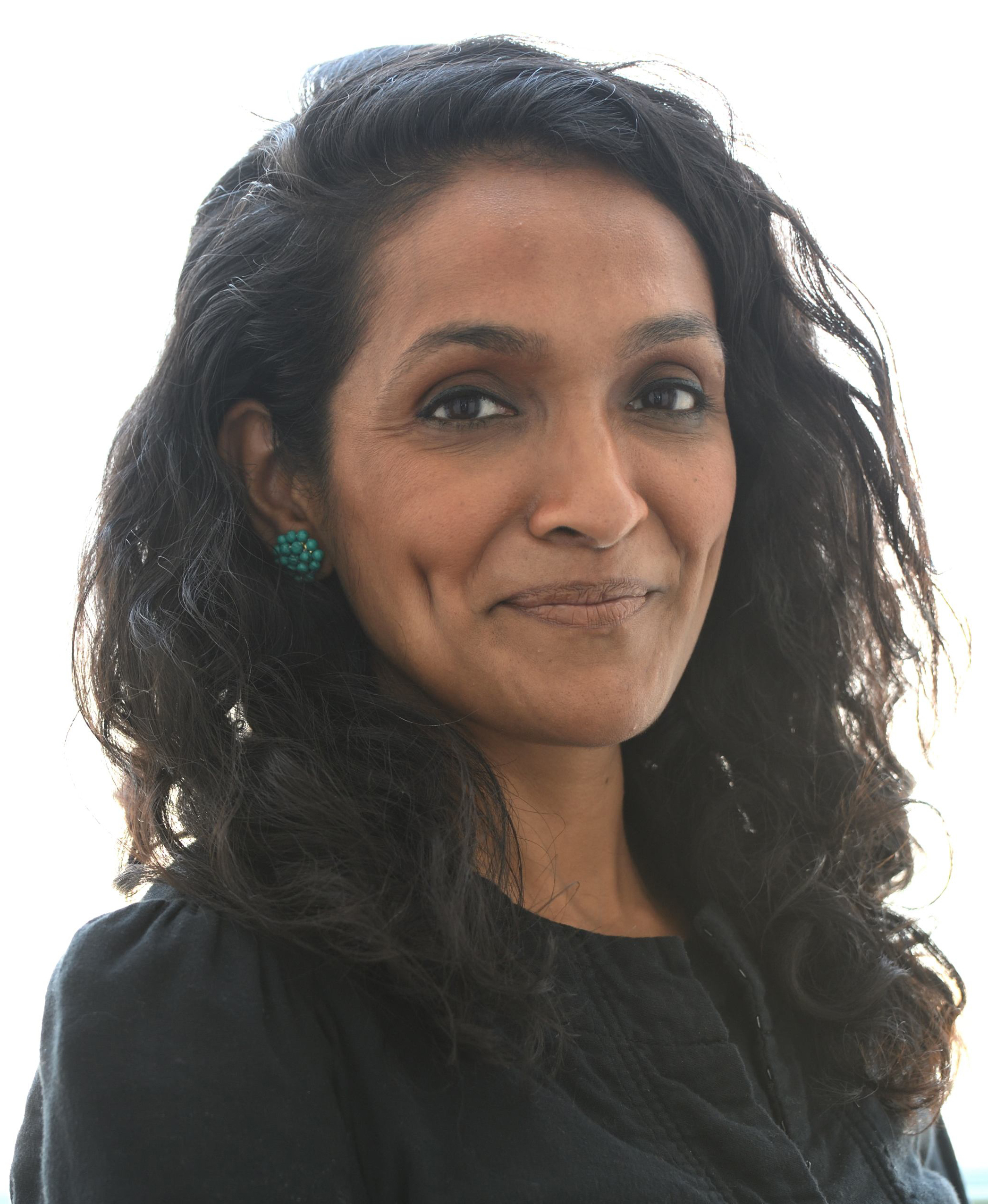
By Geetha V P & Nanditha S
She left Kerala at six, yet the place never fully left her. Born in Thiruvananthapuram to a Tamil Iyer family whose roots also ran through Thrissur, Nithya V. Raman grew up with the memory of an agraharam household, of maternal grandparents who had looked after her first years, and of a language she still follows. Relatives in Kerala have watched her rise with a particular, quiet intensity; when the result came in, the pride that travelled back across the ocean carried the weight of a child who had gone far and not forgotten where she began. That child, now forty-five, has just become the first mayor of South Asian descent in the history of Los Angeles.
The road that carried her there passed, years earlier, along the banks of the Yamuna. In the months before the 2010 Commonwealth Games, as Delhi’s authorities cleared more than 100,000 residents so that the capital might present a more polished face to the world, Raman—only recently returned from Harvard—joined the people being driven out. She documented the demolitions, recorded conditions in the distant colonies to which families were relocated, and insisted that the poor could not simply be made to disappear. The same questions of housing, visibility, and institutional neglect that claimed her attention on those riverbanks later shaped the campaign in which she defeated incumbent Karen Bass.
Born on 28 July 1981, she spent her earliest years largely in the care of her maternal grandparents. Her father, R. Venkitaraman, worked at KELTRON; her mother, Sudha, at the Indian Overseas Bank. At six she and her mother flew to join her father in Louisiana, later settling in Burlington, Massachusetts. There, as one of the few Indian children along Route 128, she learned early what it meant to be marked as outside. The experience, she has said, sharpened an enduring sense of who is rendered invisible by institutions that claim to serve everyone.
Harvard followed, a degree in social studies in 2003, and naturalisation at 22. There was, she has insisted, no grand plan when she returned to India. In Delhi the scale of the Yamuna clearances was impossible to ignore. Raman worked with residents’ groups to halt further evictions, record conditions in distant resettlement colonies, and insist on water and sanitation that the state had treated as optional. The work was unglamorous and largely ignored by a media preoccupied with stadiums. What stayed with her was the recognition that poverty alone did not explain the treatment of the urban poor; deliberate erasure did.
From Delhi she moved to Chennai. After completing a master’s in city planning at MIT in 2008, she co-founded Transparent Chennai in 2010 under the Centre for Development Finance at the Institute for Financial Management and Research. The organisation mapped public toilets, bus routes, and pedestrian infrastructure in neighbourhoods the municipal maps had simply omitted, then used the data to press for investment. Residents of Nanganallur still recall the community forums where Raman and her colleagues turned lived experience into evidence that could not be dismissed. She also trained in Bharatanatyam at Kalakshetra, a private counterpoint to the public work of making the unmapped visible.
In 2010 she married Vali Chandrasekaran, a fellow Harvard alumnus who would become a television writer. Three years later the couple moved to Los Angeles. Raman took a post with the city’s chief administrative officer, examining how public money was spent on homelessness. She saw expenditure that managed symptoms while leaving causes untouched. In 2017, eight-and-a-half months pregnant, she co-founded the SELAH Neighborhood Homeless Coalition and co-chaired the Silver Lake Neighborhood Council’s homelessness committee. She later served as executive director of Time’s Up Entertainment. The through-line was consistent: systems that treat people as problems rather than as citizens fail both the people and the city.
Politics arrived as an extension of that work rather than a departure from it. In 2020 she challenged long-serving Councilmember David Ryu in District 4. With a volunteer army that knocked on more than 80,000 doors and the endorsement of the Democratic Socialists of America, she defeated the incumbent—the first such ouster of a sitting council member in 17 years. “I wanted people like David Ryu to stop ignoring what I saw on the ground,” she later said, “and a city that was begging for City Hall’s attention and not getting it.” On the council she advanced tenant protections against harassment and buyouts, strengthened rent stabilisation, and insisted that homelessness policy be judged by outcomes rather than announcements. She was arrested while protesting for hotel workers and fought for an independent redistricting commission after a leaked recording revealed efforts to redraw her district out of existence. Re-elected decisively in 2024, she chaired the Housing and Homelessness Committee.
In early 2026, hours before the filing deadline and after having previously endorsed Mayor Bass, Raman entered the mayoral race. “Homelessness has risen, people continue to sleep on the streets, and we have had no meaningful action from City Hall for four years,” she declared. “I’m running for mayor to change that.” She described the city’s response as a humanitarian crisis in which money existed but urgency and accountability did not. Her platform called for housing at every income level—affordable, market-rate, social housing, and shelters—with the explicit goal of tripling annual production. “Building more housing is the key thing for LA’s recovery and resiliency,” she told Vanity Fair. “If we can invite more people to live here… that’s what made LA into what it is, and we won’t have that anymore if we don’t build more housing.” She promised to cut unsheltered homelessness by at least half before the 2028 Olympics by tracking every dollar, investing in what worked, and expanding time-limited rental subsidies that had already reduced street homelessness in her district by nearly half in a single year while the citywide figure rose.
Voters, frustrated by persistent encampments, housing costs, and the sense that City Hall had grown accustomed to low expectations, delivered the result. Raman defeated Bass by roughly 52 to 48 percent. Bass conceded. Raman becomes the city’s 44th mayor and the first challenger to unseat an incumbent in more than two decades. She has been clear about the limit of her ambition: “This is the last office I want to run for. I don’t want to go to Sacramento. I don’t want to go to D.C. I just really love L.A. I’m running because it feels like it’s really, really struggling right now.”
She lives in Silver Lake with Chandrasekaran and their twin children. The arc from the Yamuna’s resettlement colonies to the mayor’s office is not a story of reinvention. It is the continuation of a single insistence: that cities reveal themselves in how they treat those they would prefer not to see, and that data, organising, and sustained attention can force the unseen back into the frame. For a city long defined by its housing crisis, that insistence now occupies the highest office. In Kerala, where she still follows Malayalam and where relatives have followed every step, the distance feels smaller than it once did.
