
‘One Nation, One Emergency Helpline’ for Stroke Care Proposed by ISA Gains Support at FICCI Meet

New Delhi: The Indian Stroke Association (ISA) presented a comprehensive proposal to strengthen stroke care delivery in India at a meeting hosted by FICCI, attended by policymakers, healthcare leaders, and clinical experts. The discussion focused on addressing existing gaps in stroke management and building a more coordinated, accessible, and time-sensitive care system across the country.
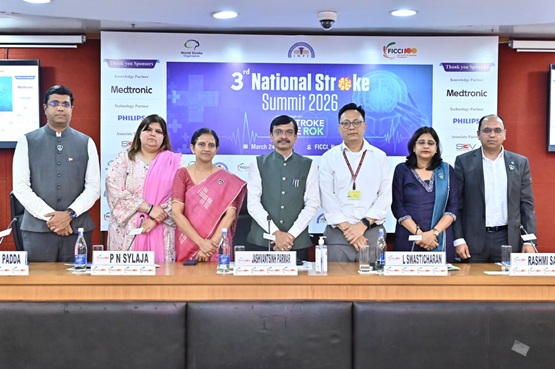
As part of the meeting, a dedicated plenary session titled ‘Strengthening Stroke Care Delivery’ brought together key stakeholders from government, clinical practice, and industry to discuss practical solutions for improving stroke care across Indian states.
The session was chaired by Dr. Jashvantsinh Parmar and moderated by Dr. P. N. Sylaja, Professor and Head of Neurology at Sree Chitra Thirunal Institute for Medical Sciences and Technology. The panel featured leading experts, including Dr. L Swasticharan, Additional DDG & Director (EMR), DGHS, GoI; Dr. Saroj Kumar, Director, NCD, Ministry of Health and Family Welfare, GoI; Dr Vikram Huded, President, Indian Stroke Association (ISA) and Head Of Neurology, Narayana Health, Bangalore; Dr. Rashmi Saraf from KEM Hospital, Mumbai; Dr. Preeti Padda, Nodal Officer, DRME, Government of Punjab; and Gaurav Vyas, Director – Image Guided Therapy, Philips India.* The discussion centred on a key question: how to make stroke care work effectively on the ground across different states in India.
Stroke continues to be a major public health challenge in India, with nearly 1.8 million new cases reported annually. Despite being largely preventable and treatable, timely access to care remains a critical barrier. To address these challenges, ISA, under the leadership of Dr. Vikram Huded, proposed a series of system-level reforms. Key recommendations included nationwide blood pressure screening, stroke-ready centers across districts, and a coordinated emergency response system.
A major highlight of the proposal was the concept of a “One Nation, One Emergency Health Helpline” for time-sensitive conditions such as stroke, heart attack, and trauma. Drawing parallels with international emergency response models, the proposal emphasised the need for a unified, easy-to-remember helpline that can enable rapid coordination between patients, ambulances, and hospitals, ultimately reducing delays in treatment.
The proposal received strong support and appreciation from Dr. Anil Bonde, Hon’ble Member of Parliament and Chairperson, IMPF, and Dr. Jashvantsinh Parmar, Member of Parliament and Joint Convenor, IMPF. Both leaders acknowledged the importance of a streamlined emergency response system and expressed support for exploring the implementation of a unified helpline at the policy level.
Dr. Vikram Huded, President of Indian Stroke Association (ISA), said, “Stroke incidence is rising rapidly in India, and it is increasingly affecting younger individuals due to lifestyle-related risk factors such as hypertension, diabetes, obesity, and smoking. India currently has less than 5% thrombolysis rates and less than 1% thrombectomy rates, indicating a major gap in early intervention and advanced stroke treatment. While stroke is both preventable and treatable, outcomes depend heavily on how quickly patients receive medical care. The concept of a ‘One Nation, One Emergency Health Helpline’ can be a game-changer, as it will help patients reach the right hospital at the right time without confusion or delay. A unified helpline can improve coordination between emergency services and hospitals, increase timely interventions like thrombolysis and thrombectomy, and ultimately save lives while reducing long-term disability.”
Dr. Arvind Sharma, Secretary of ISA, said, “Indian Stroke Association (ISA) membership is more than 1400 Stroke Neurologists across India, and as the vision and mission of ISA, we started training fellow physicians across India to partner with us in stroke advocacy. Together, we will strengthen awareness, improve early diagnosis, and expand access to advanced stroke treatment across India. We started collaboration with Physicians in 2024 with the theme of “Mission Brain Attack”, 2025 Theme “Time to act now”. This year, the theme is “Save the Brain”. President of the Indian Stroke Association Dr. Vikram Huded, and the whole Executive committee of ISA will take this initiative and further increase the awareness of Brain Attack among the public will have National programs and press meet with local organisations like Rotary, Indian Medical Association, and Association of Physicians of India.”
By focusing on early detection, faster emergency response, and improved treatment access, initiatives such as a unified national helpline have the potential to reduce stroke-related mortality and disability in the country.
