


By Nanditha Subhadra
In a democracy that prides itself on a robust security apparatus and razor-sharp intelligence, one would expect the Prime Minister’s residence — the epicenter of national power — to be an impregnable fortress. Yet, on July 21, 2026, Congress leaders led by Leader of Opposition Rahul Gandhi turned 7, Lok Kalyan Marg into a protest arena, exposing glaring cracks in the system. Police manhandled the very individuals under Z+ protection, dragging the LOP as if protocol was a mere suggestion. This wasn’t just a political spectacle; it was a textbook case of intelligence failure, the second such lapse in two days.
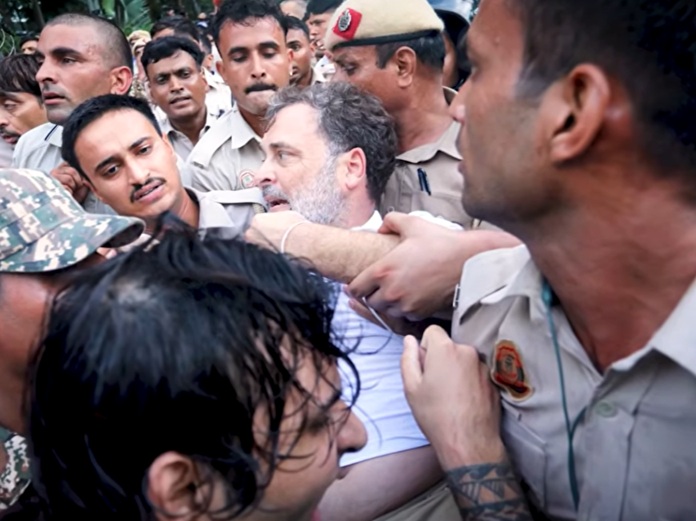
The context: Opposition parties were protesting brutal police action against students demonstrating over the NEET paper leak scandal the previous day. Demanding accountability — resignations of the Education Minister, Home Minister, and even the Prime Minister — Rahul Gandhi, Priyanka Gandhi Vadra, Akhilesh Yadav, Mallikarjun Kharge, and others marched to the PM’s doorstep. What followed was chaotic: dramatic visuals of leaders being pulled, lifted, and bundled into buses. Rahul Gandhi quipped while on the ground, “Democracy in India is happening right now.” Clothes torn, dignity bruised, the LOP and team were detained and later released. Government sources called it an “unprecedented security threat.” Unprecedented indeed — but for all the wrong reasons.
India’s intelligence ecosystem — IB, raw inputs from state police, SPG/CRPF coordination for VIPs — is designed to preempt threats. Yet, a large group of high-profile opposition figures, including the Leader of Opposition with Z+ CRPF cover, approached the PM’s residence without apparent preemptive containment or de-escalation strategy. No visible barricading of routes, no advance warnings that deterred the march effectively, and crucially, a failure to respect the security protocols that should shield protectees like Rahul Gandhi even during protests.
Recall: Rahul Gandhi operates under Z+ category now, not the elite SPG. His detail comprises CRPF personnel who coordinate with local police but do not interfere with lawful authority. However, visuals of police prying leaders apart, pulling legs, and manhandling suggest coordination breakdowns. If intelligence had flagged the protest intent (hardly a state secret given public announcements), why the reactive scramble? Why treat the LOP’s presence as an immediate “threat” requiring physical eviction rather than managed containment? This echoes past lapses, like the 2021 Rajaji Hall incident where Rahul was separated from his SPG detail due to poor liaison with state police.
The previous day’s student protests at Jantar Mantar or elsewhere already highlighted heavy-handed policing. Intelligence should have anticipated the escalation to the PM’s house. Instead, agencies appear to have been caught flat-footed again. A “siege” at the PM’s door in a high-security VVIP zone points to failures in real-time assessment, crowd dynamics prediction, and inter-agency sync. Delhi Police, under central oversight, bears responsibility, but the buck stops higher — at the Home Ministry’s intelligence collation.
Satirically speaking, one wonders if the “intelligence” reports were busy drafting press notes on “dangerous precedents” while protesters walked right up. The government slammed the Congress for starting a “dangerous tradition.” Fair point on decorum, but when the opposition feels Parliament is unresponsive, they take to the streets — and the system’s inability to handle it peacefully exposes deeper rot. Manhandling the LOP, whose security is a national concern, isn’t just optics gone wrong; it’s a breach that could embolden real threats by revealing procedural weaknesses.
This is the second incident in two days. Student protests met force on Monday; high-profile political protest on Tuesday. Patterns like these demand answers: Who approved the response strategy? Why no high-level preemptive dialogue? In a nation facing real external threats, internal security lapses erode public trust. The Home Minister’s office, intelligence chiefs, and Delhi Police Commissioner must face scrutiny. An independent review — not an internal whitewash — is essential. Resignations demanded by protesters aside, fixing accountability internally is non-negotiable.
The irony is thick: A government touting national security prowess allows its own backyard to become a protest flashpoint. Rahul’s team highlighted student safety and ministerial accountability. The response? Physical removal. Democracy thrives on dissent, not its suppression. Treating the LOP like a common agitator, ignoring his protection detail’s coordination, underscores how political polarization blinds even the guardians of security.
As the country watches, the message is clear: Intelligence failures aren’t abstract; they risk lives, reputations, and the democratic fabric.
