

Politics in Camouflage: Modi’s ‘Dimagi Naxals’ Warning Turns Diwali with Jawans into a Partisan Stage

By Our Special Correspondent
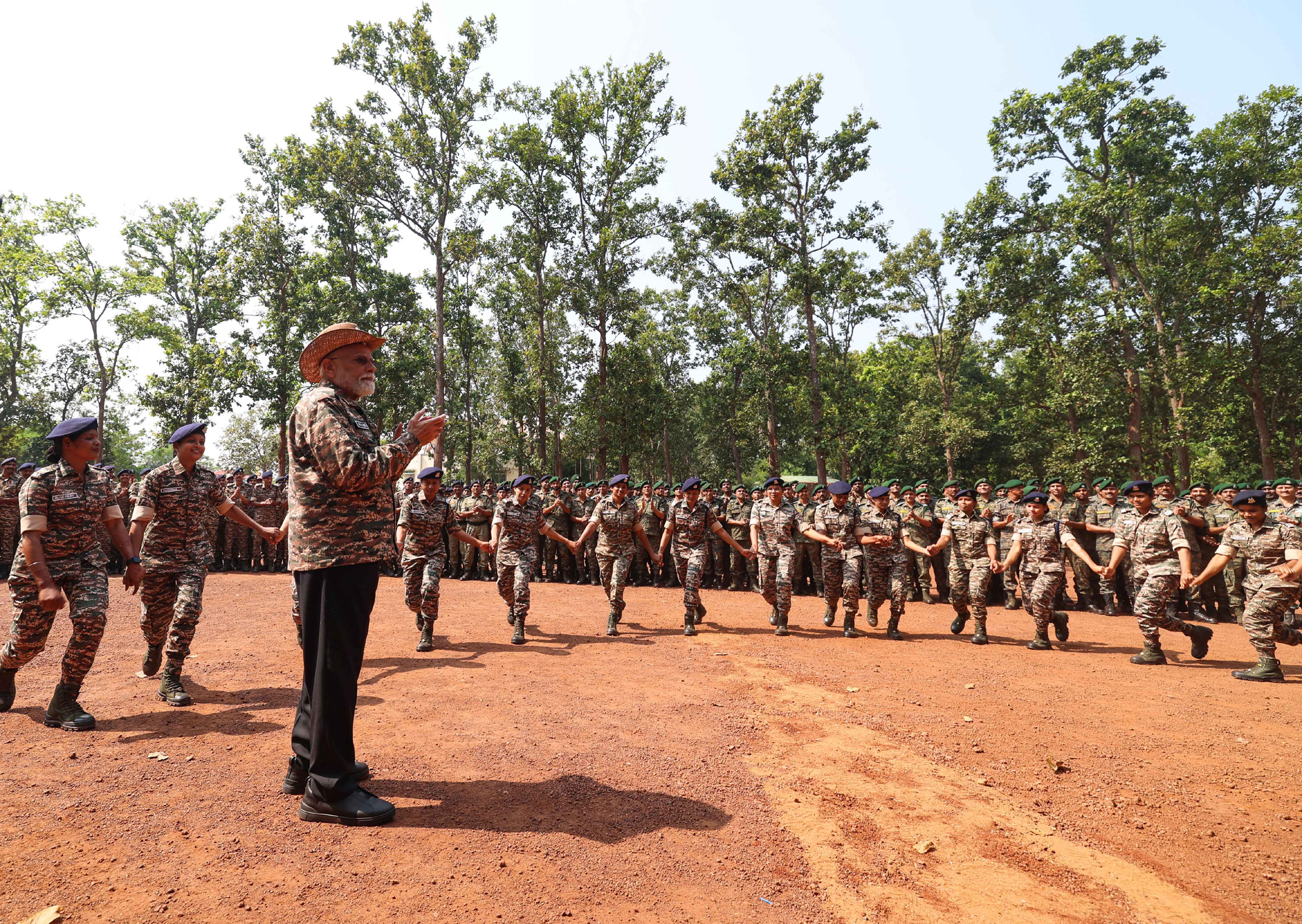
Prime Minister Narendra Modi’s Diwali visit to the CoBRA Operations Base at Karanpur in Chhattisgarh’s Bastar on November 8, 2026, illustrates a recurring tension in India’s civil-security relationship: the conversion of a ceremonial interaction with uniformed personnel into a vehicle for partisan political signalling. Dressed in camouflage fatigues and a hat bearing the CRPF insignia, Modi addressed personnel from the CRPF, CoBRA, BSF, ITBP, SSB, India Reserve Battalions, state police and specialised units including Bastar Fighters. While he credited them for what he described as the end of armed Maoist violence—the first Diwali with every district free of Naxalism, and the first time in 47 years that no CRPF jawan died on duty in a year—he devoted substantial space to the concept of “dimagi Naxals.”
In his address, Modi stated: “Armed Naxalites have vanished from the forests, but intellectual (dimagi) Naxalites have captured many organisations. Even today, they are provoking people against the Constitution and democracy of the country. These intellectual Naxalites have also infiltrated several political parties and various organisations. We must identify them, defeat them, and secure the nation.” He added that “Naxalites have been eliminated, but the threat is not yet over,” and that “we must identify and defeat such elements and secure the country.” He contrasted this with earlier governments that, he said, had “accepted Naxalism as an incurable disease and simply left it unattended,” claiming political will was restored only after 2014 and that forces had been given “the freedom to take all necessary decisions.” He further noted: “This is the first Diwali when every district of the country is free from Naxalism” and “for the first time in 47 years, not a single CRPF jawan lost his life during duty over the past year. This is the victory of the country’s correct policies and firm resolve. This is the victory of your bravery, your courage, and your restraint.” Addressing the personnel as “a part of my family,” he said he had come “to celebrate Diwali with you” on behalf of 140 crore citizens.
The “dimagi Naxals” formulation was not new. In his August 15 Independence Day address from the Red Fort, Modi had said that while armed Naxals had been eliminated in the forests, “dimagi Naxals” remained and were “looking for opportunities to create violence and unrest,” adding that “we must identify these ‘dimagi Naxals.’ We need to isolate them.” The analytical issue is not merely the repetition of the phrase but its deployment before an audience of active-duty personnel. By locating the residual threat inside “several political parties and various organisations” and instructing the forces to “identify” and “defeat” it, the speech shifted from operational assessment of Left-Wing Extremism to a broader ideological categorisation of political adversaries.
Critics contend that this crosses a significant institutional line. Security forces are constitutionally expected to remain neutral instruments of the state, responsive to the elected government of the day but insulated from partisan framing. When a Prime Minister, while wearing their uniform, characterises certain political parties as infiltrated by “dimagi Naxals” who must be defeated, the distinction between legitimate political contestation and security threats is placed under strain. The Opposition has described the address as a “political speech to uniformed personnel.” Congress communications chief Jairam Ramesh said the Prime Minister “has not spared the nation even on Diwali day his trademark abuse” and “has once again spoken of what he calls dimagi naxals.” He added: “He has used a very solemn non-political occasion, donned the uniform of the security forces, and hurled invectives at his political rivals. This is a brazen assault on all institutional norms.” Leader of the Opposition Rahul Gandhi posted: “Dear CRPF jawans, your faces said it all: you didn’t buy the PM’s lies… He called us Naxals,” and renewed his challenge to debate “who is anti-national and who is controlled by foreign forces.” Trinamool Congress leader Saket Gokhale called it “a political speech to uniformed personnel.” Mahua Moitra criticised the wearing of military fatigues and said the Prime Minister should “leave the armed forces alone.”
The accompanying cultural programme deepened the tension between ceremonial bonding and political stagecraft. Male and female security personnel danced to traditional tribal songs, forming circles around the Prime Minister, who stood at the centre and clapped along. High-energy chants of “Bharat Mata Ki Jai” filled the camp. Modi distributed sweets and paid tribute at the camp memorial to fallen CRPF personnel. Official accounts framed these scenes as camaraderie in a region once scarred by violence. Analytically, however, the combination of an explicitly partisan warning and a highly choreographed cultural display raises questions about the instrumentalisation of personnel. VIP visits already impose operational and logistical costs on forces; when they also involve directed performances and partisan messaging, the risk is that jawans are positioned less as professional instruments of the state and more as props in a political narrative.
The deeper issue is one of institutional boundary maintenance. Democratic civil-security relations rest on the premise that forces serve the Constitution and the lawful authority of the day, not the electoral or ideological interests of any party. Speeches that invite personnel to “identify” and “defeat” ideological opponents within political parties test that premise, even when the language is presented as a continuation of counter-insurgency. Whether the “dimagi Naxals” remarks are interpreted as a legitimate caution about residual ideological influence or as an effort to stigmatise dissent by associating it with Maoist violence, the choice of audience, attire and setting has turned a festival of lights into a test of how far political messaging can travel into the ranks of the security apparatus before institutional norms are visibly strained. The Opposition’s characterisation of the event as a political speech to uniformed personnel is less a partisan retort than a signal of that underlying institutional concern.
