

Rahul’s Magician Tantrum vs Tharoor’s Constitutional Masterclass: A Tale of Two Congress Speeches

By Suresh Unnithan
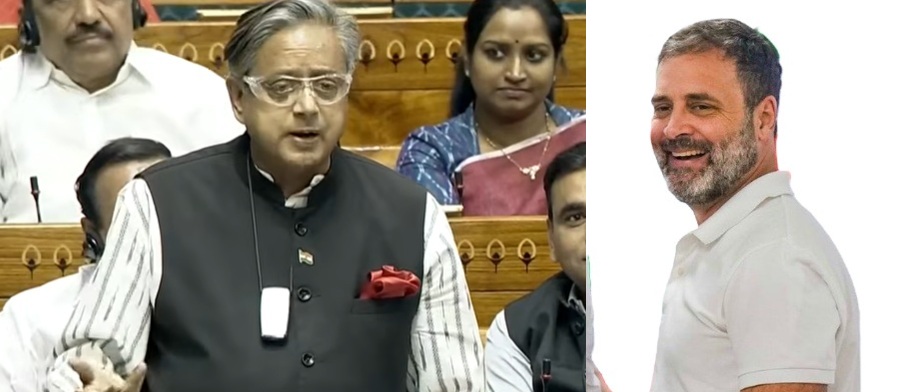
In the Lok Sabha today, on April 17, 2026, during the debate on the Women’s Reservation amendments and the linked Delimitation Bill, two Congress leaders from the same party offered masterclasses in parliamentary style — one of embarrassing decline, the other of dignified substance. Leader of Opposition Rahul Gandhi opted for the role of amateur illusionist-buster, waving the tired wand of personal insult. Shashi Tharoor played the constitutional mandarin, calmly exposing the legislative sleight-of-hand with facts, history, and constructive alternatives. The contrast exposed not just individual temperaments but the deepening crisis in opposition politics: the easy lure of playground jibes versus the harder labour of serious critique.
Rahul Gandhi’s speech was a case study in rhetorical self-sabotage. Instead of dissecting the complex interplay between women’s quota and delimitation, he branded Prime Minister Narendra Modi the “magician” who had finally “been caught.” The full routine: “The magician of Balakot, the magician of demonetisation, the magician of Sindoor has suddenly got caught.” He added flourishes about a supposed “partnership between the magician and the businessman” and framed the entire legislative package as a “panic reaction” to redraw the electoral map while pretending to champion women. The House predictably erupted. BJP members protested loudly. Speaker Om Birla intervened multiple times, urging the LoP to maintain decorum and address the substance of the bills. Gandhi persisted with metaphors, riddles, and recycled tropes, turning a debate on constitutional architecture into a vaudeville magic-show takedown.
This was not bold opposition; it was juvenile demagoguery from the highest opposition office. Calling a sitting Prime Minister a conjurer — lumping military operations like Balakot and Sindoor with economic reforms like demonetisation into a laundry list of “failed tricks” — is not piercing insight. It is the laziest form of personalised attack, the rhetorical equivalent of shouting “abracadabra, you’re exposed!” in a school debate. Such language demeans the institution. When even the Speaker must repeatedly pull the Leader of Opposition back to the legislation, Parliament has already been diminished. Defenders may hail it as “sharp rhetoric” or “fearless satire.” In reality, it reveals creative exhaustion: the inability to craft arguments that stand on merit, so one falls back on epithets and soundbites designed for TV clips rather than legislative impact.
The critique sharpens when one examines what was missing. Delimitation raises legitimate, thorny questions: how to balance population-based representation with federal equity in a diverse nation where southern states have excelled in population control while northern states have grown faster demographically. Southern fears of relative seat loss, northeastern concerns about marginalisation, the risk of straining the north-south compact — these demand data, constitutional analysis, and alternative proposals. Rahul Gandhi offered none. No deep dive into census figures. No engagement with implementation timelines. No blueprint for safeguarding smaller states. In their place: magic tricks, panic narratives, and a parting riddle for the nation to solve. When the principal opposition voice reduces Parliament to a campaign rally microphone, it signals not governmental weakness but the opposition’s intellectual surrender.
Now juxtapose this with Shashi Tharoor’s intervention on the same issues. Tharoor delivered a speech of rare parliamentary calibre — forceful in criticism, cool in delivery, grounded in constitutional principle. He explicitly supported the women’s reservation quota as a step toward gender parity. What he surgically dismantled was the government’s bundling tactic: advancing the politically explosive delimitation exercise under the politically safe umbrella of “Nari Shakti.” He called it legislative camouflage — major federal restructuring disguised as progressive reform, or in his memorable image, “Nari Shakti wrapped in barbed wire.”
Tharoor kept his cool. No personal insults. No historical score-settling turned into cheap punchlines. Instead, he articulated the core democratic anxiety with clarity: strict population-based delimitation risks penalising southern success stories like Kerala and Tamil Nadu for responsible family planning and governance, while disproportionately boosting representation for higher-fertility northern regions. This is not petty regionalism; it threatens the delicate federal compact that holds India together. He warned that hasty implementation could deepen mistrust, erode legitimacy, and produce a “disunited India” in the name of a “new India.”
Tharoor went further, offering concrete remedies. Decouple the issues: pass the women’s reservation immediately on existing strength (which the opposition would support), and subject delimitation to a transparent, standalone process — all-party committees, expert commissions, state consultations, and safeguards for federal balance. He referenced comparative models, cautioned against mechanical majoritarianism, and likened the potential disruption of poorly debated delimitation to the chaos of demonetisation — not as a lazy jibe at Modi, but as a substantive parallel about top-down shocks without adequate deliberation. The Treasury benches, accustomed to noisy interruptions, reportedly fell into telling silence at points. Reasoned facts, delivered without theatrics, have that rare power.
The difference is stark and telling. Rahul Gandhi’s magician routine reduced a debate on electoral reform and federal balance to personal vaudeville — playground name-calling dressed as insight, disruption masquerading as duty. Tharoor elevated it into a principled warning about democratic legitimacy, transparency, and constitutional morality. One relied on recycled epithets and crowd-pleasing metaphors; the other on data, precedent, and forward-looking suggestions. One demeaned the stature of the Leader of Opposition by descending into indecorous insult; the other enhanced the opposition’s credibility by treating the House with the respect it deserves.
This pattern is not new, but its persistence in the LoP is particularly damaging. Rahul Gandhi has long favoured dramatic one-liners — “suit-boot ki sarkar,” various personality-driven barbs — over sustained legislative craftsmanship. The result is consistent: short-term media buzz at the cost of long-term institutional erosion. Indians watching expect opposition to scrutinise power rigorously, propose alternatives, and strengthen processes. What they often receive instead is spectacle that insults their intelligence. Voters can distinguish flawed policy from parliamentary tantrums; the former invites debate, the latter breeds cynicism.
The irony bites hardest here. The opposition accuses the government of “panic” and map-redrawing sleight-of-hand, yet offers disruption and metaphors in response. Instead of forging a coherent alternative — a delimitation formula that protects southern equity while advancing women’s representation — the LoP chose easy theatrics. Precious session time was lost to uproar and counter-uproar. The public, yet again, witnessed elected representatives prioritising performance over problem-solving.
Parliament is neither a comedy stage nor a wrestling arena. It is the arena where the world’s largest democracy negotiates its future. When the Leader of Opposition reduces serious constitutional debate to a tired magician hunt, he does more than target one individual; he diminishes the office, the institution, and public faith in democratic processes. Tharoor’s cool, fact-driven dissection left the Treasury benches momentarily speechless because it demanded substantive answers. Rahul’s magician jibe left observers wondering whether the real disappearing act was any expectation of seriousness from the highest opposition bench.
In the contrast of these two April 17 speeches, India glimpsed both the ailment and the antidote in its parliamentary democracy: the seductive trap of petty rhetoric versus the demanding path of informed, dignified dissent. The mandarin reminded us what constructive opposition can achieve. The magician hunter, unfortunately, confirmed why decorum and substance still matter — and why their absence leaves the opposition looking smaller than the issues it claims to champion.
