

Rajasthan civic verdict: BJP wins the count, loses the street — combined opposition and Independents take nearly 60% of wards

From Our Political Correspondent
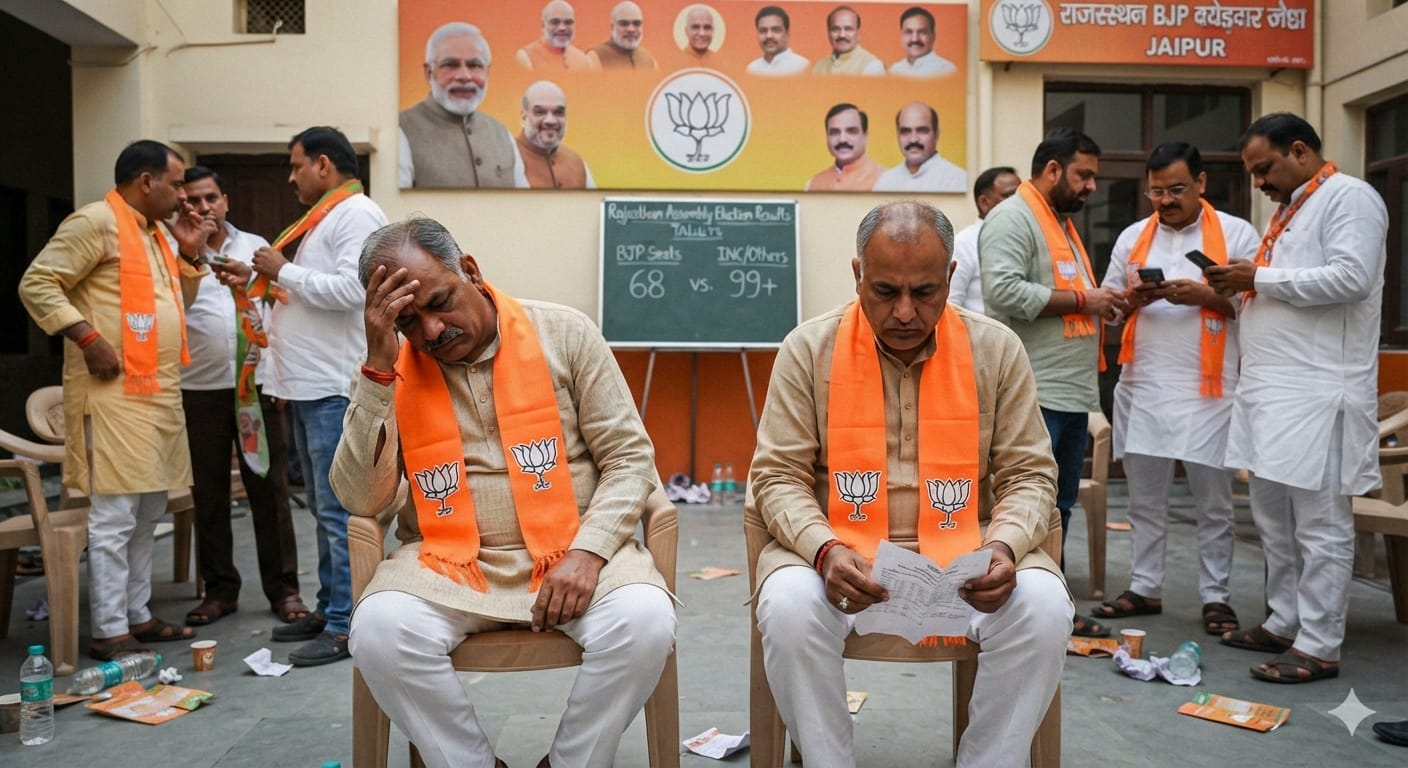
Jaipur: The Bharatiya Janata Party will claim Monday’s urban local body results as a lead over Congress. The numbers that matter tell another story. Of roughly 10,244 municipal wards counted across 309 civic bodies, the ruling party finished with about 4,170–4,180 seats — a little over 40 percent. Congress, Independents and smaller parties together took the rest: close to 6,060 wards, or about 59 percent of urban Rajasthan.
That is not a governing party consolidating power midway through its term. It is a ruling machine that, with the state and the Centre behind it, still could not persuade six voters in ten to stay with the lotus.
The BJP remains the single largest party. That fact will be repeated in every official briefing. It does not cancel the other fact: the forces arrayed against the BJP, however fragmented, are ahead. Civic boards are formed town by town, not as one legislature. Independents will be courted, bought and split. None of that erases the statewide picture. Power at Jaipur did not convert into urban consent.
The prestige map cracked first
Three results expose the gap between command and the booth.
In Bharatpur — Chief Minister Bhajan Lal Sharma’s hometown — Independents swept 36 of 65 wards. The BJP was reduced to 20; Congress to seven. The Chief Minister’s city did not reward the government. It rewarded candidates who stood outside both national parties.
In Pali, home turf of BJP state president Madan Rathore, Congress took 29 wards to the BJP’s 21 in a 65-member corporation; Independents held 15. The party chief’s city made the opposition the largest force.
In Jhalawar municipal council, long sold as Vasundhara Raje’s fortress, Congress won 29 of 45 wards. The BJP managed 13. A heavyweight’s district did not transfer loyalty; it transferred a warning.
These are not obscure municipalities. They are the places the party uses to advertise control. Losing or trailing there while holding Jaipur, Udaipur, Kota and Bhilwara is the signature of a party that still owns an urban core and is leaking everywhere personal brand was supposed to paper over local anger.
Independents are not a sideshow
More than 2,200 wards went to Independents — over a fifth of the statewide tally. In civic elections that label usually means a rebel denied a ticket, a mohalla notable, or a sitting councillor who decided the party symbol had become a liability. When that category crosses 22 percent, it points to ticket wars inside the ruling party and to voters willing to punish the government without automatically handing the town to Congress.
Jodhpur finished 44–44, Independents holding the balance. Alwar, Ajmer and Pali will be decided in negotiation rooms. Bharatpur already belongs to the unaligned. The BJP will try to assemble boards with those Independents. So will Congress. The voter has already said the two big machines were not enough.
Smaller parties added the insult. AAP took Baran municipal council outright — 31 of 60 seats, the BJP third with nine. CPI(M) seized Nokha in Bikaner district with 29 of 45. Where Congress is thin, anti-incumbency did not stay home. It found another vehicle.
What the BJP can still claim — and why it is thin
The party improved on the last municipal cycle, when Congress ran many of these boards. It has clear or near-clear majorities in Jaipur (about 78 of 150 wards, some still pending re-poll), Udaipur (53 of 80), Kota and Bhilwara. It wrested Barmer after 15 years. In a large number of smaller municipalities it still leads Congress one to one. Urban Rajasthan has not flipped the way a 2028 “wave” story would require.
That is the ceiling of the argument, not its floor. A ruling party with three years of incumbency and national branding should not need Independents to form boards in so many corporations. It should not lose the Chief Minister’s city, the state president’s city and Raje’s council on the same day. And it should not finish nearly 20 points behind the combined non-BJP field.
The downward slope
A downward trend does not mean the BJP is finished in Rajasthan. It means the slope has changed.
From “we win urban Rajasthan as a bloc” to “we win some corporations and bargain for the rest.” From leadership strongholds as automatic transfers of votes to leadership strongholds as the first places voters send a message. From a two-party contest to a three-force map: BJP, Congress, and a large unaligned local class that treats the saffron symbol as optional.
If that pattern hardens — factional rebellion on tickets, Independent bargaining, Congress holding Bikaner, Ajmer, Sikar and Jhalawar while AAP and the Left nibble the edges — the 2028 Assembly election will not be a referendum the BJP can fight on national themes alone. It will be a grind of local discontent the party has already been shown, in public, on 14 September.
Voters have not issued a death certificate. They have issued a drift notice. Combined opposition and Independents are ahead. The BJP is the largest fragment in a field that, taken together, has already voted it down. That is the warning. Parties that treat civic leaks as local weather usually discover, two years later, that the weather was the climate.
