


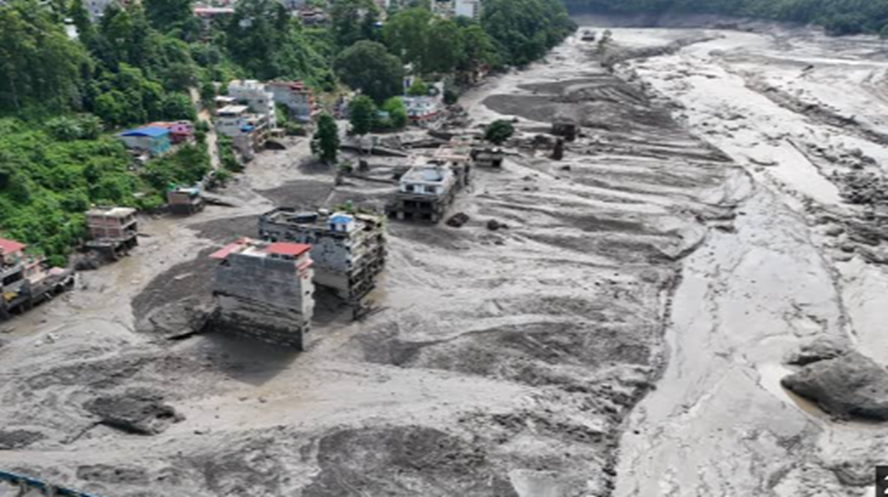
A new analysis by World Weather Attribution (WWA) examines how rapid warming and changing environmental conditions are affecting high-altitude mountain environments and contributing to increasingly complex, cascading hazards. Focusing on the devastating rock–ice avalanche and subsequent debris flood that struck Nepal’s Rasuwa district on 26 August 2026, the study examines how climate change, glacier retreat, permafrost degradation, changing precipitation and geological processes can interact to produce fast-moving mountain disasters.
Mountain environments are particularly sensitive to changes in temperature and precipitation. Rising temperatures can affect glacier mass, permafrost stability and snowfall, while changing precipitation can influence slope stability. When these processes interact with underlying geological conditions, landslides, avalanches and floods can combine and develop rapidly, creating challenges for conventional monitoring, early-warning and adaptation systems.
Against this backdrop, Dr Tom Robinson, Senior Lecturer at the University of Canterbury’s School of Earth and Environment, was part of the international research team investigating the Nepal disaster. His contribution focused on whether Nepal’s magnitude 7.8 earthquake in 2015 played a role in the event and how earthquake-related damage may have interacted with longer-term climate-driven changes. The research brought together specialists in landslides, glaciology, climate change, flooding, data science and risk management.
The disaster began when approximately two square kilometres of rock wall and glacier ice collapsed from Langtang Lirung mountain at around 5,150 metres above sea level. The material fell nearly 1,400 metres, triggering a chain of processes that transformed into a debris flood and subsequently a water-dominated flash flood, reaching the Rasuwagadhi border 22 kilometres downstream within seven minutes. The analysis found that geological conditions played a fundamental role in the slope failure, while longer-term warming and changing precipitation may have contributed to conditions affecting slope stability.
The study found that human-induced climate change has significantly increased temperatures around the site, with July and August temperatures now about 1.5°C warmer and annual temperatures about 1.9°C warmer because of human influence. However, the researchers stress that the specific 2026 avalanche cannot be attributed to climate change alone. The findings also have relevance for Aotearoa New Zealand, where Dr Robinson says many of the conditions identified in the study are also present, including warming temperatures, rapidly receding glaciers and less snow and more rain at higher elevations.
As climate change continues to reshape mountain environments, the research highlights the importance of understanding cascading hazards as interconnected processes rather than isolated risks. The findings point to the need for stronger monitoring, early-warning systems and adaptation measures, alongside continued efforts to limit future warming and better understand the risks facing communities in mountain environments.
