


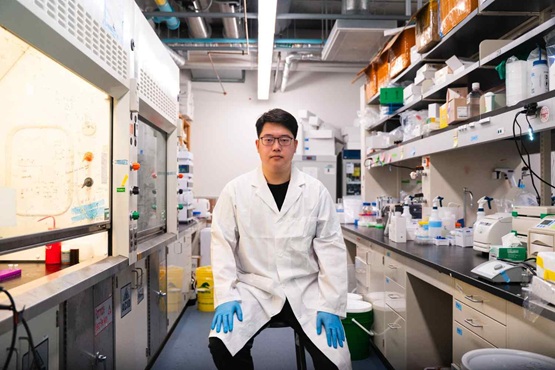
Researchers at the University of Toronto have developed a next-generation RNA therapeutic approach with the potential to treat a wide range of genetic diseases that share certain disease-causing mutations. The work advances an emerging platform in genetic medicine centred on transfer RNA, or tRNA. The team engineered tRNA to help cells read through premature stop signals and complete production of full-length proteins that would otherwise be truncated or absent.
Study lead Bowen Li, an associate professor in U of T’s Leslie Dan Faculty of Pharmacy, says the research could lay the foundation for a new class of drugs designed to treat a swath of genetic diseases through a common therapeutic strategy.
“There are so many types of disease-causing mutations – many affecting only a small number of people – that developing a separate gene therapy for every individual mutation is extremely challenging,” says Li, who is also an affiliate scientist at the University Health Network’s Princess Margaret Cancer Centre.
“With tRNA therapeutics, our goal is to develop a common therapeutic approach that could potentially address the same type of mutation across many different genes and diseases, including rare conditions that currently have few or no effective treatment options.”
Li and his team homed in on “nonsense mutations.” These mutations introduce a premature stop signal into the genetic instructions for making a protein. The result: Cells may produce little or no full-length functional protein, disrupting vital functions in ways that are difficult to treat.
Although nonsense mutations are estimated to cause only about 11 per cent of inherited genetic disorders, those number in the thousands, including subsets of cystic fibrosis and certain muscular and neurological diseases.
The study, published in Science on Aug. 27, shows that tRNA can be engineered to suppress disease-causing nonsense mutations and restore full-length protein production across a series of laboratory and
preclinical models of cystic fibrosis. The researchers also found that the approach can be combined with existing cystic fibrosis drugs, suggesting the potential for combination therapy.
“The same type of premature stop signal can occur in many different genes, causing diseases that affect the lungs, brain, muscles and other tissues”, says Li. “Our long-term goal is to develop tRNA medicines that recognize these shared stop signals, so that one therapeutic strategy could potentially be applied across many different genetic diseases.”
Study co-lead Haissi Cui, assistant professor of chemistry in the Faculty of Arts & Science, pointed the team toward a novel approach: Add back the chemical tags found in natural tRNAs. One did the trick.
“Interdisciplinary collaboration was key to this project,” says Cui. “We used nature as our design guide and found that adding one specific modification made the engineered tRNA more active and longer-lasting. It shows what becomes possible when chemistry and RNA biology come together.”
Jingan (Charles) Chen, a researcher in Li’s lab and co-lead author of the study, says the next challenge was getting the tRNAs to the cells that needed them. The team settled on lipid nanoparticles, the fatty bubbles that carried mRNA in the COVID-19 vaccines but needed a redesign to deliver tRNA.
“No matter how powerful you make those tRNAs, without delivery, they cannot be a drug,” says Chen, a PhD candidate in the Leslie Dan Faculty of Pharmacy and the Institute of Biomedical Engineering.
“That cargo-specific delivery system is one of the major advances of our study. We used a tailored lipid nanoparticle delivery system that is specifically developed for tRNA.”
In recent years, cystic fibrosis care has been transformed by a wave of drugs called CFTR modulators, such as Trikafta. But they are not effective for the roughly one in 10 patients whose disease stems from a nonsense mutation. Cystic fibrosis leaves cells unable to move salt and water, so mucus clogs the airways and gut. Modulators repair and activate the misshapen CFTR protein that controls this flow. But they can’t fix what was never built.
The U of T researchers set out to test if tRNA could change that. The question was not just whether the CFTR protein reappeared, but whether it did its job. It did both. In human airway cells with two common nonsense mutations, the protein came back and worked as it should, sticking around for more than 40 days. Further preclinical tests pointed in the same direction.
Research team members Jim Hu and Tanja Gonska, both SickKids scientists with appointments in U of T’s Temerty Faculty of Medicine, provided access to tissue from a cystic fibrosis patient with a complex
CFTR genotype containing four mutations – two of them nonsense – that left them unresponsive to existing drugs.
These samples were grown into miniature models called organoids. Although neither the modified tRNA nor Trikafta did much on its own, the patient’s cells responded when the two were used together. The tRNA restored production of the full-length protein and gave Trikafta something to work with.
Lisa Dolovich, dean of the Leslie Dan Faculty of Pharmacy, sees the study as part of U of T’s tradition of drawing from the body’s own biology to unlock new treatments, from insulin to the GLP-1 discoveries behind drugs like Ozempic.
“This is the kind of foundational research that medical breakthroughs are built on,” Dolovich says. “By tackling the science and the delivery together, we’re closer to turning a discovery into a drug.”
The researchers say the study represents a major step forward in demonstrating tRNA’s therapeutic promise. Li’s lab is looking to expand the approach to other organs, each of which will need a specialized delivery system. For the lungs, the team has shown its particles can survive being turned into a fine mist ¬– a first step toward a treatment that patients could inhale at home.
The research was supported by the Canadian Institutes of Health Research, the Natural Sciences and Engineering Research Council, Cystic Fibrosis Canada, the Cystic Fibrosis Foundation, the New Frontiers in Research Fund, the Canada Research Chairs Program, the Connaught Fund, the Harrington Discovery Institute and the National Institutes of Health.
