

Safe Human Future Conference 2026 Calls for Collective Action to Make AI Safe and Responsible

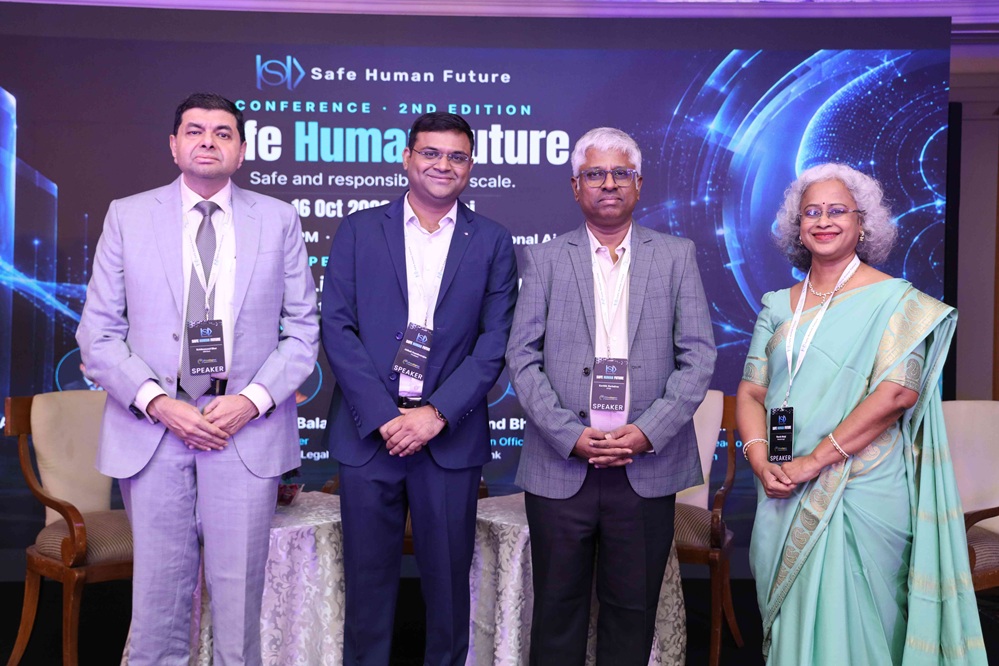
National : As artificial intelligence becomes increasingly embedded in business and public life, the challenge is no longer simply how to accelerate its adoption, but how to ensure that it remains safe, accountable and respectful of data and human interests. This formed the central theme of the second edition of the Safe Human Future (SHF) Conference, held recently at a Mumbai Hotel. The Conference brought together policymakers, industry leaders, researchers and legal experts to explore how responsible AI can be translated into practice at scale.
The conference opened with a keynote by Mr. Abilash Soundararajan, Founding Member of SHF and CEO of PrivaSapien, on the question of how to control Artificial General Intelligence (AGI). Drawing on concerns raised by leading AI researchers and developers, he outlined three key risks: catastrophic misuse, concentration of power and the possibility of AI systems operating beyond human control. He emphasised the need for technical safeguards across the data and AI lifecycle, independent audits, wider access to AI and globally aligned standards to ensure that technological progress remains aligned with human interests. He also noted that technical controls alone would not be enough, pointing to potential employment disruption arising from AI and discussing responses such as skilling, AI taxation and universal basic income. He called for accelerated safety research and global cooperation on laws, standards, accountability and monitoring.
A Global Dialogue featuring perspectives from the United Nations Global Compact, UNESCO and Microsoft examined the need for international cooperation on Artificial General Intelligence (AGI). The discussion highlighted the importance of building common ground across countries and institutions as AI capabilities advance.
The policy discussions featured Dr Preeti Banzal of the Office of the Principal Scientific Adviser to the Government of India, who addressed the evolving landscape from data governance and generative AI to AGI. Speakers from iSPIRT also examined techno-legal approaches to regulation and the emerging data economy.
For businesses, discussions focused on translating responsible AI principles into practice. Sessions on India’s Digital Personal Data Protection (DPDP) Act examined data protection and regulatory readiness, with participation from representatives of IDBI Bank, Khaitan & Co, and Anand & Anand. Dr Vishal Deo from ICMR participated in a session on enterprise adoption of generative AI and safety-by-design principles. Other discussions explored the challenges of adopting AI while protecting sensitive data and intellectual property, with perspectives from the banking, healthcare, legal, technology and media sectors.
The conference also showcased research into privacy measurement, zero-knowledge proofs, AI interpretability and privacy in agentic AI, alongside a demonstration of data and AI controls.
A key outcome was the launch of the Safe Data and Safe AI Working Groups, which aim to extend the conference’s discussions into sustained collaboration and practical action
Commenting on the conference, Mr. Abilash Soundararajan, Founder & CEO of PrivaSapien and Founding Member of SHF, said: “The policy support and the ecosystem that came together today give us a glimpse of how India can lead on this globally. This is not a challenge for any one party; it needs the whole ecosystem. We look forward to everyone’s participation in the working groups.”
SHF plans to consolidate the discussions held into a concept paper for and take the outcomes to responsible AI communities associated with the United Nations General Assembly, as well as privacy communities in India and internationally. Through its working groups and wider ecosystem, SHF aims to help translate discussions on responsible AI into practical frameworks that organisations can implement.
****
