


NEW DELHI : Two years ago, Mozilla asked two leading experts on deceptive design, Dr. Harry Brignull and Cennydd Bowles, to examine how Microsoft treats people who try to use a browser other than Edge on Windows. Today the same researchers published Over The Edge 2.0, and their conclusion has not changed: Microsoft continues to steer users towards Edge across Windows, Edge, Bing, and now Copilot through deceptive practices that make it difficult for users to download, set as default, and continue using alternative browsers.
Key findings from the report include:
● Windows Search and Widgets continue to ignore users’ default browser choices and open links in Edge.
● Edge is still injecting a banner directly into the Chrome download page on google.com.
● Windows Backup does not consistently preserve browser preferences when users migrate from Windows 10 to Windows 11.
The researchers retested such practices across Windows 10 and Windows 11 in four regions – the USA, India, the UK, and Germany (representing the European Economic Area). In the EEA, where the Digital Markets Act imposes obligations on large digital gatekeepers to promote user choice and curb anti-competitive practices, regulation forced Microsoft to remove some of the worst patterns. While it still has some harmful design patterns, Microsoft has built a relatively fairer user experience for browser choice vis-a-vis other regions. Outside the EEA – especially in India, Brazil, and the US, nearly every documented harmful pattern remains in force. This disparity reflects an active choice by Microsoft, one it could make differently, and it underlines the benefit that ex ante competition regulation, which prevents anti-competitive conduct before it occurs, can bring for consumers.
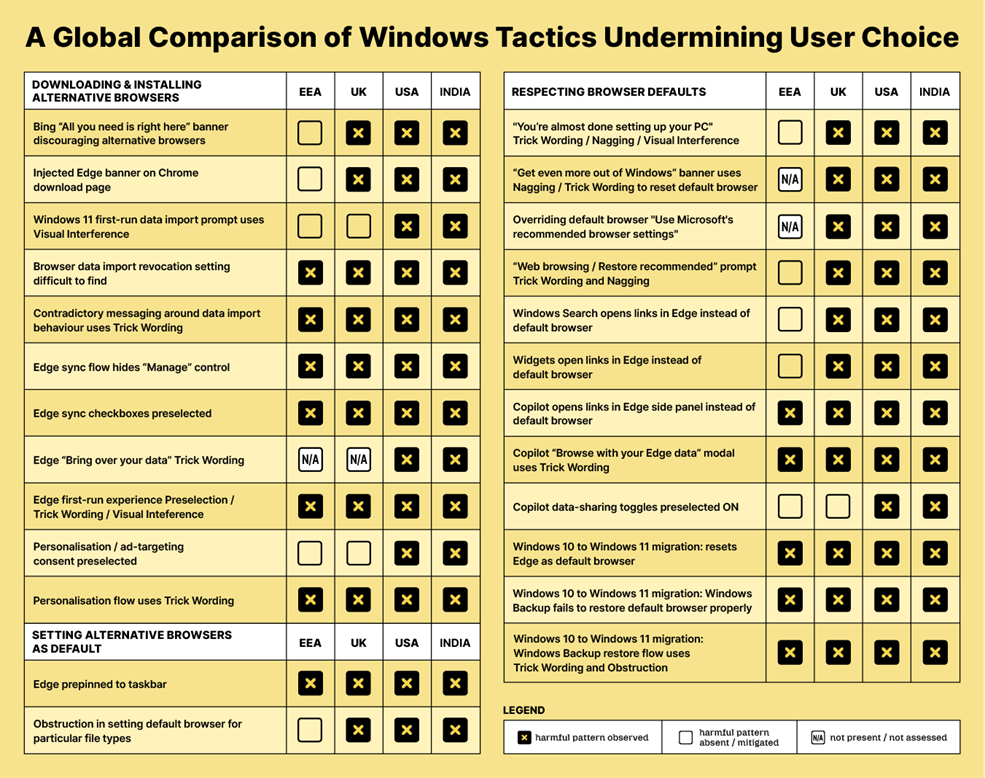
The default browser should not depend on the jurisdiction and Mozilla is asking Microsoft to ship the fairer designs it already builds, everywhere. Mozilla is publishing the report and calling on Microsoft to close the remaining gaps in the EEA and ship that experience worldwide.
“Microsoft has shown that it can respect user choice. When regulators are watching, they make some changes. We would ask them to do it globally, rather than relying on competition regulation to force their hand,” said Kush Amlani, Global Competition and Regulatory Lead at Mozilla.
Why This Matters
Windows powers roughly 65% of desktop devices worldwide, giving Microsoft’s platform choices an outsized impact on more than 1.4 billion users. In India, nearly 43% of Windows users were still on Windows 10 as of Q1 2026 – the highest share among the regions tested, making the preservation of browser choice particularly important.
Browser defaults increasingly shape how people access information, interact with the web, and encounter emerging AI services. As AI investments accelerate, incentives to bundle AI products with existing dominant services and steer users towards preferred ecosystems may increase. The report found that Copilot, Microsoft’s AI-powered assistant, forces web links to open in a side panel rendered by Edge, regardless of a user’s chosen default browser. If such AI-driven self-preferencing goes unchecked, choices made today could shape the digital landscape for the next decade.
Closing the Gap in India
India is one of the world’s largest Windows markets, and is developing its own approach to digital-market regulation, including potential ex ante obligations for large gatekeepers. The report’s findings are directly relevant to this conversation: regulatory pressure has already improved user choice in the EU, while the persistence of harmful designs elsewhere shows the need for stronger safeguards.
