

Singhvi Accuses CEC of ‘Hijacking’ Election Commission, Calls It Internal Bulldozer of Dual Assault on Democracy

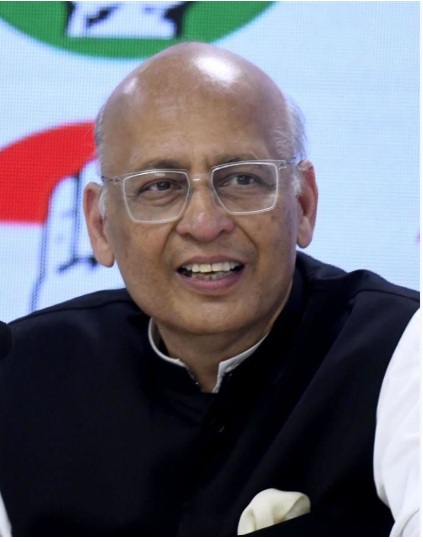
New Delhi: Congress leader and senior advocate Dr Abhishek Manu Singhvi on Wednesday accused the Chief Election Commissioner of running the Election Commission as a personal fiefdom, turning fellow commissioners into “ornamental dummies” and partnering an “external bulldozer” of the government in what he termed a grave assault on India’s constitutional health.
Addressing the media at the AICC office at 24 Akbar Road, Singhvi said the BJP had opened “an office for the murder of democracy” with the CEC on one side and the Home Ministry on the other. He described the situation as a “double bulldozer sarkar” — an external one that has targeted institutions including the press and even the judiciary, and an internal one inside the Commission itself.
Singhvi began by praising an Indian Express report published the same day as “journalism of courage, research and analysis” and a standard that sections of “Godi media” should emulate if they wish to fulfil the role of the fourth pillar under Article 19(1)(a).
He reminded the gathering of the 1995 Supreme Court judgment delivered in the T.N. Seshan era. The court had held that the CEC is only first among equals and that every Election Commissioner “must have a say in decision-making.” If the CEC’s word were treated as final, the other commissioners would become “non-functional or ornamental,” the judgment said. Thirty years later, Singhvi alleged, that ruling had been consigned to the dustbin.
According to him, Election Commissioners Vivek Joshi and Gyanesh Kumar Sandhu had recorded written dissent 14 times in 10 months. On 13 August they termed changes to Form 6 — used by first-time 18-year-old voters — “unauthorised or illegal.” The form now requires applicants to declare whether their parents or grandparents figured in an earlier Special Intensive Revision (SIR), a condition neither the original form nor the rules contain. Only the government can amend the form, they wrote; the Commission as a whole cannot. The CEC, Singhvi said, had nevertheless altered it unilaterally and met subsequent queries with “eloquent silence.”
The consequence, he argued, is intergenerational disenfranchisement. Some 13 crore names have already been struck off the rolls. Children of those deleted voters who turn 18 will find it far harder to enrol, even if they possess Aadhaar, residence proof and citizenship documents, because the new filter looks first at ancestral SIR status.
In May the two commissioners also objected that hundreds of Electoral Registration Officers — the local officials legally empowered to add or delete names — were being denied access to their own ERO Net portal by the Commission’s IT wing. In August Sandhu questioned how the Commission had filed 16 lakh appeals in West Bengal against inclusions ordered by appellate officers, without any authorisation from the other two members. Again, there was no reply.
Singhvi cited official figures: 7.8 crore deletions in the first two phases (13 per cent of the earlier roll) and 6.18 crore more in the ongoing third phase covering 16 states and three Union Territories (17 per cent of 36 crore electors). An additional 5.43 crore voters have received notices seeking extra documents. If even half of those notices result in deletions, the total could exceed 15.5 crore, he said. The burden, he added, falls heaviest on the poor and socially disadvantaged who lack resources to fight notices.
He linked the process to a larger “obsession with victory at any cost” — an opposition-less West Bengal Assembly that formally supports the ruling side, wholesale defections, and the arrest of a Congress candidate in a 2007 FIR just before a 2026 bypoll.
Singhvi demanded that all dissent notes be placed in the public domain rather than being stonewalled through RTI. “Dissent is not disruption; dissent is democracy protection,” he said. The CEC, he declared, has “no moral, legal or constitutional right to continue in office even for one second” and should resign.
The issue, he added, is of pan-India importance and will be taken up by the INDIA alliance. After the latest revelations, he said, “nobody can possibly repose trust and faith in the head of the institution.”
