

Srinagar–Nalanda Dialogue 2026 Concludes with Call for Knowledge, Cultural Exchange and Sustainable Development

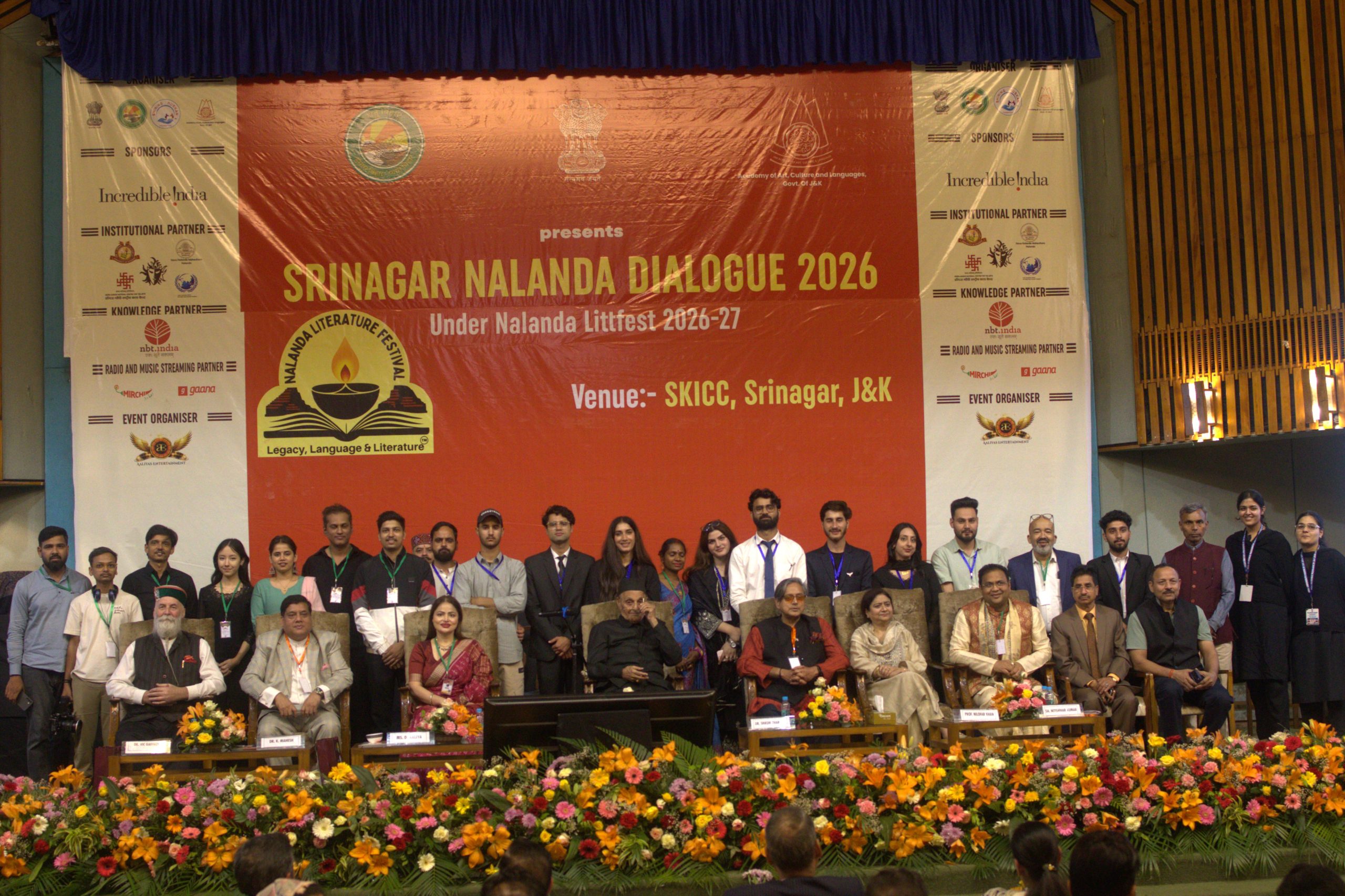
SRINAGAR : The Srinagar–Nalanda Dialogue 2026, hosted at the SKICC-Srinagar, J&K, under the aegis of the Nalanda Literature Festival (Nalanda LittFest), concluded with the adoption of the Srinagar–Nalanda Declaration, reaffirming the importance of dialogue, knowledge-sharing, cultural exchange and sustainable development in addressing contemporary challenges.
The concluding Valedictory Session (Srinagar–Nalanda Declaration Session) brought together distinguished scholars, policymakers, cultural leaders and international experts to reflect on the enduring intellectual ties between Kashmir and Nalanda; two historic centres of learning that have shaped civilizational thought across Asia.
The dignitaries on the dais included Padma Vibhushan Dr. Karan Singh, President and Patron of the Nalanda Literature Festival; Dr. Shashi Tharoor, Member of Parliament and noted author; Sh. Nitishwar Kumar, senior public intellectual and former IAS officer; Prof. Nilofer Khan, Vice-Chancellor of the University of Kashmir; Ms. D. Aaliya, Festival Chairperson; Sh. Ganga Kumar, Festival Director, Dr. K. Mahesh; and Dr. Vic Gaffney, international adviser to the Nalanda Literature Festival.
Delivering the keynote valedictory address, Dr. Shashi Tharoor described the gathering as a symbolic reunion of two great traditions of learning. He noted that both Srinagar and Nalanda historically served as crossroads of ideas, scholarship and cultural interaction.
“Dialogue is not an accessory to knowledge; dialogue is a process through which knowledge grows,” Dr. Tharoor said, stressing that societies flourish when ideas are exchanged freely. He added that “cultures are strengthened not through exclusion, but exchange,” and reminded participants that “learning is not a private pursuit but a shared human endeavor.”
Highlighting Kashmir’s contribution to global intellectual history, Dr. Tharoor recounted the journey of Tibetan scholar Thonmi Sambhota, who travelled to Kashmir to study linguistic traditions before helping develop the Tibetan script. The episode, he said, illustrated the Valley’s historic role as a bridge connecting diverse civilizations and knowledge systems.
Presiding over the session, Dr. Karan Singh reflected on the 2000 years deep historical links between Kashmir and Nalanda, describing Kashmir as the “northern intellectual counterpart of Nalanda.” He spoke of the region’s unique synthesis of Buddhist, Shaiva and Sufi traditions, recalling the legacy of Emperor Kanishka’s Fourth Buddhist Council, the spiritual influence of Shah-e-Hamadan, and the enduring philosophical contributions of Kashmir Shaivism.
With the International Day of Yoga Dr. Singh elaborated on the broader meaning of Yoga as the union of individual consciousness with the divine. Explaining the four classical paths – Jnana Yoga (knowledge), Bhakti Yoga (devotion), Karma Yoga (action), and Raja Yoga (spiritual discipline) – he urged younger generations to embrace Yoga as a holistic philosophy of life rather than merely a physical exercise.
Concluding his address, Dr. Singh recited the ancient Sanskrit prayer: “Sarve sukhina santu, sarve santu nirāmayāḥ, sarve bhadrāṇi paśyantu, mā kaścit duḥkha bhāgbhavet” (May all beings be happy, healthy, witness auspiciousness, and remain free from suffering).
While summarising the outcome of the whole day’s dialogue, Dr. Vic Gaffney emphasized the need to connect India’s ancient knowledge traditions with contemporary global scholarship. He highlighted the role of universities and cultural institutions in promoting accountable governance, preserving heritage and fostering sustainable development through research, dialogue and international collaboration.
Concluding his summary of the day’s events, Dr. Gaffney reminded everyone that: “AI also allows for the marginalized to access information that they could never do before and not only that, project their message across using social media and so on so that their voices can be heard in the community.”
While addressing the session, Prof. Nilofer Khan, Vice-Chancellor of the University of Kashmir, underscored the deep historical and intellectual convergence between Kashmir and Nalanda as enduring centres of learning and inquiry. She highlighted Kashmir’s centuries-old contribution to philosophy, literature and knowledge systems, linking it to India’s broader civilizational heritage.
“Nalanda symbolized openness, dialogue and the universal quest for wisdom. Kashmir too occupies a unique and distinguished place in the intellectual history of our civilization,” she said, stressing the importance of preserving indigenous knowledge systems.
Sh. Nitishwar Kumar spoke on the importance of dialogue as a transformative force in society, observing that the younger generation continually discovers new meanings in history and culture. He stressed that intellectual exchange remains essential to preserving India’s civilizational heritage while inspiring future innovation and creativity.
The adoption of the Srinagar–Nalanda Declaration marked the culmination of the dialogue. The declaration called for greater collaboration between educational institutions, policymakers and cultural organizations to strengthen knowledge-based governance, preserve cultural and ecological heritage, and promote sustainable tourism as a vehicle for peace, mutual understanding and economic development.
The declaration also emphasized pluralism, civilizational dialogue and the continued relevance of ancient knowledge systems in addressing modern challenges. Delegates highlighted the need to balance development with conservation, ensuring that Jammu and Kashmir’s rich cultural and environmental legacy is protected for future generations.
Earlier in the proceedings, former Uttar Pradesh Minister Sh. Anurag Bhadoria congratulated Sh. Ganga Kumar, Festival Director, and the organizing team for successfully convening the dialogue. He praised Dr. Karan Singh’s remarkable intellectual vitality and lauded Dr. Shashi Tharoor’s contributions to public discourse, scholarship and leadership.
Delivering the formal Vote of Thanks, Dr. K. Mahesh highlighted the contemporary revival of Nalanda’s cultural significance and referred to the recent Geographical Indication (GI) recognition accorded to Bihar’s renowned Bawan Buti sarees. He underscored the importance of ensuring that intellectual and cultural initiatives translate into meaningful socio-economic development at the grassroots level.
Dr. K Mahesh expressed gratitude to the dignitaries, delegates, faculty members, students and organizers who contributed to the success of the event. He specifically acknowledged the inaugural address delivered by the Lieutenant Governor of Jammu & Kashmir, thanked Prof. Nilofer Khan for hosting the NLF team at the University of Kashmir, and recognized the leadership of Sh. Ganga Kumar, Festival Director, and Ms. D. Aaliya, Festival Chairperson, in bringing the initiative to fruition.
As the curtains fell on the Srinagar–Nalanda Dialogue 2026, participants reaffirmed a shared commitment to preserving India’s civilizational wisdom while fostering new pathways for cooperation, scholarship and cultural understanding. The message emerging from Srinagar was clear: enduring progress is built not merely through institutions, but through dialogue, curiosity and the continuous exchange of ideas across cultures, regions and generations.
