


By Suresh Unnithan
In Thalavoor, a silent village in Kollam district, Kerala, the machinery of democracy is grinding away at a record pace. Despite Sunday being a mandatory weekly holiday for government and private employees alike, a young lady BLO—a dedicated school teacher burdened with the care of aged parents and young children—found herself compelled to tread from one house to another, collecting filled SIR forms. She visited the home of this correspondent at least half a dozen times: first to hand over the enumeration forms from the Election Commission of India (ECI), then repeatedly to retrieve completed ones, and finally to serve notices for personal hearings before the Assistant Electoral Registration Officer (AERO) at a distant school. According to the BLO, the ECI provided no clear guidelines for those unable to travel—senior citizens, the bedridden, hospitalized patients, or individuals undergoing treatment for critical illnesses—leaving vulnerable voters and overburdened officers alike in a difficult position.
This experience reflects the broader strain imposed by the Special Intensive Revision (SIR) of electoral rolls in Kerala, a comprehensive house-to-house verification exercise launched ahead of the 2026 Assembly elections. The first such intensive revision since 2002, the SIR required BLOs—mostly government school teachers and other employees—to distribute, collect, and digitize forms for nearly every voter in the state within tight deadlines. The enumeration phase ran from November 4, 2025, initially to December 4 but extended to December 18 following requests and Supreme Court observations. The draft electoral roll was published on December 23, 2025, listing 2,54,42,352 electors, down from the pre-SIR figure of around 2.78 crore voters. Claims and objections against the draft continue until January 22, 2026, with the final roll expected in February 2026.
Kerala operates with over 25,000 polling stations (with plans for around 5,000 additional booths for 2026 to limit voters per station to about 1,200). Each BLO typically handles an average of 1,000 to 1,500 voters, a workload that ballooned during the SIR due to multiple mandatory visits per household (often three or more), form follow-ups, digitization targets, and notices for hearings. Many BLOs, including women balancing family duties, worked 12–14 hours daily, often on personal vehicles and even holidays, incurring heavy fuel costs—far exceeding the monthly SIR allowance of around Rs 2,000. In Thalavoor’s case, one BLO reported spending over Rs 8,000 on fuel alone in a single month.
Support from political party Booth Level Agents (BLAs) was minimal; despite being listed from various parties, including the BJP (which had been vocal in support of the SIR), few responded to calls for assistance, leaving BLOs isolated. As government employees, compliance with ECI directives was mandatory, offering no room for refusal. The lack of specific provisions for mobility-challenged voters forced BLOs into repeated pursuits of untraceable or homebound electors, heightening frustration on both sides.
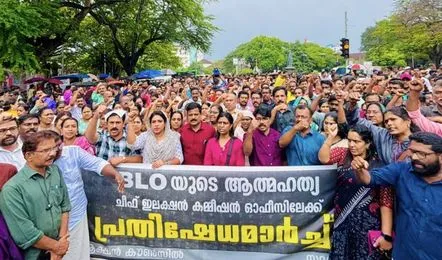
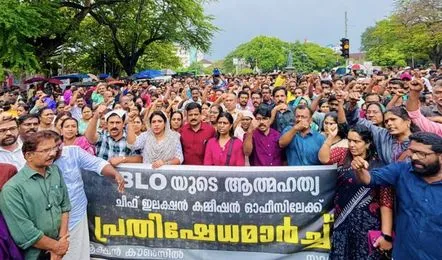
The pressure proved tragic in some instances. In November 2025, a 44-year-old BLO named Aneesh George from Kannur district was found dead by hanging at his home in Ettukudukka near Payyannur. His family and colleagues alleged unbearable workload and deadline stress from SIR duties, sparking state-wide outrage. Government employee unions—including the Action Council of State Government Employees and Teachers, Joint Committee of Teacher Service Organisations, and Kerala NGO Association—called a one-day boycott of BLO work in protest, demanding relief measures. While district authorities claimed no direct linkage to targets (noting he had completed much of his assigned work), the incident fuelled broader concerns about mental strain. Initiatives like the ‘Joyathon’ campaign in districts such as Thiruvananthapuram aimed to provide short breaks and morale boosts, but critics argued these were insufficient against the exercise’s intensity.
Voters with mobility issues faced particular hardships. The door-to-door model offered no formal accommodations for senior citizens, the bedridden, or those under critical treatment, requiring them—or relatives—to coordinate with BLOs or risk exclusion. Hearings at distant AERO locations added further barriers, contributing to initial untraceable cases and potential disenfranchisement in the draft roll.
The ECI justified the SIR as essential for accurate, inclusive rolls ahead of 2026 polls, emphasizing verification to eliminate discrepancies. Deadlines were adjusted slightly (e.g., enumeration extended to December 18, claims/objections to January 22), but no detailed public explanation addressed why such an intensive, compressed approach was needed over routine revisions. In Kerala, the LDF-led government passed resolutions labelling it a “citizenship survey by the backdoor,” while opposition voices questioned the timing amid local body elections and the human cost.
As of early January 2026, with claims and objections on-going, the SIR in Kerala highlights systemic challenges: overburdened BLOs, inadequate support, financial strain, and barriers for vulnerable voters. The hurriedly conducted process, while achieving high enumeration and digitization rates, has left lingering suspicions about its perfection and urgency. Better compensation, stronger BLA involvement, digital alternatives for the mobility-impaired, and more flexible timelines could help ensure future revisions strengthen democracy without exacting such a heavy toll.
