

Tamil Nadu’s Growth Story Moves Beyond Chennai; Six Emerging Cities to Drive Real Estate and Economic Growth Towards 2036: JLL Report

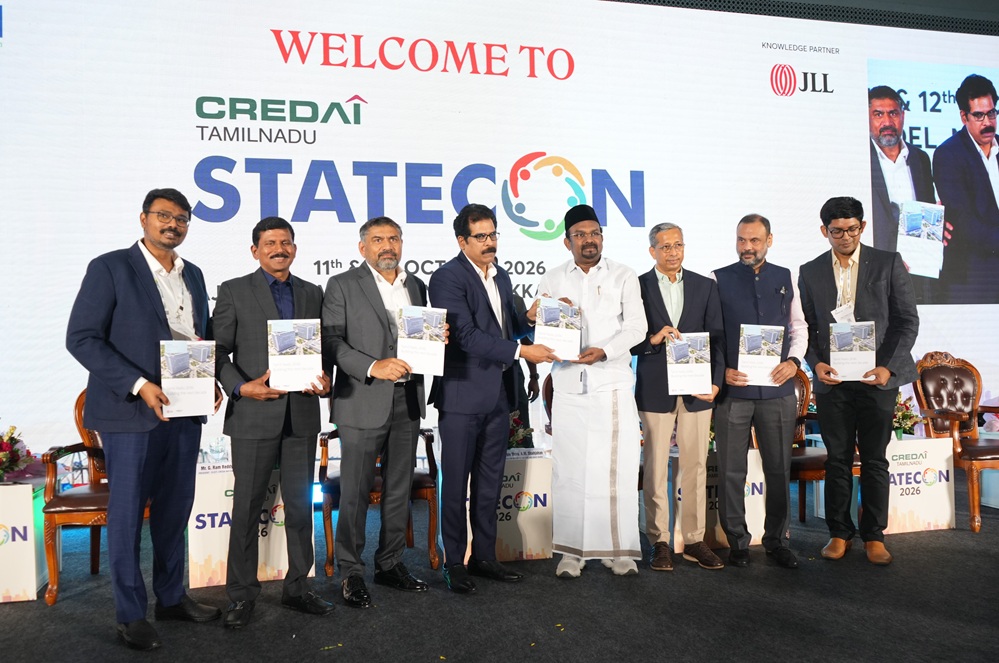
Chennai : Tamil Nadu’s next phase of economic and real estate growth will increasingly be driven by cities beyond Chennai, with Coimbatore, Madurai, Tiruchirappalli, Hosur, Salem and Thoothukudi emerging as important economic and investment destinations, according to a new report by JLL Research prepared for CREDAI Tamil Nadu’s STATECON 2026.
Titled ‘Tamil Nadu 2036: Building the Next Decade’, the report examines the state’s evolving economic landscape, investment flows, infrastructure development, emerging industrial and services clusters, and real estate opportunities across different asset classes. It highlights the growing decentralisation of economic activity and the need for coordinated urban development to support Tamil Nadu’s ambition of becoming a USD 1.5 trillion economy by 2036.
Tamil Nadu, currently India’s second-largest state economy, has a nominal GDP of approximately Rs. 29.95 lakh crore, accounting for around 10% of the country’s GDP. Manufacturing contributes over 20% of the state’s economic output and has recorded a compound annual growth rate (CAGR) of 8.3% between 2021 and 2025. The state also accounts for 15% of India’s total manufacturing employment, providing livelihoods to approximately 4.2 million people.
The report points out that the state’s economic growth is increasingly supported by advanced manufacturing, electronics, electric vehicles, green energy, semiconductors, information technology and Global Capability Centres (GCCs). These sectors are generating demand for industrial parks, Grade-A office spaces, residential developments, logistics facilities and organised retail infrastructure.
Six cities emerging as growth drivers
The report identifies six cities as key growth centres that will shape Tamil Nadu’s next phase of urbanisation and real estate development.
Coimbatore has established itself as a strong industrial and services hub, combining its traditional manufacturing base with an expanding technology and GCC ecosystem. The city has over 60 operational GCCs, 9.1 million sq. ft. of Grade-A office stock and a growing engineering research and development ecosystem.
Madurai is emerging as southern Tamil Nadu’s services and cultural capital, supported by its strong temple tourism economy, expanding healthcare infrastructure, IT parks and improving connectivity. The city’s growing medical tourism and hospitality sectors are also creating opportunities for residential and commercial developments.
Tiruchirappalli is positioned as a strategic central transit and industrial hub, supported by its engineering and manufacturing ecosystem, educational institutions, healthcare infrastructure and emerging GCC potential.
Hosur is witnessing rapid industrial transformation, driven by investments in electric vehicles, electronics manufacturing and logistics. Its proximity to Bengaluru, coupled with growing industrial activity, is generating demand for industrial, warehousing and residential developments.
Salem is diversifying beyond its traditional strengths in steel, textiles and agro-processing, with emerging opportunities in IT services, logistics and industrial development. Its strategic location connecting Chennai, Bengaluru and Coimbatore further strengthens its investment potential.
Thoothukudi is emerging as a major maritime, green energy and advanced manufacturing destination, supported by port-led infrastructure, green hydrogen investments, shipbuilding initiatives and expanding industrial activity.
Investment momentum strengthens across the state
The report highlights the significant progress made in converting investment commitments into projects on the ground. Tamil Nadu has attracted over 1,283 MoUs over the last 5.5 years, representing committed investments exceeding Rs. 11 lakh crore and the potential to generate more than 37 lakh jobs. The MoU-to-project conversion rate has reached approximately 73–78%, reflecting stronger investment implementation.
The South Zone leads in capital concentration, with investments exceeding Rs. 1.68 lakh crore, driven by port-led industrial development and green energy projects. The West Zone has attracted over Rs. 1.2 lakh crore, supported by manufacturing, engineering and emerging services sectors, while the North Zone has recorded investments exceeding Rs. 51,000 crore, primarily driven by automotive, electric vehicle and electronics manufacturing.
Real estate opportunities extend across asset classes
The report identifies significant opportunities across residential, industrial, commercial, retail and hospitality segments as economic activity expands beyond Chennai.
In the residential segment, plotted developments continue to dominate the emerging city markets, accounting for approximately 79–88% of residential launches across the secondary growth corridors. Chennai continues to account for 51.5% of the state’s residential launch activity, while the West and South zones are witnessing increasing development activity.
Industrial and logistics real estate is another major growth opportunity. The report notes that Tamil Nadu has 50 SIPCOT industrial parks, including eight Special Economic Zones, spread across 24 districts, covering approximately 48,900 acres. However, industrial land availability in mature markets such as Coimbatore and Madurai has been almost completely absorbed, creating opportunities for private institutional investment in Grade-A industrial and logistics facilities.
The GCC ecosystem is also expanding beyond Chennai. Coimbatore has emerged as a significant technology destination, with approximately 60% of its GCC workforce engaged in engineering R&D. The expansion of TIDEL and TIDEL Neo infrastructure across Madurai, Tiruchirappalli, Hosur and other cities is expected to support the growth of the state’s distributed technology ecosystem.
In the organised retail segment, Coimbatore and Salem currently account for approximately 1.2 million sq. ft. of institutional mall space. Madurai, Tiruchirappalli, Hosur and Thoothukudi represent the next set of opportunities as employment, incomes and consumer spending increase.
The hospitality sector is also expected to benefit from Tamil Nadu’s strong temple tourism ecosystem and growing demand for premium, sustainable tourism in hill destinations.
Policy interventions critical to achieving the 2036 vision
While highlighting the state’s strong economic fundamentals, the report underscores the need for proactive policy measures and infrastructure development to ensure that real estate supply keeps pace with industrial and employment growth.
It recommends extending single-window clearance mechanisms to project expansions, formalising land pooling as a mechanism for industrial land development, and pre-approving Transit-Oriented Development (TOD) zoning along planned metro corridors in Coimbatore and Madurai.
The report also calls for a clear rollout calendar for TIDEL Neo infrastructure to provide greater visibility for investors and GCC operators. In addition, it emphasises the importance of developing workforce housing, educational institutions, healthcare facilities and other social infrastructure ahead of employment growth.
Commenting on the report, Mr. W. S. Habib, President, CREDAI Tamil Nadu, said:
“Tamil Nadu’s growth story is no longer Chennai’s alone. Coimbatore, Madurai, Tiruchirappalli, Hosur, Salem and Thoothukudi are growing simultaneously, creating new opportunities for organised real estate development across the state. As Tamil Nadu works towards its USD 1.5 trillion ambition by 2036, the focus must be on faster approvals, land pooling, transit-oriented planning and housing that remains within reach. CREDAI Tamil Nadu is committed to partnering with the Government in strengthening the real estate ecosystem and supporting the state’s next phase of growth.”
The report concludes that Tamil Nadu’s USD 1.5 trillion economic ambition will depend on coordinated development across all six emerging cities rather than sequential growth concentrated around Chennai. Timely clearances, planned infrastructure, efficient land utilisation and the development of supporting social infrastructure will be critical to translating the state’s investment momentum into sustainable urban and economic growth.
****
