


By Suresh Unnithan
In the shadowed sanctums of ancient Kashmir and the vibrant temple walls of medieval India, Tantric arts bloom as exquisite technologies of consciousness. They serve as elegant bridges spanning the material and spiritual realms, inviting the seeker to expand awareness and accelerate personal transformation. Far from mere aesthetic ornaments, these sacred forms—yantras etched in precise geometry, mandalas unfolding like cosmic lotuses and the vivid iconography of deities—function as meditative instruments. They reweave the neural tapestry of the human mind, evoke profound emotional states known as rasa, and grant a direct, visceral taste of non-dual consciousness where the observer and the observed dissolve into ecstatic unity.
Tantric art operates as a living alchemy. Its intricate patterns and symbols gently shift perception from the fragmented clamor of everyday life toward a unified, cosmic vista. The practitioner, gazing upon a yantra’s concentric circles and intersecting lines, is drawn inward from external distractions to the central bindu—that infinitesimal point of pure potential representing the void, or shunyata. In this still center, the restless mind quiets, surrendering to a vaster intelligence where individual boundaries melt and the self recognizes its eternal kinship with the universe.
These arts also weave healing and psychological harmony. Yantras paired with resonant mantras create vibrational fields of coherence, realigning fragmented energies across physical, emotional, and spiritual layers. They soothe deep-seated fears, dissolve psychiatric distortions, and restore wholeness, much like a symphony resolving dissonant notes into harmonious chords.
Central to this transformative power is the awakening of Kundalini—the coiled, serpentine energy dwelling at the base of the spine, embodying the primordial divine feminine force, Shakti. Through visualization of sacred imagery, the practitioner coaxes this latent power upward through the subtle channels and chakras. As it ascends, each energy center blossoms, culminating at the crown in a godlike state of luminous, blissful consciousness. The body itself becomes a living temple, the nervous system a conduit for divine electricity.
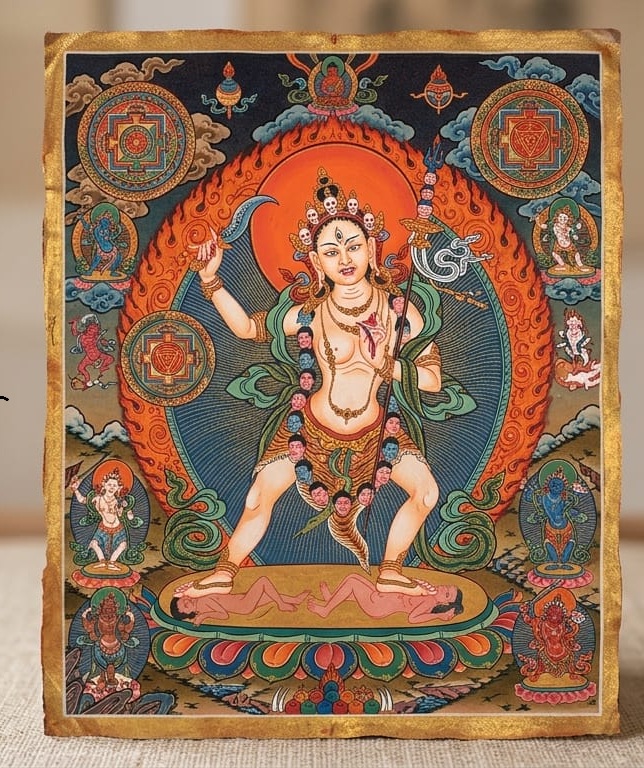
In its fiercer expressions, Tantric art confronts the shadows courageously. The wrathful form of Goddess Kali—tongue extended, garlanded with skulls, dancing upon the corpse of ego—embodies the compassionate destroyer. She urges the viewer to face taboos, attachments, and societal chains, shattering the rigid ego and liberating the spirit from conventional limitations. What seems terrifying reveals itself as a merciful force clearing the path for authentic freedom.
Every element within these compositions acts as a memory palace, encoding esoteric teachings that train unwavering focus and kindle inner awareness. Yantras function as psychological archetypes, their rhythmic geometries lulling the mind into meditative stillness. Mandalas, with perfect circular symmetry, mirror the universe in miniature, allowing the viewer to perceive their own mind reflected in the cosmos and the cosmos echoed within the psyche. Deity forms—Shiva in serene repose or Shakti in dynamic embrace—represent the practitioner’s own enlightened potential: the sacred union of consciousness and energy.
Woven throughout this sacred visual language is Rasa theory, the ancient alchemy of emotions. Rooted in Bharata Muni’s Natya Shastra and profoundly elevated by Abhinavagupta, rasa (literally “juice” or “essence”) transforms raw human feelings into pathways of divine realization. Through color, form, gesture, and iconography, Tantric art triggers determinants (vibhavas), physical expressions (anubhavas), and transitory states (vyabhichari bhavas), culminating in an ecstatic savoring that mirrors kundalini’s ascent.
The nine rasas unfold as living portals. Śṛṅgāra (erotic love and beauty), evoked in the entwined forms of Shiva and Shakti at temples like Khajuraho, transmutes sensual longing into spiritual ecstasy. Hāsya (laughter) brings levity through the cosmic jest of deities. Karuṇā (compassion) tenderizes the heart through images of maternal sorrow. Raudra (fury) blazes in Kali’s destructive dance, incinerating ignorance with compassionate wrath. Vīra (heroism) instills courage for the inner journey. Bhayānaka (terror) and Bībhatsa (disgust) force confrontation with mortality and the grotesque, purifying aversions. Adbhuta (wonder) sparks awe before the miraculous symmetry of yantras. Finally, Śānta (peace) emerges as the crowning tranquility when all other flavors harmonize, revealing the serene essence of pure consciousness.
These rasas do not stand isolated; they interlace like threads in a cosmic tapestry. A single Kali image might blend fury, terror, and compassion, propelling the connoisseur (rasika) through emotional layers toward ultimate serenity. In this way, Tantric art forges the heart into an alchemical vessel, refining raw feeling into the pure gold of realization.
At the radiant heart of this tradition stands Abhinavagupta, the 10th-century Kashmiri polymath whose genius fused aesthetics, ritual, and metaphysics into an incandescent whole. In his monumental Tantraloka and the Abhinavabharati—his luminous commentary on the Natya Shastra—he wove the Trika system of Kashmir Shaivism. Reality reveals itself as a sacred triad: Shiva (pure luminous consciousness), Shakti (its dynamic self-reflective power), and Nara (the limited soul that forgets its divinity). The universe is not an illusion to escape but the playful self-expression (svatantrya) of Shiva—ever pulsating in infinite freedom.
Abhinavagupta’s core insight pulses with Spanda—the subtle, ecstatic vibration of awareness, like the quiver of a vina string or the first tremor of Himalayan dawn. Through the 36 tattvas (principles of reality), consciousness descends into multiplicity yet remains one. Liberation dawns in the lightning-flash of Pratyabhijna—spontaneous recognition that “I am Shiva.” Even ordinary life becomes a field for awakening when the practitioner attunes to this inner throb.
His greatest contribution to aesthetics lies in elevating rasa to Tantric sacrament. The nine emotional flavors are not theatrical devices but direct tastes of the Divine. When the sensitive spectator surrenders to sacred art or performance, ego boundaries dissolve, and the universal Shanta Rasa—tranquil essence of pure consciousness—emerges as the ground from which all others arise and into which they resolve. Art thus becomes yoga: the gaze upon Kali shatters attachments through raudra and bhayānaka; the embrace of lovers awakens non-dual union through shringara. Every aesthetic moment offers a microcosm of cosmic play, a portal to samadhi.
In the Tantraloka, Abhinavagupta unfolds the full spectrum of Tantric practice—mantras, mudras, rituals, and even left-hand elements—as skillful means (upayas) to ignite recognition. The Sri Yantra, with its nine interlocking triangles, perfectly encodes this vision: the interplay of Shiva and Shakti across levels of consciousness, converging in the central bindu of pure awareness. Gazing upon it, the seeker experiences the universe contracting into a point and exploding outward as the cosmos—mirroring Spanda’s eternal pulsation.
From a modern vantage, these ancient technologies resonate with contemporary understanding. Tantric practices foster neuroplasticity, sculpting new neural pathways that support expanded awareness, emotional resilience, and heightened presence. The subtle body—with its nadis, chakras, and pranic flows—aligns with interoceptive mapping, the nervous system’s sophisticated perception of internal signals. Yantra gazing and rasa engagement appear as precise tools for modulating unconscious structures and bridging conscious awareness with deeper neural depths.
In an age of distraction and fragmentation, the combined wisdom of Tantric arts, Rasa theory, and Abhinavagupta’s Trika philosophy offers a timeless invitation. The mind is not a fixed machine but a fluid canvas capable of profound rewiring and boundless expansion. Gaze upon the sacred geometry, savor the emotional flavors, attune to the inner Spanda, and let recognition dawn: the divine resides not beyond the veil but within the very geometry of perception, pulsing as your own luminous awareness.
The world is not to be renounced but relished—for it is Shiva dancing in the mirror of your consciousness. In this tasting, fragmentation yields to wholeness, and the soul awakens to its eternal, sovereign freedom.
