

Tech co-development, localisation can unlock ₹1 lakh crore opportunity for India’s EV manufacturing ecosystem

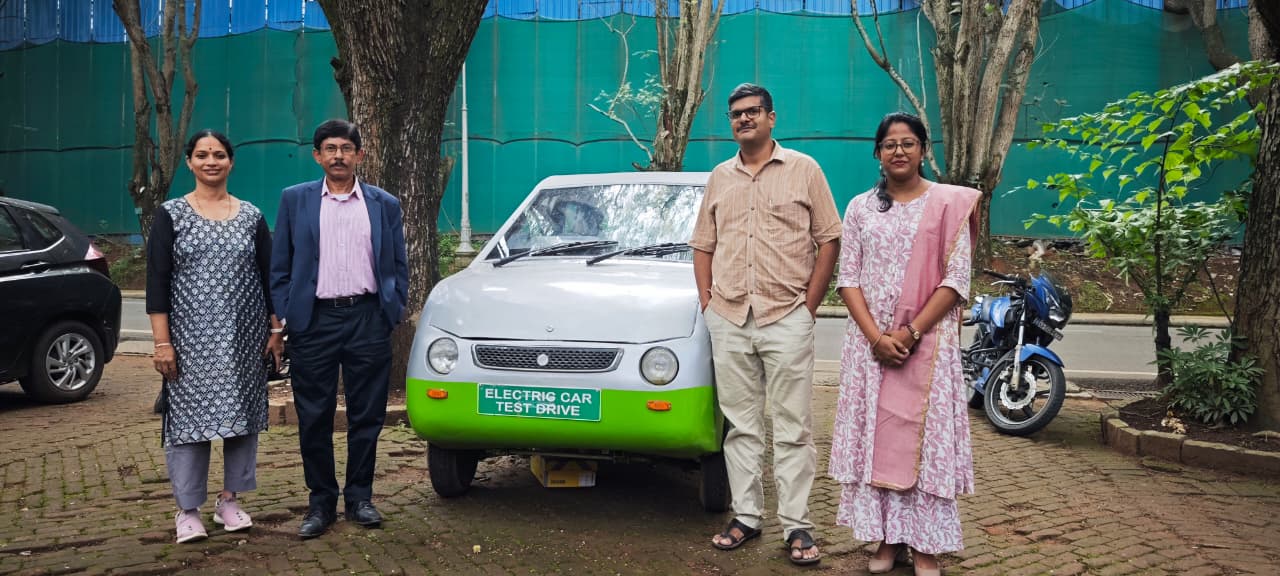
Bengaluru: India’s electric mobility market is expected to grow exponentially over the next decade, yet nearly two-thirds of an electric vehicle’s components — from batteries and motors to power electronics — are still imported. Bridging this gap could unlock about ₹1 lakh crore opportunity for domestic manufacturers and MSMEs, according to market research at Pravriddhi, the product accelerator programme by the Foundation for Science, Innovation & Development (FSID) at the Indian Institute of Science (IISc).
Pravriddhi aims to convert India’s deep R&D capability into scalable, commercial manufacturing by enabling technology co-development, localisation, and skill-building across the manufacturing value chain. This vision was at the core of its national webinar “EV Syntropy: Bringing Together Academia, Industry & Government to Unlock Manufacturing Opportunities,” which brought together policymakers, researchers, and industry leaders.
Speakers included Manoj Desai (Deputy Director, Automotive Research Association of India – ARAI), Prof. Anindya Deb (Department of Design and Manufacturing, IISc), Akshaye Barbuddhe (Director, Impactware Technologies – GoEco), and Yogesh Pandit (Director, Product Acceleration, FSID. leads Pravriddhi program). The session was moderated by senior journalist Shine Jacob, Business Standard.
Yogesh Pandit, Director, Product Acceleration FSID, said India’s next phase of EV growth depends on local innovation pipelines that connect indigenous technology with factory floors. “Nearly two-thirds of an EV’s bill of materials comes from imports. Pravriddhi’s Product Accelerator Framework enables academia, regulators, and manufacturers to co-develop technologies that are designed, tested, and built in India. By converting indigenous technology into scalable products, supported by design expertise, regulatory guidance, and early-stage capital, we can unlock opportunity for domestic manufacturers and MSMEs. Localisation drive would not only cut import dependence but also establish India as a global supplier of EV technologies by 2035.”
Manoj Desai, Deputy Director, of the Automotive Research Association of India (ARAI) emphasised that India’s regulatory framework already supports rapid innovation and localisation. “Our standards are globally harmonised and technology-agnostic. ARAI works closely with the industry to ensure safety and performance while encouraging the use of new materials and designs,” he said. Desai highlighted ARAI’s new sandbox environments and satellite centres, which allow startups and MSMEs to conduct pre-compliance testing and validation at lower cost — a move expected to accelerate component-level localisation.
Prof. Anindya Deb of IISc, Department of Design & Manufacturing (DM), where he heads the CAR (Creative Automotive Research) Lab, emphasised that India must evolve from adopting foreign technologies to creating original ones. “Indian automakers are capable and resilient, but global competitiveness will come only from investing in R&D, advanced materials, and lightweight architectures. Innovation in design and materials will define India’s ability to lead in sustainable mobility.”
From the industry’s side, Akshaye Barbuddhe, CEO of GoEco, said that power-electronics manufacturing is India’s biggest value-creation opportunity. “Despite progress in battery assembly and drive systems, India still depends on imports for high-value components such as switchgear and DC charging systems. Building domestic capacity here will determine cost, reliability, and competitiveness,” he said.
Barbuddhe added that IoT-enabled charging networks and smart energy systems will open new business opportunities for MSMEs and regional suppliers, further deepening India’s manufacturing base.
Concluding the discussion, Pandit said India’s transition to self-reliant EV manufacturing will depend on closing three structural gaps — mindset, risk capital, and skills.
“Between today and a Viksit Bharat 2047, India must learn to take bigger R&D bets, channelize patient capital into technology, and build advanced manufacturing skills. Pravriddhi is designed to make that convergence happen,” he added.
