

The Tightening Noose: Pinarayi Vijayan’s Family Case, a Restive CPI, and the CPI(M)’s Loneliest Hour

By Suresh Unnithan
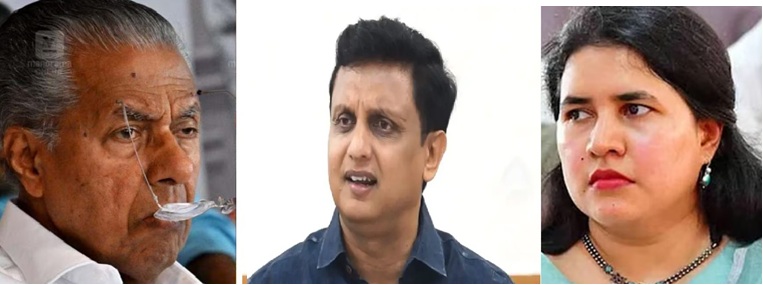
The letter arrived like a delayed invoice. On 7–8 September 2026, the Enforcement Directorate sent the Kerala Police Chief a 25-page dossier under Section 66(2) of the PMLA, asking that an FIR be registered under the Prevention of Corruption Act against Leader of the Opposition Pinarayi Vijayan, his daughter T. Veena, and his son-in-law, former minister P.A. Mohamed Riyas.
The charge is unsparing. Vijayan, the ED says, received ₹3.28 crore as a bribe from Cochin Minerals and Rutile Limited, routed through Veena’s defunct firm Exalogic Solutions as IT consultancy that investigators claim was never performed. Riyas is accused of helping move money, including alleged transfers to Dubai. The agency leans on a statement attributed to former CMRL CFO P. Suresh Kumar and handwritten notes recovered in searches.
This is no longer only a central-agency versus Left-leader story. The Congress-led UDF government of V.D. Satheesan, which unseated Vijayan four months ago, now holds the file. The Chief Minister has spoken of “major allegations” and promised a decision after legal scrutiny—FIR or a reference to the Vigilance and Anti-Corruption Bureau. Home Minister Ramesh Chennithala has said the letter cannot be ignored.
If the state consents and a case is registered, Kerala’s opposition map will not merely tilt. It may tear.
Vijayan’s reply has been the old Pinarayi: contempt first, argument later. He called the dossier a “shameful political hit job,” mocked the timeline (the disputed payments predate Veena’s marriage to Riyas), and snapped at reporters who followed him toward a rest-house washroom—he had come to pee, not to see them. The Polit Bureau still wraps the family in the party flag. Cadres once attacked an ED vehicle after a search at the rented house where father and daughter stayed. That reflex—every summons as class war—is now the organisation’s liability.
A section of the CPI(M) leadership and cadre no longer pretends otherwise. They treat the Exalogic affair as Vijayan’s private account, not a party programme. After the 2026 rout—the LDF cut to 35 seats, the CPI(M) to 26—they do not want the next five years spent defending a household ledger. They want distance. That murmur is new. For a decade the party fused its institutional authority with one man’s prestige. Defeat has made the fusion look like a cult that left the organisation brittle.
The CPI has been waiting for precisely this moment of brittleness.
The two communist parties are already in open dispute over the Deputy Leader of the Opposition. Vijayan treated the post as CPI(M) property by tradition. CPI state secretary Binoy Viswam refused to accept “precedent” after a historic defeat and demanded collective leadership. The CPI has talked of separate protests on Vizhinjam and PM SHRI, boycotted LDF parliamentary-party choreography, and watched IUML leaders praise it as the more authentic communist current while sending feelers. Viswam still says the LDF is “CPI’s child” and that the party will not kill its own infant. That is not a vow of obedience. It is a warning that the child must be allowed to grow a spine.
A registered FIR against Vijayan would not automatically produce a formal CPI walkout tomorrow. Full exit is costly. The CPI has eight MLAs. Outside the LDF it risks becoming a pressure group without a house. Inside a wounded CPI(M)-dominated front it risks remaining a junior partner that absorbs the odium of Vijayan’s legal trouble without sharing power. The likelier path is a staged distancing: sitting as a distinct bloc, bargaining issue by issue, refusing to let every attack on Veena or Riyas become an LDF line, and keeping the door ajar to the UDF’s flanks. That is how small parties leave alliances in Kerala—not with a manifesto, but with a series of absences.
If that drift hardens into exit, the political fallout for the CPI(M) would be severe.
First, isolation. A 26-member party in a 140-seat House is an opposition, not a front. The LDF’s moral claim has always been Left unity, not the CPI(M) alone. Lose the CPI and the brand becomes a rump Marxist machine associated with one family case and one ageing leader who still speaks as if he were chief minister.
Second, cadre exhaustion. The party is already preparing an extended state committee to explain the 2026 collapse. An FIR would hand the anti-Pinarayi current inside the organisation a legal exhibit. Every defence of Vijayan would look like the leadership choosing the household over the party. Local committees that spent a decade enforcing loyalty would find it harder to explain why the next election must be fought as a referendum on Exalogic.
Third, succession paralysis. Vijayan remains the omnipotent node—Polit Bureau member, Opposition Leader, the man who decides which names go to the Speaker. A criminal case does not instantly remove him. It does freeze the space around him. No ambitious CPI(M) leader can openly prepare a post-Pinarayi order while the official line is that the party and the accused are one. The result is drift at the top and indiscipline below.
Fourth, a gift to the UDF. Satheesan’s government is still finding its feet. An FIR lets it claim the high ground of “the law applies to everyone.” A CPI that peels away, even partially, lets the Congress argue that the Left is not a historic bloc but a personality arrangement that cracked the moment the personality came under statute. The IUML’s feelers to the CPI already sketch that future: pick off the smaller communist party, isolate the larger one, and turn “Left unity” into a museum phrase.
Fifth, national embarrassment. The CPI(M) has spent years accusing the Centre of weaponising the ED against opposition leaders. That argument is harder to make when the party’s Kerala face is named in a corruption FIR that a state government—run by a rival that itself denounces the ED in Delhi—chooses to process. Allies in other states will notice. So will voters who already punished the LDF for arrogance in office.
None of this requires treating the ED’s case as proven. Courts have earlier declined to order probes on related petitions. Vijayan is entitled to fight every count. What is no longer available is the old manoeuvre: convert a family investigation into a party emergency and dare anyone, including the CPI, to dissent. The noose is still procedural. The greater danger for the CPI(M) is political. A party that never learned to share power with its oldest ally may discover that when the leader is finally named in an FIR, the ally has already begun to leave—quietly, then unmistakably—and that the organisation left behind is smaller, angrier, and still commanded by a man who believes the room belongs to him.
