


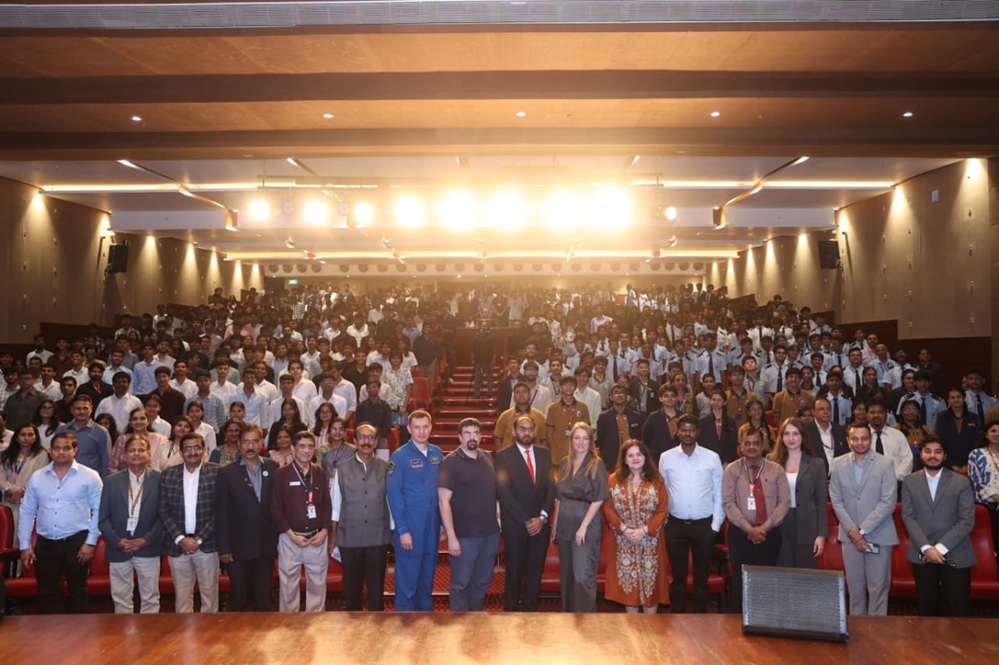
Mumbai : The annual Festival of Science was held in India in October with the support of Rosatom. Organised by the autonomous non-profit organisation Energy of the Future, the festival brought together 2,500 schoolchildren, university students, teachers and representatives of the scientific community across Mumbai, Chennai and Thoothukudi.
The festival programme brought together Russian and Indian expertise in scientific research and demonstrated the potential applications of nuclear technologies across various fields. In Mumbai, participants interacted with Russian cosmonaut Nikolai Tikhonov, who spoke about preparations for space missions and the prospects for using nuclear technologies in space exploration. Indian oceanographer and Arctic researcher Bijoy Nandan presented the potential applications of nuclear and isotope techniques in studying the world’s oceans and monitoring the health of marine ecosystems.
One of the key focus areas of the programme was introducing students to opportunities for technical education and career development in the nuclear industry. Srivignesh Poonaram, an ambassador for Russian nuclear education and a student at the Engineering Physics Institute of Biomedicine at the National Research Nuclear University MEPhI, shared his experience of studying in Russia and spoke about Obninsk Tech, an international scientific and educational centre for nuclear and related technologies.
With the participation of Tomsk Polytechnic University, educational sessions were organised in Mumbai and Chennai, highlighting opportunities to study at Russian universities, scholarship programmes and professional development pathways. In Chennai, the events were held at KCG College of Technology, part of the Hindustan Group of Institutions.
The concluding events of the festival took place in Thoothukudi, where Lucky Rawat, winner of the international Knowledge Icebreaker 2026 project, shared his experience of an expedition to the North Pole aboard a Russian nuclear-powered icebreaker. Participants were also introduced to the fundamentals of engineering design through hands-on practical sessions.
“This year, we expanded the geographical reach of the festival by including Thoothukudi, a city located near the Kudankulam Nuclear Power Plant construction site, a flagship project of Russian-Indian cooperation in nuclear energy. It is important to us that young people in regions where Rosatom projects are being implemented have the opportunity to interact directly with scientists and researchers, learn about modern technologies and explore prospects for professional development in scientific and technical fields. Such initiatives not only help foster interest in science but also build long-term engagement with local communities,” said Alexandra Yustus, Deputy Director General for Communications at Rosatom International Network.
“Scientific progress is built on collaboration, curiosity and the exchange of knowledge between countries. Initiatives such as the Festival of Science provide students with opportunities to engage with international experts and gain a deeper understanding of the real-world challenges shaping scientific research. At the Hindustan Group of Institutions, we believe that such experiences are essential in preparing graduates who can respond to future challenges and make meaningful contributions to the advancement of science, innovation and society,” said Dr Anand Jacob Verghese, Chairman of the Hindustan Group of Institutions.
