

Today in Parliament: Rahul Gandhi Alleges India’s Data, Farmers, Energy ‘Sold Out’ in US Pact

From Our Political Correspondent
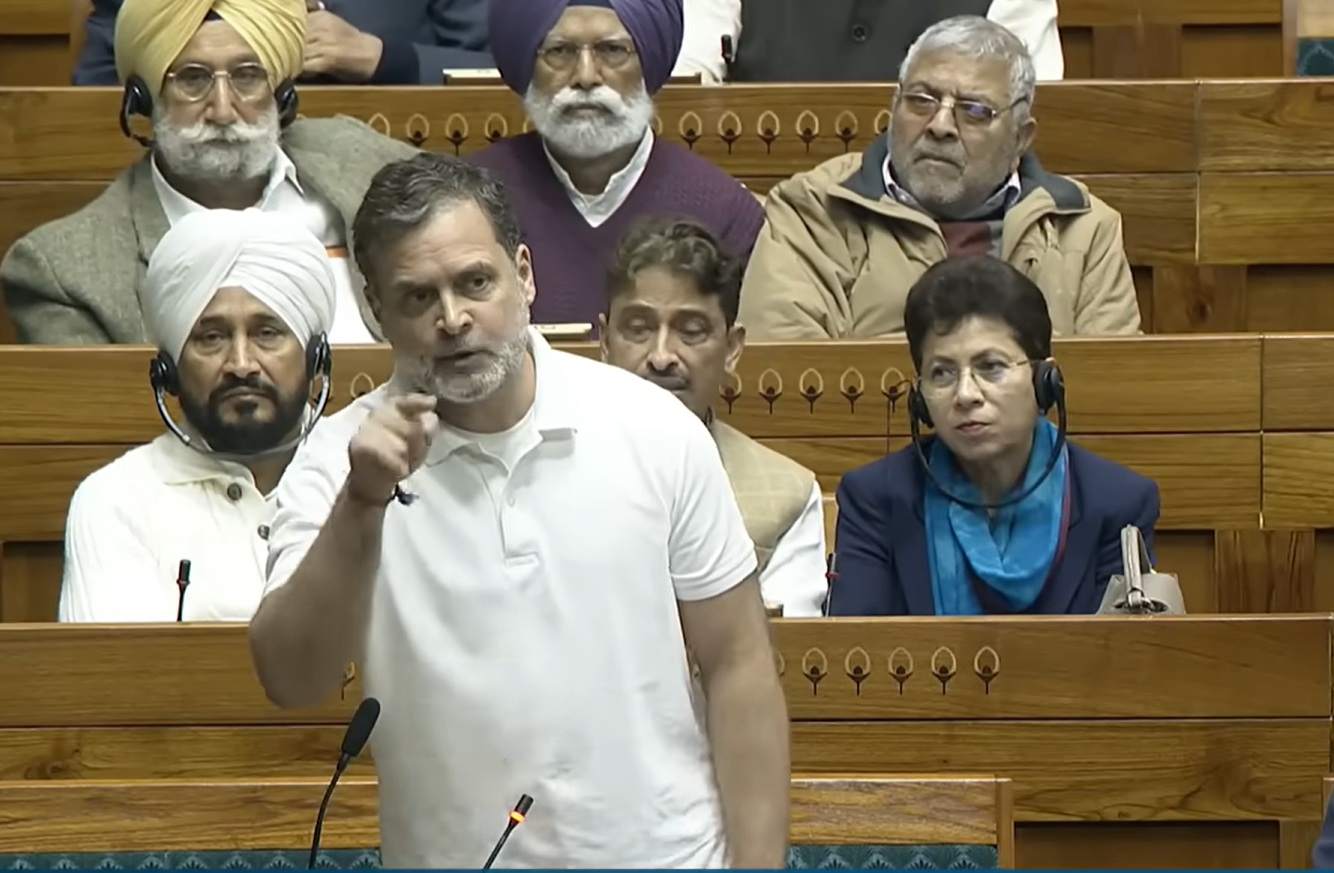
New Delhi: In a combative and metaphor-laden speech during the Lok Sabha discussion on the Union Budget, Leader of Opposition Rahul Gandhi launched a scathing attack on the government, accusing it of surrendering India’s strategic assets—data, energy security, farmers’ interests, and trade sovereignty—in a purported trade deal with the United States. Using an extended analogy from mixed martial arts and jiu-jitsu, Gandhi framed the government’s actions as a “choke” leading to a forced “tap out” or surrender.
Opening with light-hearted banter, Gandhi thanked Parliamentary Affairs Minister Kiren Rijiju for earlier compliments on his fitness and explained that he practices jiu-jitsu. He then transitioned into his central metaphor: in martial arts, a fight begins with securing a “grip,” progresses to a “choke,” and ends when the opponent, realising defeat, taps out. “In jiu-jitsu the grip is visible,” he said, “but in politics it is hidden.” He implied that invisible pressures had forced the government into capitulation.
Gandhi cited the Economic Survey’s own observations to bolster his argument, noting its acknowledgement of intensifying geopolitical conflicts, the challenge to US dollar dominance, and the weaponisation of energy and finance. He agreed with the Survey’s assessment that the world is shifting from stability to instability, pointing to ongoing conflicts in Ukraine, Gaza, and the Middle East. Yet, he argued, the Budget offered no meaningful response to these threats.
Highlighting India’s strengths in a turbulent world, Gandhi identified three pillars: its 1.4 billion people generating the world’s largest pool of data (“the petrol for AI”), food security provided by farmers and labourers, and energy independence. “Data is wealth,” he stressed, warning that artificial intelligence will disrupt India’s IT sector and replace many software engineers.
He then turned to what he called “the US deal,” claiming it represented a wholesale surrender of these very strengths. According to Gandhi, the agreement includes:
Giving up control over digital trade rules
Ending data localisation requirements
Allowing free flow of data to the United States
Imposing limits on digital taxes
Exempting source-code disclosure
Offering 20-year tax holidays to large tech companies
On trade, he alleged tariffs on Indian exports to the US had risen six-fold while US tariffs on imports fell to zero, potentially adding $100 billion annually to India’s import bill. He claimed the textile sector faced devastation because Bangladesh now enjoys zero-duty access to US markets while Indian exporters face 18 per cent duties. Farmers, he said, would be crushed by subsidised American agricultural imports of maize, soybean, sorghum, and cotton.
Most gravely, Gandhi accused the government of ceding energy sovereignty, alleging the US would now dictate from whom India can purchase oil, with punitive tariff hikes as enforcement. “For the first time in Indian history, our farmers are facing a storm,” he declared.
Gandhi insisted that no Indian Prime Minister would sign such a deal voluntarily. He suggested that Prime Minister Narendra Modi had been placed in a “choke” by external pressures, alluding—amid repeated interruptions and rulings from the Chair—to cases in the United States involving businessman Gautam Adani and references to sealed Epstein files. Though repeatedly cautioned and eventually refraining from naming individuals after sustained objections from the Treasury benches, Gandhi maintained that the government had compromised national interest to protect a financial network facing scrutiny abroad.
Concluding his speech, Gandhi described the Budget and the alleged trade deal as a “tragedy” and a “complete surrender” that jeopardises the future of 1.5 billion Indians—their data, their farmers, their small businesses, their software engineers, and national energy security.
The speech triggered frequent interruptions from ruling party members and multiple interventions by the Speaker to maintain decorum. Gandhi repeatedly offered to authenticate his claims with documents but was not permitted to table them during the proceedings.
The sharp exchange underscored deepening political polarisation over economic policy, foreign relations, and allegations of external influence at a time when the government maintains that India is negotiating trade agreements from a position of strength and that national interest remains paramount.
