

Trump’s Bullying Backfires: The EU-India FTA Signals the Decline of American Trade Dominance

By Suresh Unnithan
President Donald Trump’s aggressive “America First” tariff wars, characterized by brazen intimidation and unilateral coercion, were meant to bully the world into submission and restore unchallenged U.S. economic supremacy. Instead, his heavy-handed tactics—slapping punitive duties on allies and adversaries alike—have provoked a defiant global backlash. The landmark Free Trade Agreement (FTA) between the European Union and India concluded on January 27, 2026, stands as a stinging rebuke to Trump’s overreach. Dubbed the “mother of all deals” by Indian Prime Minister Narendra Modi, this accord not only circumvents U.S. pressure but accelerates the erosion of Washington’s post-war trade hegemony, exposing the limits of Trump’s attempt to overpower the globe through economic strong-arming.
Trump’s second term, beginning in January 2025, saw a rapid intensification of protectionist aggression. In a blatant display of intimidation, the resent administration imposed escalating tariffs on India, culminating in a 50% levy—explicitly as punishment for India’s continued purchases of discounted Russian oil despite U.S. sanctions pressure. Threats loomed over European partners as well, with Trump railing against perceived imbalances and even floating absurd demands like control over Greenland. These moves, rooted in a misguided belief that tariffs could force global capitulation, aimed to reshore jobs and extract concessions. Yet, far from bending knees, major economies have united in resistance, forging alliances that deliberately sideline the U.S. The EU-India FTA, accelerated in its final months precisely as a hedge against Trump’s bullying, exemplifies this strategic defiance.
The agreement is sweeping and transformative. It eliminates or sharply reduces tariffs on over 96% of EU goods exports to India by value, with phased cuts on luxury items like European cars (from up to 110% to as low as 10%), wines (from 150% to 20-30%), and sectors such as chemicals, machinery, and pharmaceuticals. India gains enhanced access to the EU market for textiles, electronics, jewelry, and labour-intensive products, with tariffs phased out on 90-99% of its exports over seven years. Current bilateral trade, valued at around $136-150 billion annually, is projected to explode; potentially doubling EU exports by 2032 and creating the world’s largest free trade zone spanning two billion people.
This pact directly undermines Trump’s supremacy on multiple fronts. For India, reeling from a 21% drop in U.S. exports due to the 50% tariffs, the EU’s affluent market offers a robust alternative, blunting the impact of American punishment. The EU, meanwhile, advances its “de-risking” from China while tapping India’s $4.2+ trillion economy, insulating itself from Trump’s erratic threats. Diplomats have candidly admitted that Trump’s coercive actions provided a “useful tailwind,” propelling the deal to closure after nearly two decades of stalled talks.
Globally, the FTA hastens the decline of U.S. trade dominance. Trump’s isolationist bullying has spurred a multipolar realignment, with nations prioritizing diversified, resilient partnerships over dependence on a volatile America. India has recently sealed deals with the UK, Australia, and others, while the EU has advanced pacts with Mercosur, Mexico, and Indonesia. This EU-India accord fills a glaring “U.S. trade vacuum,” disadvantaging American exporters as competitors mutually eliminate barriers.
The ripples are already felt within the United States. Trump’s tariffs, while appealing to his base, are alienating key domestic stakeholders. American businesses reliant on global supply chains, farmers facing retaliatory duties, and exporters shut out of growing markets are voicing frustration. Industry lobbies and even some Republican lawmakers warn of job losses and higher consumer prices, potentially fuelling internal opposition to Trump’s overreach. As U.S. Treasury Secretary Scott Bessent lamented the deal in bitter terms, highlighting Europe’s gains while America imposed sacrifices, cracks in domestic support may widen.
Moreover, this agreement emboldens other nations to challenge Trump’s dominance head-on. By demonstrating that collective action can neutralize U.S. coercion, it sets a precedent for broader coalitions—perhaps inspiring accelerated deals in Asia, Africa, or Latin America that exclude Washington. Side agreements on defence, digital trade, and climate further deepen EU-India strategic ties, diminishing Trump’s leverage in geopolitics.
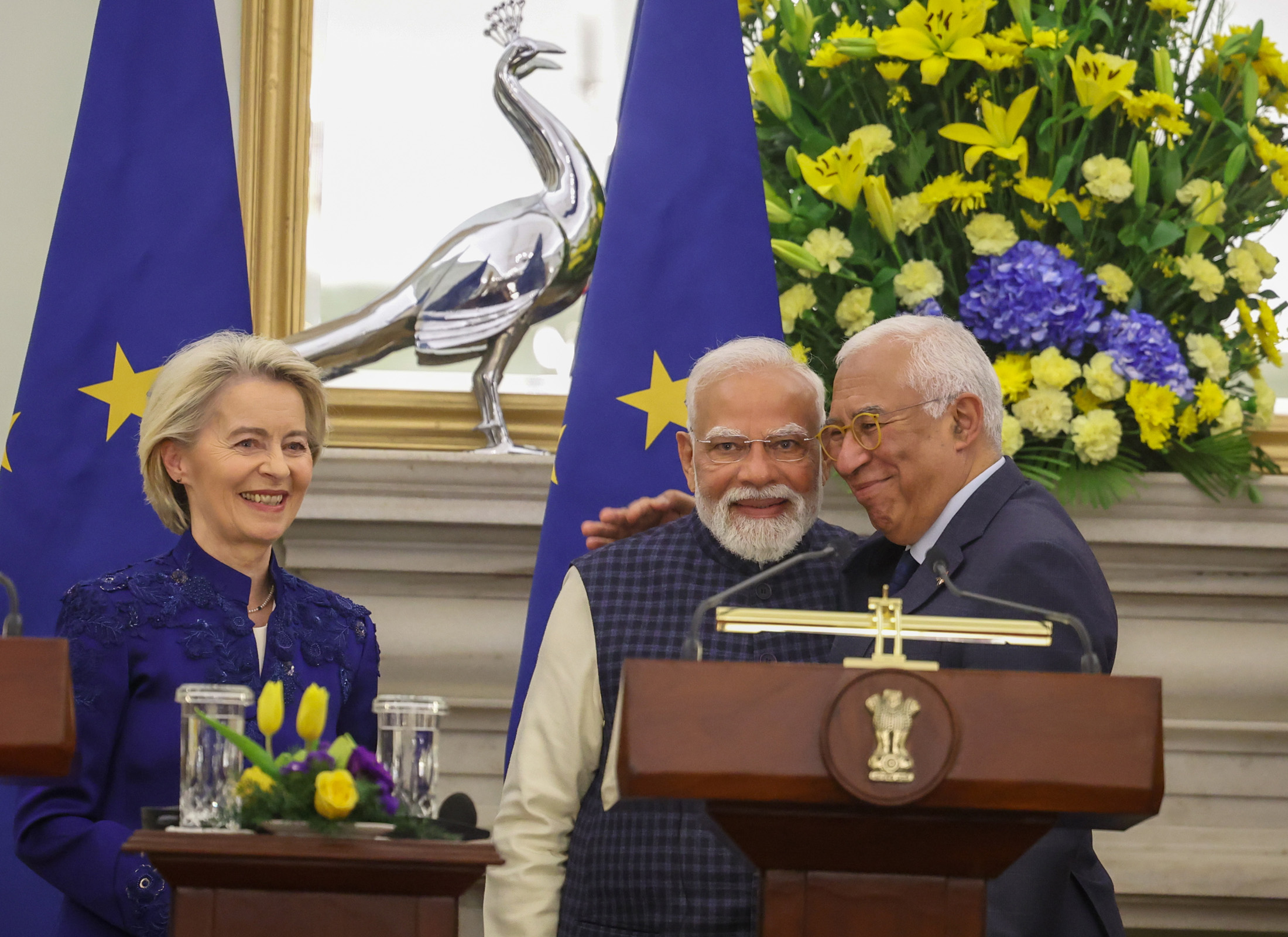
Critics may claim the FTA stems purely from economic complementarity, not anti-Trump sentiment. Yet the timing—sealed amid Trump’s tariff onslaught—and explicit acknowledgments of U.S. pressure as a catalyst tell a different story. As Modi and EU Commission President Ursula von der Leyen celebrated in New Delhi, the subtext was unmistakable: the world is rejecting Trump’s intimidation.
Ultimately, Trump’s tariff wars, designed to bully the globe into subservience and reclaim unchallenged supremacy, are proving disastrously counterproductive. The EU-India FTA marks a pivotal moment in this unravelling, isolating America while empowering others to chart independent courses. If Trump persists in his overreach, the erosion of U.S. economic influence will only accelerate, redefining global power for generations and exposing the folly of ruling through fear.
